
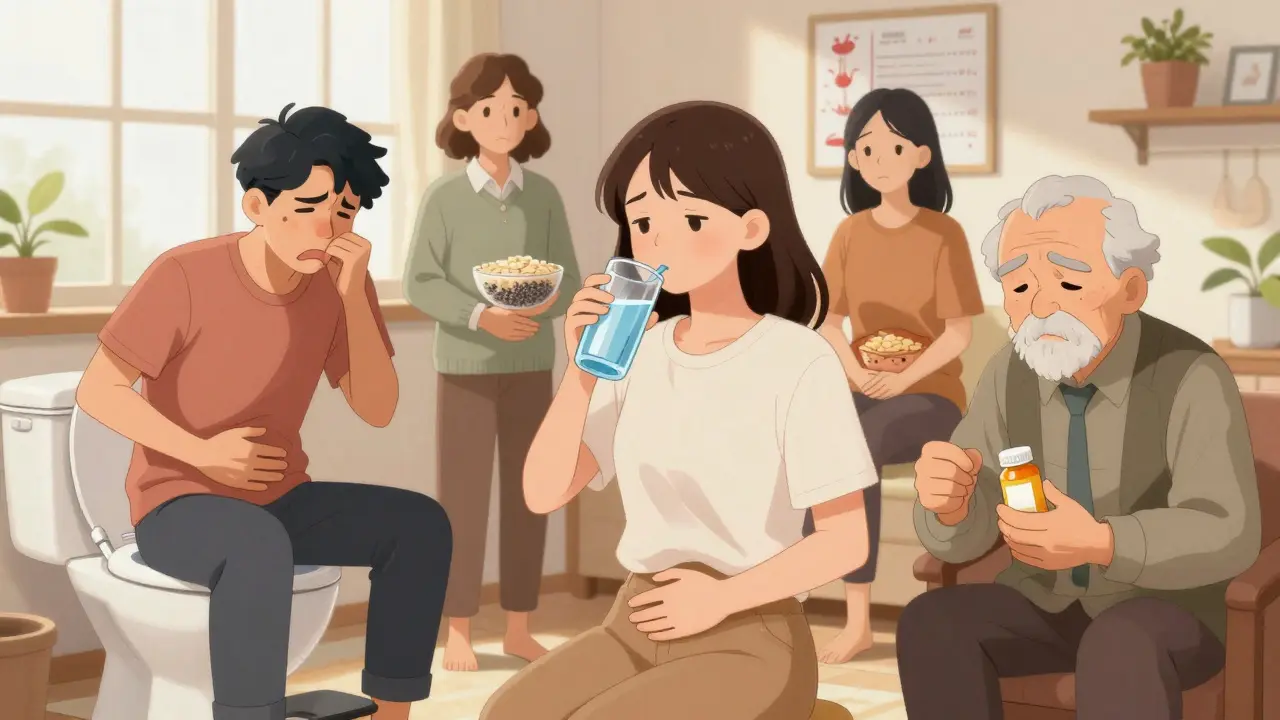
What Exactly Is Constipation?
Constipation isn’t just about not going to the bathroom every day. Medically, it’s defined as having fewer than three bowel movements a week, with stools that are hard, dry, and difficult to pass. You might feel like you haven’t fully emptied your bowels, or you may need to strain a lot. It’s not a disease-it’s a symptom. And it’s common. About one in three people in clinical settings experience it regularly. In the U.S. alone, more than 2.5 million people see a doctor for constipation each year.
The problem happens when your colon absorbs too much water from waste. Normally, food moves through your digestive tract in 24 to 72 hours. But in constipation, that process slows down. Stool sits longer, dries out, and becomes stubborn. It’s not just about diet. It can be tied to nerves, medications, hormones, or even how you sit on the toilet.
Why Does Constipation Happen?
There are two big categories: primary (functional) and secondary causes. Primary constipation means there’s no clear medical reason-it’s just how your body works. Secondary means something else is causing it.
Common lifestyle triggers include:
- Not eating enough fiber (most Americans get only 15 grams a day; experts recommend 25-30)
- Drinking too little water (less than 1.5 to 2 liters daily)
- Sitting too much, especially if you have a desk job
But the real culprits often lie deeper. Medications are a major cause. Opioids-like oxycodone or morphine-cause constipation in 40% to 95% of people who take them. Calcium channel blockers (used for high blood pressure) and tricyclic antidepressants are also big offenders. Diabetes affects nearly 60% of patients with the condition, and hypothyroidism shows up in 10% to 15% of constipation cases.
Neurological problems like Parkinson’s disease, multiple sclerosis, or spinal cord injuries can mess with the signals between your brain and gut. Up to 80% of people with these conditions struggle with bowel movements. Even a stroke can lead to long-term constipation if it affects nerve control.
Women are more likely to have it-67% of patients are female. And it gets worse with age. After 60, the risk goes up by about 1.5% every year. Older adults often take more meds, move less, and drink less water-all perfect conditions for constipation to stick around.
What Type of Constipation Do You Have?
Not all constipation is the same. Doctors classify it based on what’s actually going wrong in your body.
Normal transit constipation is the most common-about 60% of chronic cases. Your stool moves through your colon at a normal speed, but you still feel blocked, strain a lot, or think you haven’t finished. This is often tied to pelvic floor issues or poor habits, not slow digestion.
Slow transit constipation (15-30% of cases) means your colon is sluggish. Stool takes more than 72 hours to pass. This is harder to treat and often needs stronger meds or testing.
Defecatory disorders affect 20-50% of people with chronic constipation. Your pelvic floor muscles don’t relax properly when you try to go. You might push hard but nothing comes out. This is diagnosed with a balloon expulsion test-where you’re asked to push out a small balloon filled with water. If you can’t do it in a minute, something’s off.
Refractory constipation means nothing’s working. You’ve tried fiber, water, and at least one laxative, and you’re still stuck. This affects 15-20% of patients and often needs specialist care.

Laxatives: What Works and What Doesn’t
Laxatives aren’t all created equal. Some help. Some don’t. And some can hurt you if you use them too long.
Bulk-forming laxatives (like psyllium or methylcellulose) are the safest long-term option. They soak up water and swell up, making stool bigger and easier to push out. But they only work if you drink enough water. If you don’t, they can make things worse-blocking your intestines instead of helping. Take them with at least 8 ounces of water per dose.
Osmotic laxatives are the first-line treatment for most people. Polyethylene glycol (PEG 3350) draws water into your colon to soften stool. It’s effective in 65-75% of cases, has almost no side effects, and is safe for daily use. Lactulose and magnesium hydroxide work similarly but can cause gas or cramps.
Stimulant laxatives (senna, bisacodyl) make your colon contract harder. They work fast-often within 6 to 12 hours. But they’re only meant for short-term use. Using them longer than 12 weeks can damage your colon muscles, leading to a condition called cathartic colon, where your colon stops working on its own.
Stool softeners (like docusate sodium) are popular, but studies show they’re barely better than a placebo. They don’t help much unless you’re already taking something else.
For stubborn cases, doctors prescribe drugs like lubiprostone, linaclotide, or plecanatide. These work by increasing fluid secretion in the gut. They’re expensive-linaclotide costs over $1,200 a year-but they help 45-60% of people who haven’t responded to anything else.
How to Fix Constipation for Good
If you want to stop relying on laxatives, you need to change your habits. Not for a week. For life.
Step 1: Eat more fiber-but slowly. Go from your current intake (probably around 15g) to 25-30g over 4-6 weeks. Add 5g every 3-4 days. If you jump too fast, you’ll bloat and feel worse. Good sources: oats, beans, lentils, apples, pears, chia seeds, and vegetables like broccoli and Brussels sprouts. Soluble fiber is especially helpful because it turns into a gel that softens stool.
Step 2: Drink water with every meal. For every 5g of extra fiber you add, drink an extra 250-500mL of water. That’s about one extra glass. Dehydration is the silent enemy of fiber. Without enough water, fiber turns into a brick in your gut.
Step 3: Train your body to go. Sit on the toilet for 10-15 minutes after breakfast. That’s when your gastrocolic reflex is strongest-your colon naturally wakes up after eating. Don’t rush. Don’t scroll. Just sit. Use a footstool to raise your feet. This puts your hips at a 35-degree angle, which straightens your rectum and makes it easier to push. Studies show this reduces straining by 60%.
Step 4: Move more. Walking 20-30 minutes a day helps your colon contract. You don’t need to run. Just get up and move. Even standing up every hour helps.
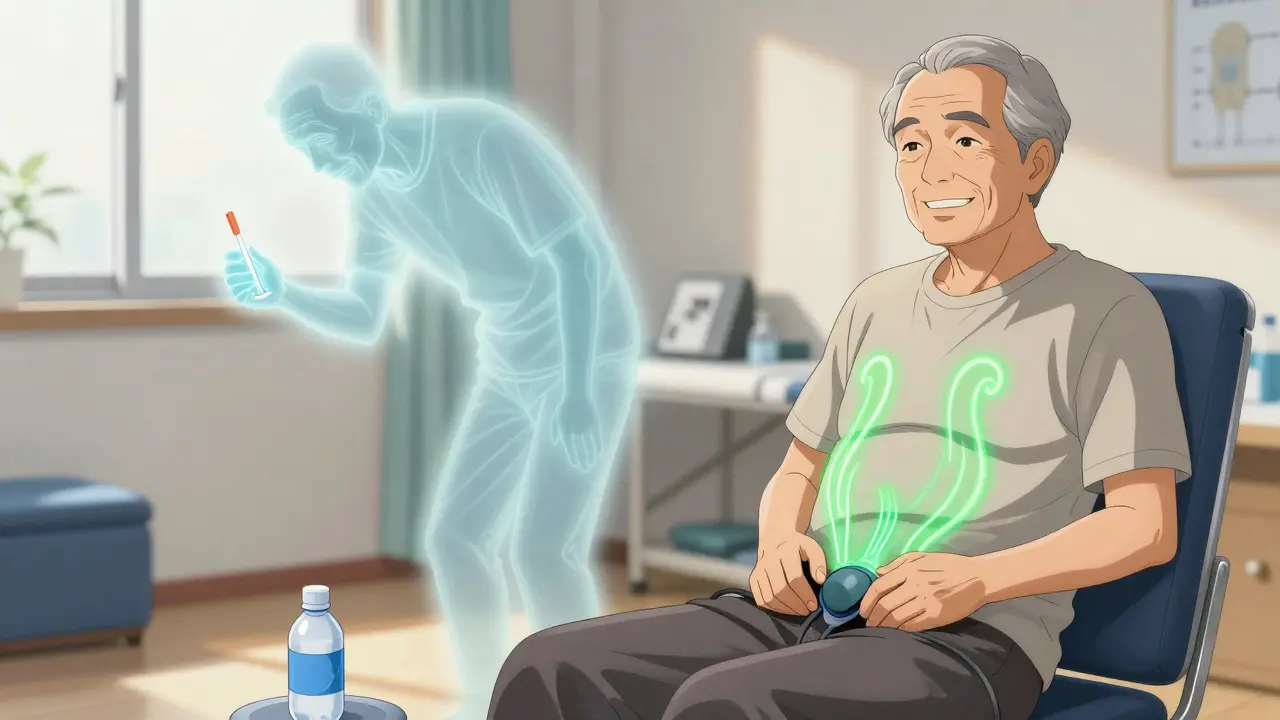
Step 5: Try biofeedback if you’re still stuck. If you’ve been told you have a pelvic floor disorder, biofeedback therapy can retrain your muscles. You’ll work with a therapist for 6-8 weekly sessions, using sensors to see how your muscles respond. About 70-80% of people see big improvements. It’s not cheap ($100-$150 per session), but it’s one of the few treatments that actually fixes the root problem.
When to Worry: Red Flags
Most constipation isn’t dangerous. But some signs mean you need to see a doctor right away:
- Unintentional weight loss of 10 pounds or more
- Bleeding from the rectum
- Stools that are very narrow or pencil-thin
- Constipation that started suddenly after age 50
- Family history of colon cancer
- Constipation lasting more than 6 weeks without improvement
These could point to something serious-like a tumor, inflammatory bowel disease, or a neurological condition. Don’t wait. Get checked.
What Doesn’t Work (And Why)
There’s a lot of misinformation out there. Here’s what you should skip:
- Enemas and suppositories for daily use-they irritate your colon and make it dependent.
- Drinking coffee to “stimulate” bowel movements-it might help a little, but it’s not a solution. Plus, too much caffeine dehydrates you.
- “Colon cleanses” or detox teas-they’re expensive, unnecessary, and can cause electrolyte imbalances.
- Just taking more laxatives-this is the most common mistake. People think if one pill helps, two will help more. But over time, your body gets used to it, and you need higher doses. Then you’re stuck in a cycle.
Real People, Real Results
One woman, 52, had been constipated for 15 years. She tried everything-fiber pills, laxatives, enemas. Nothing stuck. Then she started: 25g of psyllium husk every morning, 2 liters of water, coffee after breakfast, and sitting on the toilet with her feet on a stool for 10 minutes. Within 8 weeks, she was going regularly without any pills. She still takes the fiber, drinks her water, and sits every morning. It’s her new routine.
Another man, 68, with Parkinson’s, struggled for years. His doctor recommended biofeedback. After six sessions, he went from needing a suppository every other day to going naturally every 2-3 days. He says it gave him back his dignity.
These aren’t miracles. They’re smart, consistent habits.
The Bigger Picture
Constipation costs the U.S. healthcare system over $1.7 billion a year. The global laxative market is worth $2.3 billion. But money isn’t the real cost. It’s the quality of life. People skip social events because they’re afraid of being stuck. They avoid travel. They feel embarrassed. They lose sleep.
And it’s getting worse. By 2030, constipation rates are expected to rise 12% because of aging populations and more diabetes. The solution isn’t more pills. It’s better education, better habits, and better access to care.
If you’ve been dealing with this for months or years, you’re not alone. And you don’t have to live like this. Start small. Add fiber. Drink water. Sit right. Move daily. Give it time. Your body will thank you.






Neela Sharma January 3, 2026
Fiber isn't magic-it's medicine. I grew up in a village where we ate lentils and millet every day. No laxatives. No pills. Just food that remembers it came from the earth. Your body wasn't built for processed crumbs and soda. It's not about willpower. It's about respect.
Start with one bowl of oats. One glass of water. One quiet moment on the toilet. Not because you're told to-but because you deserve to feel whole.
Michael Burgess January 4, 2026
I used to take senna like candy. Every day. For years. Then I got lazy and just... stopped. Didn't go for four days. Panic mode. But I didn't reach for the pills. I drank water. Ate an apple. Sat on the toilet for 10 minutes after breakfast like the article said. And guess what? It worked. Not because I'm special. Because my body was just waiting for me to stop fighting it.
Also-footstool. Game. Changer. 🙌
Brittany Wallace January 5, 2026
I love how this post doesn't just say 'eat more fiber' like it's a bumper sticker. It actually explains *why* and *how*. I'm from a culture where bowel habits are whispered about. This feels like a quiet revolution. Thank you for normalizing the conversation. I'm sharing this with my mom. She's 72 and has been suffering silently for decades. Maybe now she'll feel seen.
Palesa Makuru January 6, 2026
I don't know why people act like constipation is just a 'lifestyle issue'. Have you seen how many people are on SSRIs? Or how much sugar is in everything? And don't even get me started on glyphosate in our water. This isn't about you not drinking enough water-it's about the system poisoning you. They want you to buy laxatives, not fix the root. The FDA doesn't care. The pharma lobby does.
Angela Fisher January 7, 2026
I knew it. I KNEW IT. This is all about the water fluoridation. They put it in the pipes to slow down your bowels so you can't escape the surveillance state. Why do you think they push psyllium? It's a distraction. They want you thinking about fiber while they track your colon movements through your smart toilet. I tested it-when I stopped drinking tap water, my poops went from 3x a week to 3x a day. Coincidence? I think not. 🤫💧🚽
Ian Detrick January 9, 2026
There's a deeper truth here that no one talks about: constipation isn't just physical. It's emotional. When you hold in your poop, you're holding in your life. The body remembers what the mind refuses to release. The colon is the last organ to let go. If you're chronically constipated, ask yourself: what are you afraid to let go of? Not the fiber. Not the water. The fear.
Shruti Badhwar January 11, 2026
I appreciate the clinical breakdown of transit types. As a nurse in a geriatric ward, I see this daily. The most heartbreaking cases are the ones where patients are told to 'just eat more fiber' without proper instruction. Many elderly can't chew vegetables. Others can't reach the toilet in time. We need more accessible solutions-like pre-chopped fiber blends, timed toilet access, and staff-assisted positioning. This isn't just personal responsibility. It's systemic care.
Angela Goree January 13, 2026
I’ve been on PEG 3350 for 8 years. My doctor says it’s fine. My insurance says it’s covered. My colon says it’s tired. I’m done. I’m switching to chia seeds and squatting on a toilet stool. If I die from it, I die with dignity. Not with a pill in my hand.
Liam Tanner January 15, 2026
This is the kind of post that should be required reading in high school health class. Not just for constipation-for how we treat our bodies. We treat them like machines you can fix with a button. But they’re alive. They remember. They respond. They heal. If you listen. And this? This is how you listen.