
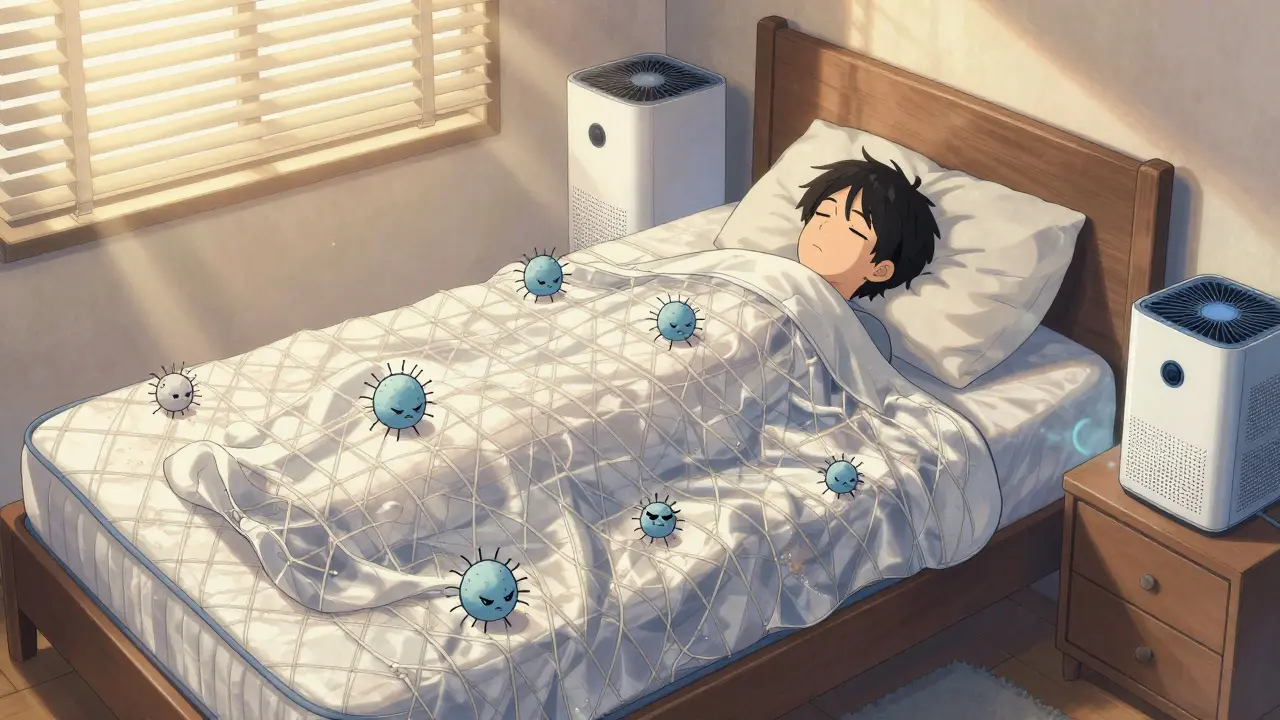
For millions of people, waking up with a stuffy nose, itchy eyes, or a cough that won’t quit isn’t just inconvenient-it’s daily life. If you’re one of them, you’ve probably tried antihistamines, nasal sprays, or inhalers. But what if the real problem isn’t your body’s reaction-it’s what’s in your home? Allergen avoidance isn’t about avoiding life. It’s about reclaiming it by changing the environment you live in.
Why Your Home Is the Problem
Your house isn’t just shelter. It’s a breeding ground for allergens. Dust mites live in your mattress. Pet dander clings to your couch. Mold grows behind the bathroom tiles. Cockroach droppings hide in kitchen cabinets. And pollen? It rides in on your clothes and shoes. The most common indoor allergens-dust mites, pet dander, mold, and cockroach particles-affect more than half of all allergy sufferers in the U.S. According to the American College of Allergy, Asthma, and Immunology, 80% of people with allergies are sensitive to dust mites. That’s not a small percentage. That’s the majority. And yet, most people only treat the symptoms, not the source. The good news? You don’t need to move out. You just need to change how you manage your space.Dust Mites: The Silent Saboteurs
Dust mites aren’t visible. They’re smaller than a grain of sand. But their waste? That’s what triggers sneezing, wheezing, and asthma attacks. These tiny creatures thrive in warm, humid places-especially your bed. The most effective fix? Start with your mattress, pillows, and duvet. Buy allergen-proof covers made from tightly woven fabric that blocks mites and their waste. Look for ones certified to block particles under 10 microns. They cost $30 to $100 per set, but studies show they reduce allergen exposure by 73% to 90%. Next, wash your bedding every week in water at least 130°F (54.4°C). Cold water won’t kill mites. Hot water does. If you can’t wash everything weekly, at least wash sheets and pillowcases every seven days. Don’t forget to dry them on high heat. Humidity control is just as important. Dust mites die when indoor humidity drops below 50%. Use a hygrometer to monitor levels. If your home stays above 50%, invest in a dehumidifier. A basic one costs under $150 and can cut mite populations by more than half.Pet Dander: Can You Keep Your Pet?
If you love your cat or dog, you don’t have to give them up-but you do need to change how you live with them. The most dramatic result? Removing pets from the home reduces cat allergen (Fel d 1) by 100 to 1,000 times over six months. That’s not a guess. That’s what the American Academy of Allergy, Asthma & Immunology found. But if that’s not an option, here’s what works:- Keep pets out of bedrooms. This creates a low-allergen sanctuary where you sleep.
- Bathe cats weekly. Studies show this cuts airborne Fel d 1 by 41%.
- Use a vacuum with a true HEPA filter. Regular vacuums blow allergens back into the air. HEPA vacuums trap them. One study showed a 66% drop in dog allergens after switching.
- Wipe down pets weekly with a damp cloth. This removes loose dander before it spreads.
Mold: Hidden in Plain Sight
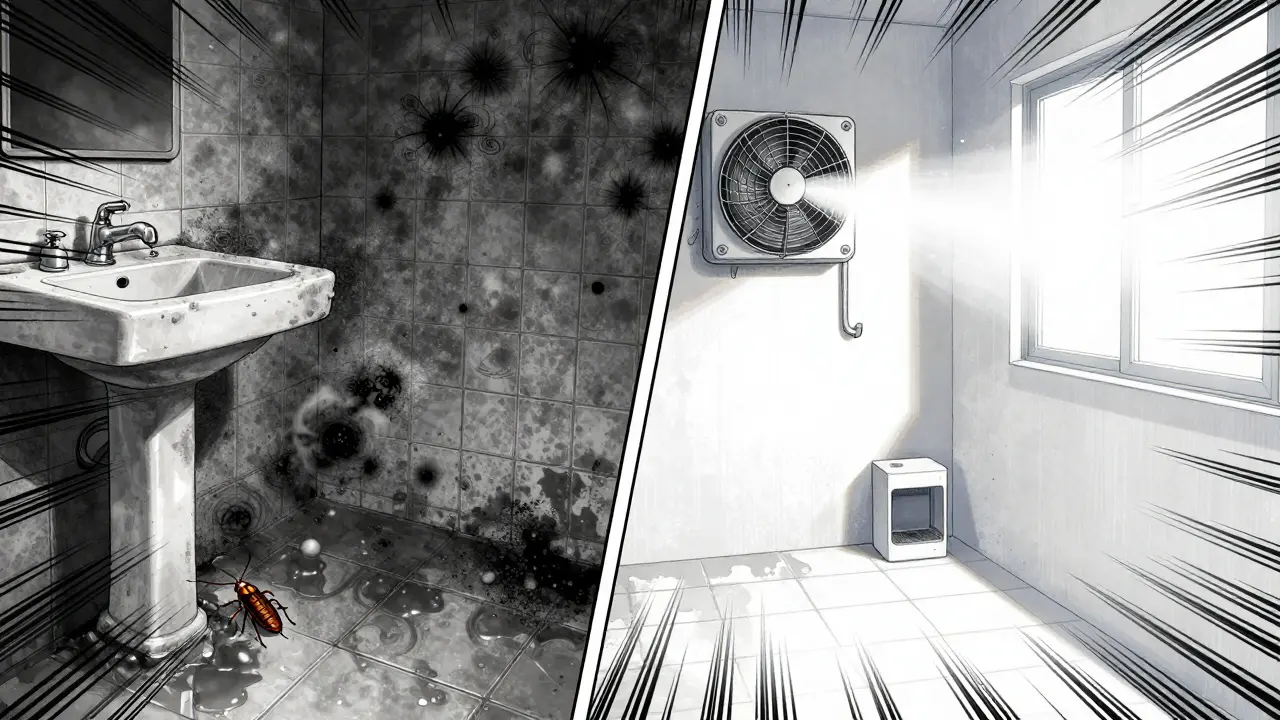
Mold doesn’t just grow in basements. It grows in bathrooms, under sinks, behind wallpaper, and in damp laundry rooms. Mold spores are airborne-and they’re a major trigger for asthma. The fix starts with humidity. Keep indoor levels between 30% and 50%. Use a dehumidifier in problem areas. In the bathroom, run the exhaust fan for 20 minutes after every shower. If you see mold, clean it with a mixture of vinegar and water-or better yet, a product labeled for mold removal. Bleach doesn’t kill mold roots; it just whitens the surface. Fix leaks within 24 to 48 hours. Water sitting for more than two days invites mold. Check under sinks, around windows, and near the water heater. Even small drips matter.
Cockroaches: The Overlooked Trigger
If you live in an older building or a city apartment, cockroach allergens might be silently affecting you. Their saliva, feces, and body parts are potent triggers-especially for children. The solution isn’t just spraying. It’s prevention.- Store all food in airtight containers-even pet food.
- Take out the trash every night. Don’t leave it sitting.
- Seal cracks around pipes and baseboards.
- Use bait stations or boric acid, not aerosol sprays. Sprays scatter allergens; baits kill the colony.
Why Single Fixes Don’t Work
You might think: “I’ll just buy a HEPA filter.” Or, “I’ll get dust-proof covers.” But research shows that single interventions rarely improve symptoms. A 2023 review of 15 clinical trials found that 78% of studies using just one method-like mattress covers alone-showed no significant improvement in asthma or rhinitis symptoms. Why? Because allergens don’t come from one place. They come from everywhere. The real breakthrough comes from combining strategies. Use HEPA filters in the bedroom. Install allergen-proof bedding. Control humidity. Keep pets out of sleeping areas. Clean regularly with a HEPA vacuum. When you do all of this together, allergen levels drop by 75% to 90%. And symptoms? They improve in 83% of cases.The Cost vs. Benefit
You don’t need to spend thousands. Start with the highest-impact, lowest-cost steps:- HEPA air purifier (bedroom): $100-$250
- Allergen-proof mattress and pillow covers: $30-$100
- Dehumidifier: $80-$150
- HEPA vacuum: $200-$400
What Doesn’t Work
There’s a lot of noise out there. Be careful.- UV air purifiers don’t kill dust mites or neutralize allergens. They’re for germs, not particles.
- Essential oil diffusers? They can irritate airways. Skip them.
- “Hypoallergenic” products aren’t regulated. Just because it says so on the label doesn’t mean it works.
- Removing carpet alone won’t help if you don’t control humidity or wash bedding.
How to Start Today
You don’t need to overhaul your home overnight. Here’s a simple 3-step plan:- Week 1: Buy allergen-proof covers for your mattress and pillows. Wash all bedding in hot water.
- Week 2: Get a hygrometer. If humidity is above 50%, buy a dehumidifier for your bedroom.
- Week 3: Get a HEPA vacuum and use it once a week. Keep pets out of the bedroom.
When to Get Help
If you’ve tried these steps and still struggle, it’s time to see an allergist. Get tested. Find out exactly what you’re allergic to. Not everyone reacts to dust mites. Some react to pollen, mold, or rodents. Your home strategy should match your triggers. Also, if you have asthma, talk to your doctor about combining environmental control with medication. The two work best together.Final Thought: It’s Not Perfect-But It’s Powerful
No system is 100% foolproof. You can’t eliminate every allergen. But you don’t need to. You just need to reduce exposure below the level that triggers your immune system. This isn’t about being obsessive. It’s about being smart. Your home should be your safe place-not your biggest health risk. Start small. Stick with it. And remember: the goal isn’t to live in a sterile bubble. It’s to breathe easier-in your own home.Can allergen avoidance replace allergy medication?
No, allergen avoidance shouldn’t replace medication-it should support it. Medications like antihistamines and inhalers treat symptoms, while environmental control reduces triggers. The best results come from using both. Studies show people who combine the two need less medication over time and have fewer flare-ups.
Do air purifiers really help with allergies?
Yes, but only if they have a true HEPA filter and are sized correctly for the room. A HEPA filter captures 99.97% of particles as small as 0.3 microns, which includes dust mites, pet dander, and mold spores. Place one in your bedroom and run it on high while you sleep. Units that provide 4-6 air changes per hour work best. Avoid ionizers or UV-only purifiers-they don’t remove allergens effectively.
How often should I wash bedding to control dust mites?
Wash all bedding-including sheets, pillowcases, and blankets-in hot water (at least 130°F or 54.4°C) every week. This kills dust mites and removes their waste. If you can’t wash everything weekly, prioritize sheets and pillowcases. Use allergen-proof covers on your mattress and pillows as a backup barrier. Cold water won’t kill mites, even if you wash frequently.
Is it necessary to remove pets if I’m allergic?
Not always, but it’s the most effective solution. Removing pets from the home reduces cat allergen levels by up to 1,000 times. If you can’t rehome your pet, keep them out of bedrooms, bathe them weekly, and use a HEPA vacuum on furniture and carpets. Some people find they can tolerate pets better after making these changes-but it takes months to see results.
What’s the best way to control humidity in my home?
Use a hygrometer to monitor indoor humidity. Keep it between 30% and 50%. If it’s too high, use a dehumidifier-especially in bedrooms, basements, and bathrooms. Run it for 12-18 hours daily during humid months. In dry climates, a humidifier may be needed, but never above 50%. Avoid letting water sit in drip pans, and fix leaks immediately to prevent mold growth.






Henry Jenkins January 27, 2026
I’ve been doing most of this for two years now-allergen covers, dehumidifier in the bedroom, HEPA vacuum twice a week-and honestly, it’s the only thing that’s cut my nighttime coughing in half. I used to wake up sounding like a asthmatic seal. Now? I actually sleep through the night. It’s not perfect, but it’s the closest thing to normal I’ve had in a decade.
Also, worth noting: I tried the vinegar-and-water mold thing on my bathroom tiles. It worked for a while, but then it came back. Ended up buying a proper mold-killing spray from Home Depot. Bleach is useless, yeah, but some of those ‘green’ cleaners are just marketing. Look for the EPA-registered ones.
And yeah, I know people say ‘just get rid of the cat,’ but my cat is 17. I’m not kicking her out. I just keep her out of the bedroom, bathe her every 10 days with a hypoallergenic shampoo, and wipe her down with a damp microfiber cloth. It’s not glamorous, but it works.
Also, one thing no one talks about: your clothes. If you’ve got pets, change out of your outdoor clothes before you go to bed. I used to just collapse on the bed after work-bad idea. Now I toss everything in the laundry right when I walk in. Game changer.
And don’t sleep with your windows open if you’re in a pollen-heavy area. I learned that the hard way. Pollen rides in on your hoodie like it’s hitchhiking. I keep the AC on with a good filter instead.
It’s not about being obsessive. It’s about being strategic. You don’t need to live in a bubble. You just need to know where the allergens are hiding-and then outsmart them.
Dan Nichols January 27, 2026
Stop treating this like a lifestyle blog. This isn’t ‘reclaiming your life’-it’s a full-time job with no pay. You’re telling people to wash bedding at 130°F every week? Good luck with that if you’ve got a toddler or a partner who hates laundry. And who’s got $700 to spend on ‘allergen control’ when they’re already paying for meds, rent, and groceries?
Also-HEPA vacuums? I’ve had three. They all clog within two months. And don’t get me started on ‘allergen-proof’ bedding. I bought a set that claimed to block particles under 10 microns. Turns out my 5-year-old peed on it. The cover didn’t stop the pee. Just made it smell worse.
And don’t even get me started on the ‘cockroach droppings’ thing. You think people in apartments can just ‘seal cracks’? You think landlords care? I live in a 1950s building where the pipes leak and the walls are paper-thin. You want me to ‘call an exterminator’? Good luck with that. My landlord says ‘we don’t do that unless it’s visible.’
Stop pretending this is easy. It’s not. It’s privilege disguised as advice.
Renia Pyles January 28, 2026
Oh wow. So now I’m supposed to feel guilty because I love my cat and I don’t want to bathe her every week? Like I’m the villain here? I’ve got asthma. I know what triggers me. But you think I’m gonna let some internet guru tell me I can’t cuddle my pet because of some 1999 study?
And what’s with this ‘humidity control’ nonsense? I live in a humid state. My dehumidifier sounds like a jet engine and costs $150 a month in electricity. You think I’m gonna run that 18 hours a day? No. I’m gonna take my antihistamines and sleep.
This whole post is just shame wrapped in science. You’re not helping. You’re just making people feel bad for not being perfect.
Karen Droege January 29, 2026
Okay-real talk. I’m a respiratory therapist and I’ve seen this play out a hundred times. People come in gasping, saying ‘I’ve tried everything.’ And nine times out of ten? They’re doing *something*-but not *everything*.
Here’s what I tell them: You don’t need to do all of it at once. But if you skip even one pillar-say, you get the covers but ignore humidity-you’re leaving the door wide open. Dust mites don’t care if you’re tired. Mold doesn’t care if you’re broke. Allergens are not polite.
And yes, $700 sounds steep. But let me show you the math: $120/month on inhalers and ER visits? That’s $1,440 a year. You’re not spending money-you’re investing in breath. And if you can’t afford it all at once? Start with the mattress covers and hot water washes. That’s 70% of the battle right there.
Also-HEPA vacuums? Buy used. Craigslist, Facebook Marketplace. I’ve seen people get perfectly good ones for $50. And dehumidifiers? Look for ‘Energy Star’ models-they’re cheaper to run. Don’t let the price tag scare you. This isn’t luxury. It’s survival.
And if you think pet dander is ‘just part of life’-you’re wrong. I’ve had patients who went from needing daily steroids to breathing normally after keeping cats out of the bedroom for six months. It’s not magic. It’s physics. Allergens are particles. Particles can be trapped. They can be removed.
You don’t have to be perfect. But you do have to be consistent. One step. Every week. That’s how you win.
Napoleon Huere January 30, 2026
What’s fascinating to me isn’t the science-it’s the cultural assumption that control equals safety. We’ve turned our homes into fortresses against invisible enemies. We seal cracks, wash at 130°F, buy HEPA filters like they’re holy relics.
But what are we really afraid of? The dust mite? The mold spore? Or the idea that our bodies are fragile? That we’re not in charge?
Maybe the real allergen isn’t in the mattress. Maybe it’s in the belief that we must eliminate all risk to be worthy of health.
I’m not saying ignore the advice. I’m saying: don’t let it become a religion. Your body isn’t a lab. It’s alive. It adapts. It learns. It heals-not by sterilizing everything around it, but by learning to coexist.
What if, instead of fighting the allergens, we learned to tolerate them? What if we trained our immune systems to be less reactive-not by removing triggers, but by slowly reintroducing them? That’s what immunotherapy does. Maybe the answer isn’t control. Maybe it’s surrender.
Just a thought.
Aishah Bango January 31, 2026
People who don’t take this seriously are the reason allergies are getting worse. You think your cat’s cuddles are worth breathing like you’re drowning? You think your laziness with laundry is ‘self-care’? No. It’s negligence.
And if you can’t afford a HEPA vacuum? Get a used one. Or borrow one. Or go to the library-they have vacuum rentals now. Don’t make excuses. This isn’t a lifestyle choice. It’s a medical necessity.
I had a friend who refused to wash her bedding because ‘it’s too much work.’ She ended up in the ER with an asthma attack. Her kid had to be hospitalized. You think that’s about ‘privilege’? No. That’s about being stubborn and ignorant.
Stop romanticizing your discomfort. This isn’t a blog post. It’s your life.
Peter Sharplin February 2, 2026
Just wanted to add something practical: I live in a 1920s house with no insulation and drafty windows. The humidity thing was killing me. I tried a $150 dehumidifier-it barely moved the needle.
Then I found this trick: I put a few silica gel packs (the kind that come in shoeboxes) in a mesh bag and hung them near my bed. Not as powerful as a dehumidifier, but it helped stabilize things overnight. Cheap. Silent. No electricity.
Also-use a humidifier in winter, but only if you clean it weekly. Mold in humidifiers is worse than mold on walls. I’ve seen it. Don’t let it happen.
And for pet owners: brush your cat or dog outside. Every day. Even five minutes. It cuts airborne dander by like 40%. I do it while I drink my coffee. Doesn’t take much.
Small things. Big impact. You don’t need a full overhaul. Just consistency.
shivam utkresth February 2, 2026
Bro, in India we don’t even have HEPA filters in most homes. We use mosquito nets on windows, cotton sheets washed in sunlight, and neem leaves tucked under the mattress. We’ve been dealing with dust mites for centuries without buying $200 vacuums.
Also-hot water? We boil clothes in big pots on the stove. Works better than machines. And dehumidifiers? We open windows at night when it’s cool. Simple. Free.
Don’t get me wrong-your science is solid. But this feels like Western over-engineering. Sometimes the oldest solutions are the best. Your body adapts. You don’t need to fight every particle.
Also-cat allergens? We have 10 cats in our joint family. Everyone’s allergic. But we all live. We just take antihistamines and don’t sleep on the couch. Problem solved.
Stop making this so complicated. It’s not a tech startup. It’s your home.