

When you take a calcium supplement with your morning coffee, or an iron pill with your lunch, you might think you’re doing the right thing for your health. But what if that same pill is quietly blocking the medicine you’re taking for your thyroid, infection, or heartburn? These aren’t rare edge cases-they happen every day, often without people realizing it.
Why Calcium and Medications Don’t Mix
Calcium is one of the most common supplements in the UK and the US. Around 67% of women and 25% of men take it regularly, mostly to protect bone health. But calcium doesn’t just go to your bones-it also binds to certain drugs in your gut, stopping them from being absorbed. This is called chelation. It’s like calcium puts a lock on the medication, and your body can’t unlock it.The biggest culprits? Antibiotics like tetracycline and ciprofloxacin. If you take calcium at the same time as ciprofloxacin, your body absorbs up to 40% less of the drug. That’s not just a small drop-it means your infection might not clear up, and you could end up with worse symptoms or even a resistant infection.
Levothyroxine, the standard treatment for underactive thyroid, is another major concern. Calcium reduces how much of this hormone your body can use. Studies show you need to wait at least four hours after taking levothyroxine before you take any calcium supplement. Even a multivitamin with calcium can throw off your thyroid levels if taken too close.
Iron’s Hidden Conflicts
Iron supplements, especially ferrous fumarate, are commonly prescribed for anaemia. But iron doesn’t just bind to antibiotics-it also gets blocked by the very medicines meant to calm stomach acid.Proton pump inhibitors (PPIs) like omeprazole and pantoprazole, and H2 blockers like famotidine, reduce stomach acid. Iron needs acid to dissolve and be absorbed. No acid? No iron uptake. You could be taking your iron pill faithfully, but if you’re also on heartburn medication, your body might not be getting any benefit.
Iron also locks onto tetracycline antibiotics-doxycycline, minocycline, and others-just like calcium does. The fix? Take iron at least two hours before, or four hours after, these antibiotics. Many people don’t know this, and their infection treatment fails because they took their iron with their pill.
And here’s a practical twist: milk. It’s full of calcium. If you take your iron supplement with a glass of milk-or even a bowl of cereal with milk-you’re defeating the purpose. Instead, take iron with orange juice. The vitamin C helps iron absorb better, and it doesn’t interfere like calcium does.
Timing Matters More Than You Think
It’s not enough to say, “I take my pills at different times.” You need to know how much different.- For calcium and levothyroxine: wait at least four hours.
- For calcium and ciprofloxacin: wait at least two hours, but four is safer.
- For iron and tetracycline antibiotics: take iron two hours before or four hours after.
- For iron and heartburn meds: take iron at least two hours before the PPI or H2 blocker.
Some people think, “I’ll just take my supplement at night.” But if you’re on a once-daily thyroid pill, taking calcium at bedtime might still interfere if you’re eating late or taking other meds. Consistency matters. Try to take your supplements at the same time every day, away from your prescriptions.

What About Antacids and Calcium?
Tums and other antacids contain calcium carbonate. If you’re taking them for heartburn, you might not realize you’re also taking a calcium supplement. And if you’re on antibiotics or thyroid meds, that’s a problem.Even if you think you’re just taking an antacid occasionally, those occasional doses can add up. One Tums tablet has 200-400 mg of elemental calcium. That’s enough to interfere with drug absorption. If you’re on long-term heartburn treatment, talk to your doctor about alternatives that don’t contain calcium, like alginate-based products (Gaviscon), which work differently and don’t bind to drugs.
Children and Complex Schedules
Parents often struggle with this. A child on doxycycline for acne might also need iron for anaemia. Both are taken daily. The timing becomes a logistical nightmare. One missed gap, and neither treatment works properly.Doctors sometimes switch to alternative antibiotics like azithromycin, which doesn’t interact with iron or calcium. Or they adjust the iron dose and timing to fit around school and meals. Don’t assume your pharmacist or GP will catch this automatically-many don’t ask about supplements unless you bring it up.
What Should You Do?
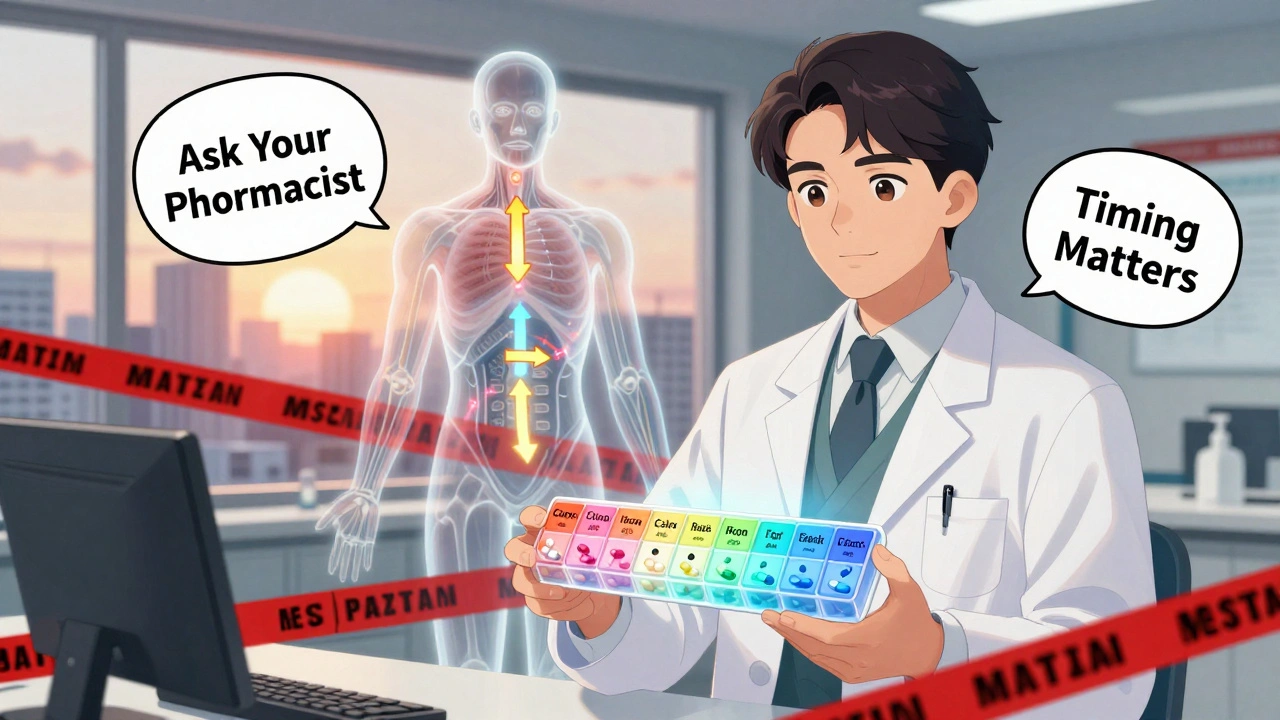
1. Make a list of everything you take: prescriptions, supplements, vitamins, even over-the-counter antacids. 2. Check each one for interactions. The NHS and GoodRx have free tools you can use. Look specifically for calcium, iron, magnesium, and zinc. 3. Ask your pharmacist to review your full list. They’re trained to spot these conflicts. Most pharmacies offer free med reviews. 4. Use a pill organizer with time slots. Separate your meds and supplements by hours, not just morning and night. 5. Never stop a medicine without talking to your doctor. If your iron isn’t working, don’t just take more. It might be a timing issue.Why This Isn’t Just a ‘Minor’ Issue
This isn’t about inconvenience. It’s about treatment failure. A woman on levothyroxine who takes calcium at breakfast might feel tired, gain weight, and get depressed-symptoms she thinks are her thyroid not improving. But it’s the calcium blocking the hormone. She could be on the wrong dose for months, when all she needed was to move her supplement to lunchtime.Or a man on ciprofloxacin for a UTI takes his calcium pill with dinner. His infection doesn’t clear. He’s prescribed a second round. He gets side effects. His doctor thinks he’s non-compliant. But he was following the label-just not the interaction rules.
These interactions are documented, predictable, and preventable. Yet they happen because no one asks. No one tells. And patients assume all supplements are safe.
What’s Changing?
In 2023, the NHS updated its guidance on ferrous fumarate to stress individualized timing. Pharmacists are now encouraged to ask patients about supplements during medication reviews. Some electronic health records now flag potential mineral-drug conflicts automatically.But the biggest change needs to come from you. If you take a supplement, say so. If you’re unsure, ask. Don’t assume your doctor knows you’re taking calcium. Don’t assume your pharmacist knows you’re taking antacids daily. Write it down. Bring it in. Your treatment depends on it.
Can I take calcium and iron together?
No. Calcium and iron compete for absorption in your gut. Taking them together reduces how much of each your body can use. Space them at least two hours apart. If you’re taking both for health reasons, take iron in the morning on an empty stomach with orange juice, and calcium with dinner.
What if I forget and take my iron with my antibiotic?
Don’t panic. Skip the next dose of the antibiotic if it’s still within the same day, and restart the next day with the correct timing. If you’re on a short course (like 7-10 days), one mistake won’t ruin everything-but don’t make it a habit. If you’re unsure, call your pharmacist.
Does it matter if I take my supplement with food?
Yes. Iron is best taken on an empty stomach for maximum absorption, but if it upsets your stomach, take it with a small amount of food-just avoid dairy, whole grains, tea, or coffee. Calcium can be taken with food to reduce stomach upset, but never with thyroid or antibiotic meds.
Are there supplements that don’t interact?
Some forms of iron, like ferric citrate or heme iron, have fewer interactions, but they’re less common and often more expensive. There’s no calcium supplement that avoids interactions with levothyroxine or antibiotics. The best option is timing, not switching brands.
Should I stop taking calcium if I’m on thyroid medication?
No. Calcium is important for bone health, especially for women over 50. Just separate it from your thyroid pill by at least four hours. Many people take their thyroid first thing in the morning, then eat breakfast and take calcium with lunch or dinner. That’s safe and effective.
If you’re on multiple medications and take supplements, you’re not alone. But you’re also not helpless. With a little planning and a few simple changes, you can make sure your pills work the way they’re supposed to.





Jane Quitain December 6, 2025
OMG I just realized I’ve been taking my calcium with my thyroid med since last year 😳 I’ve been so tired and blamed it on stress… turns out my bones were stealing my hormones??
Jennifer Anderson December 7, 2025
thank u for this post!! i was takin iron w my omeprazole for months n thought i was just ‘not responding’ to treatment… now i know why i still felt like a zombie. switched to taking iron at 7am n ppi at 8pm. energy’s back. 🙌
Sadie Nastor December 9, 2025
my mom’s on levothyroxine n takes tums like candy bc she gets heartburn every night… she’s been on 150mcg for 3 years but her TSH is still high. i’m gonna print this out n hand it to her with a cup of tea. maybe this’ll be the thing that finally clicks. 💛
Sangram Lavte December 10, 2025
Timing is everything. The science is clear, but the real issue is patient education. Most people don’t realize supplements are drugs too. Pharmacies need to do more than just hand out bottles-they need to have conversations. I’ve seen too many patients fail treatment because no one asked about their multivitamin.
Oliver Damon December 12, 2025
Chelation isn’t just a pharmacokinetic quirk-it’s a systemic failure in how we conceptualize ‘self-care.’ We treat supplements as harmless add-ons, but they’re bioactive compounds with receptor-level interactions. The fact that calcium competes with tetracycline for divalent cation transporters isn’t anecdotal-it’s biochemistry. Yet we let patients guess. This is why medicine needs to move beyond ‘take with food’ to ‘take at this precise interval, away from these specific ions.’
Kurt Russell December 12, 2025
THIS IS A LIFESAVER. I had a UTI last year that turned into a kidney infection because I took my calcium pill with my cipro. I was in the ER for 3 days. I thought I was being ‘responsible’ by taking my supplements. Turns out I was sabotaging my own body. I’m telling EVERYONE now. Share this. Save someone.
Stacy here December 13, 2025
They don’t want you to know this. Big Pharma doesn’t profit when you fix your health with timing instead of another prescription. They want you on 5 meds, 3 supplements, and a weekly IV drip. This post? It’s a threat to the system. But hey-your thyroid’s still underactive, right? Keep taking that calcium. Maybe next year they’ll add a ‘Calcium Blocker’ pill to your stack. 💊🪄
Desmond Khoo December 14, 2025
took iron w my doxycycline once by accident. felt like a ghost for a week. now i take iron w orange juice at 7am, meds at 8pm. life changed. 🍊✨
Louis Llaine December 16, 2025
So… we’re supposed to schedule our lives around pill windows now? Next they’ll tell me to time my sneezes to avoid drug interactions. 😴