
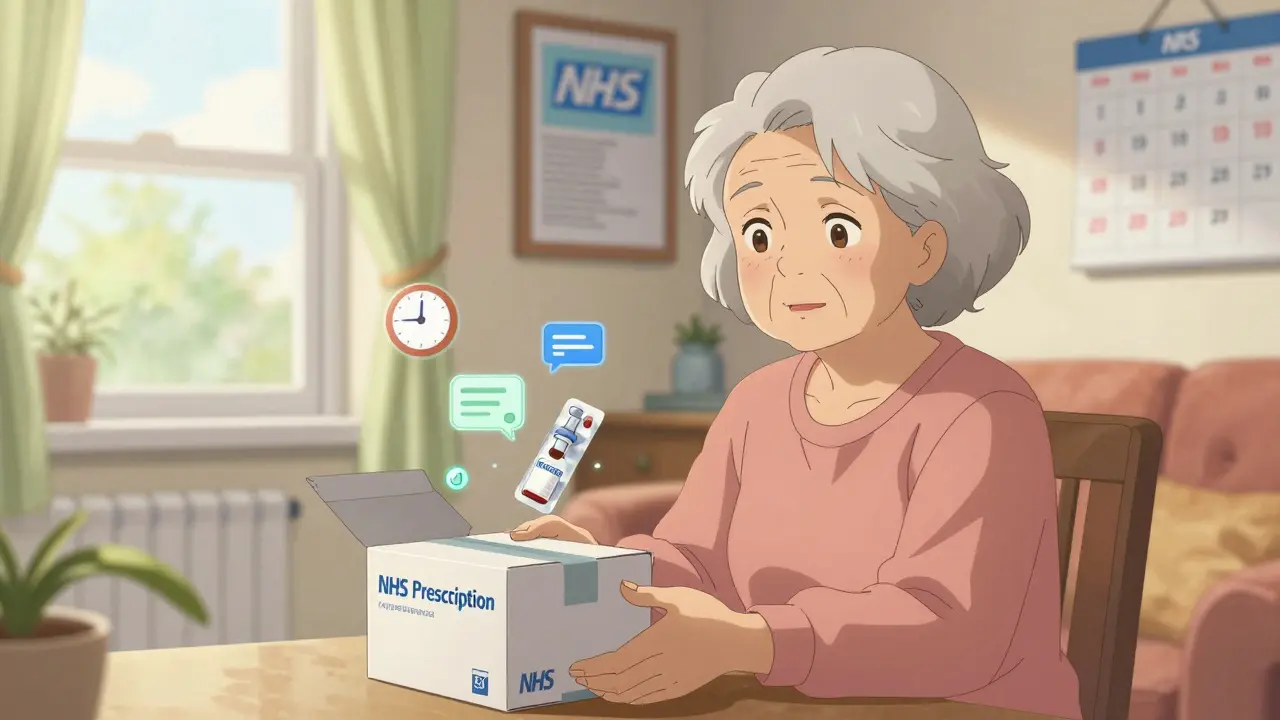
Getting your prescriptions delivered to your door isn’t just a luxury anymore-it’s becoming the norm. Especially for people managing long-term conditions like high blood pressure, diabetes, or asthma, the simple act of picking up pills from a pharmacy can feel like a chore. Now, with services that deliver generics straight to your home, you can skip the wait, the travel, and the hassle. And yes, this works in the UK too.
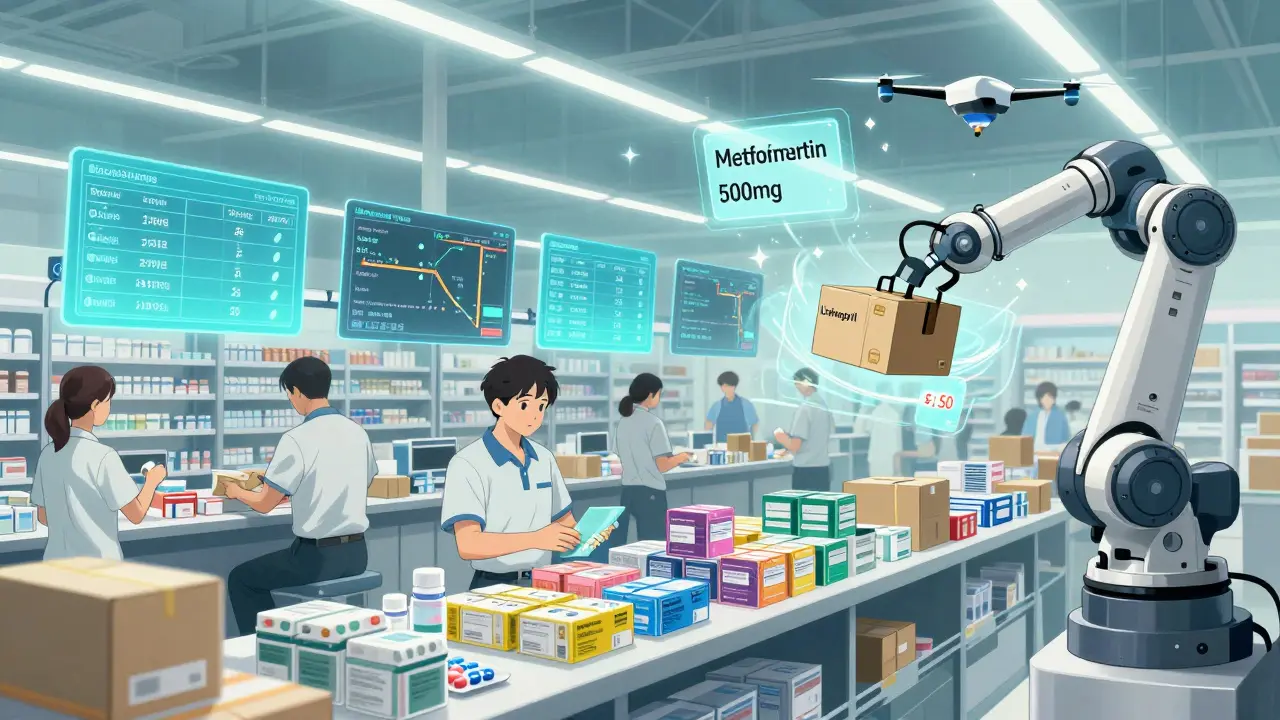
Generics make up over 90% of prescriptions filled in the UK, but they account for less than 20% of total drug spending. Why? Because they’re cheap. And that’s exactly why delivery services are pushing them hard. When a pill costs £1.50 instead of £15, the profit margin is razor-thin. But volume makes up for it. Deliver 100,000 boxes of generic metformin a week? That’s revenue. And if you can do it reliably, you build loyalty.
How It Works: From Prescription to Doorstep
Here’s how it actually happens. You get a prescription from your GP-either digitally via the NHS app or on paper. You choose a delivery service: it could be your local pharmacy that now offers home delivery, or a digital-only provider like Capsule is a UK-based digital pharmacy that partners with NHS GPs to deliver medications directly to patients’ homes, or even Amazon Pharmacy is a service that integrates with NHS prescriptions and offers free delivery for eligible patients. You upload your prescription, they verify it with your GP, and within 24 to 48 hours, your meds arrive in a discreet box.
No need to call in refills. No standing in line. No forgetting because you’re busy. Many services now send automated reminders via text or email. Some even bundle your pills into daily dose packs-morning, afternoon, night-labelled clearly. This cuts down errors, especially for older adults taking five or more pills a day.
Why Generics? The Hidden Advantage
Generic drugs are chemically identical to their branded cousins. Same active ingredient. Same dosage. Same effect. The only difference? Price. A 30-day supply of generic lisinopril might cost £3.50. The branded version? £28. That’s why the NHS pushes generics. And why delivery services rely on them.
But here’s the catch: delivery services don’t make much money on generics. They make it up in volume and convenience. Think of it like this: a pharmacy might earn 20p per generic pill. But if you deliver 500,000 pills a month? That’s £100,000. And if you keep the customer for five years? That’s £500,000 in steady revenue. That’s why companies are investing heavily in logistics-same-day delivery, temperature-controlled packaging, real-time tracking.
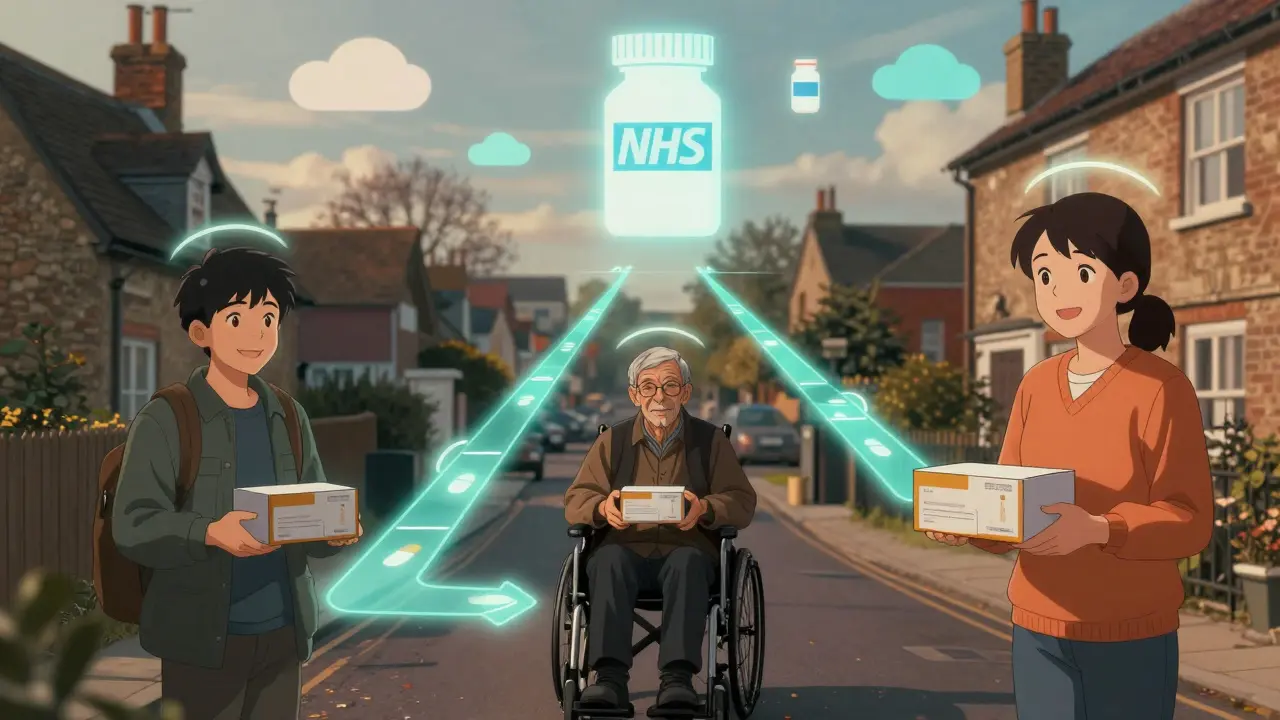
For patients, this means access. No more skipping doses because you can’t get to the pharmacy. No more rationing pills because you’re waiting for a benefit payment. For people with mobility issues, chronic pain, or caring responsibilities, this isn’t a convenience-it’s a lifeline.
Who’s Doing It Best in the UK?
Not all services are equal. Here’s what’s working:
- NHS-registered pharmacies like Boots and Lloyds offer free delivery for repeat prescriptions. No app needed-just sign up online or over the phone.
- Capsule integrates directly with NHS e-prescriptions. You get a 24-hour delivery window. They even offer free returns if you change your mind.
- Amazon Pharmacy now accepts NHS prescriptions in the UK. Free delivery on orders over £10. You can track your package like a parcel.
- NowRx (expanding into the UK) focuses on same-day delivery in urban areas. Great if you run out on a Friday night.
Traditional pharmacies are catching up fast. Boots now has over 1,200 locations offering same-day delivery in major cities. Lloyds Pharmacy launched its digital hub in late 2024, cutting prescription processing time from 48 hours to under 12.
What You Need to Know Before Signing Up
Not every service works the same. Here’s what to look for:
- Insurance coverage: In the UK, NHS prescriptions are capped at £9.90 per item. Delivery services don’t charge extra for this. But if you’re paying privately, check if they pass on savings.
- Delivery windows: Some services promise 24-hour delivery. Others only do it on weekdays. If you’re on a tight schedule, ask ahead.
- Temperature control: Some meds-like insulin or certain antibiotics-need refrigeration. Make sure the service uses cold-chain packaging. Most do now, but it’s worth confirming.
- Refill automation: Can you set up auto-refills? Do they alert you before running out? This is critical for chronic conditions.
- Customer support: If your delivery is late, can you talk to a real person? Some apps only offer chatbots. Avoid those.
Common Problems and How to Avoid Them
It’s not perfect. Here are the issues people run into-and how to sidestep them:
- Insurance delays: If your prescription needs prior authorisation, delivery can stall. Always check with your GP or pharmacist before switching services.
- Wrong dosage: Rare, but happens. Always check your pills when they arrive. If something looks off, call immediately.
- Missed deliveries: If you’re not home, some services leave packages at the door. Ask for a safe drop-off spot or request a signature.
- App glitches: Digital platforms can crash. Always have a backup: keep your NHS repeat prescription slip, or call your pharmacy directly.
The Bigger Picture: Why This Matters
This isn’t just about saving time. It’s about health outcomes. A 2024 study by the NHS is the UK’s publicly funded healthcare system that manages over 1.2 billion prescriptions annually found that patients using delivery services were 42% more likely to take their meds as prescribed. For people with heart disease or diabetes, that’s the difference between hospitalisation and staying well.
And it’s only getting bigger. By 2030, over 30% of UK prescriptions will be delivered at home. That’s not speculation-it’s the NHS’s own projection. With an aging population and rising chronic disease rates, this model isn’t optional anymore. It’s infrastructure.
Even the smallest towns now have delivery options. In Bristol, where I live, even rural pharmacies partner with courier networks to get meds to people on the outskirts. It’s no longer about urban convenience-it’s about rural access, disability support, and keeping people out of hospitals.
What’s Next?
Look ahead: AI will soon predict when you’ll run out of meds before you even notice. Drones are being tested in remote areas. Smart pill bottles will text you if you miss a dose. And insurance providers are starting to cover delivery fees as part of preventive care.
But for now, the simplest step is this: if you’re on regular prescriptions, sign up for delivery. It’s free. It’s safe. And it saves you more than just time-it saves your health.
Can I get my NHS prescription delivered for free?
Yes. If you’re on an NHS repeat prescription, most UK pharmacies-including Boots, Lloyds, and NHS-approved digital services-offer free home delivery. You just need to register once. There’s no extra charge, even for generics.
Are generic drugs as effective as branded ones?
Absolutely. Generic drugs contain the exact same active ingredients as branded versions and must meet the same strict safety and effectiveness standards set by the UK’s Medicines and Healthcare products Regulatory Agency (MHRA). The only difference is cost-generics can be up to 90% cheaper.
What if I need my meds delivered on the same day?
Same-day delivery is available in most major UK cities through services like NowRx, Capsule, and Amazon Pharmacy. It’s not yet universal, but if you’re in London, Manchester, Birmingham, Bristol, or Leeds, you can usually get your meds within 24 hours. Call ahead to confirm availability.
Can I get cold-chain delivery for insulin or other temperature-sensitive meds?
Yes. All reputable prescription delivery services now use insulated packaging with cold packs for insulin, certain antibiotics, and other temperature-sensitive medications. Look for services that explicitly mention "cold-chain delivery" in their terms. If you’re unsure, call their customer service before ordering.
Is my data safe when I use an online pharmacy?
If you’re using an NHS-registered pharmacy or a service approved by the General Pharmaceutical Council (GPhC), your data is protected under UK law. Always check that the website has a GPhC registration number displayed. Avoid any service that asks for payment upfront without a prescription or seems unregulated.
Can I switch back to picking up my meds at the pharmacy later?
Yes. Switching between delivery and in-store pickup is completely allowed. Your NHS prescription record stays the same. Just let your pharmacy or delivery service know you want to change your preference. No penalties, no hassle.
If you’re on regular medication, especially generics, delivery services remove barriers that have held people back for decades. No more rushing to the pharmacy before closing. No more forgetting because you’re tired. No more choosing between meds and bus fare. This is healthcare that works around your life-not the other way around.


Liam Crean February 19, 2026
This is one of those quiet revolutions no one talks about but everyone benefits from. I’ve been on statins for five years, and before delivery, I’d miss doses because I’d forget or the pharmacy was closed. Now? My meds show up every month like clockwork. No more scrambling. No more guilt. It’s not glamorous, but it’s life-changing.
And the dose packs? Genius. I used to have a pill organizer that turned into a mess. Now everything’s labeled, separated, and ready to go. I don’t even think about it anymore. That’s the real win-not the savings, but the mental relief.
Jeremy Williams February 19, 2026
While the logistical efficiency of home delivery is commendable, one must not overlook the systemic implications of commodifying healthcare access. The normalization of pharmaceutical logistics as a default service inadvertently erodes the public health infrastructure’s role as a non-market-based provider. In essence, what begins as convenience morphs into dependency on private enterprise for fundamental medical adherence.
Moreover, the emphasis on generics, while economically rational, risks reinforcing a two-tiered perception of therapeutic value-where efficacy is assumed equal, but psychological reassurance tied to brand recognition remains unaddressed. This is not merely a distribution model-it’s a cultural shift in patient trust.
Ellen Spiers February 21, 2026
Let’s be brutally honest: this ‘convenience’ is a corporate Trojan horse. Delivery services don’t care about your health-they care about your prescription volume. They’re not saving you time; they’re optimizing supply chains to squeeze margins out of £1.50 pills. And don’t get me started on the ‘discreet packaging’-that’s not for privacy, it’s to avoid stigma, which means they know you’re on antidepressants or HIV meds and are profiting off your shame.
Also, ‘NHS-approved’ doesn’t mean ‘safe.’ It means ‘legally compliant.’ There’s a difference. The MHRA regulates content, not logistics. If your insulin arrives warm because a courier didn’t check the cold chain? That’s not negligence-it’s a business model. And someone’s going to die before this gets audited.
Hariom Sharma February 22, 2026
This is amazing! In India, we still struggle to get meds on time, especially in small towns. The fact that in the UK you can get your daily pills delivered like a coffee order? That’s what real progress looks like.
I hope this model spreads globally. Imagine rural moms in Bihar or Tamil Nadu not having to walk 5km to get insulin. This isn’t just convenience-it’s dignity. Keep pushing this forward!
Caleb Sciannella February 23, 2026
The economic logic underpinning this model is both elegant and deeply concerning. The marginal profit per unit of generic medication is indeed negligible-often less than 20 pence-but when aggregated across millions of patients, the revenue becomes structurally significant. This is not merely a distribution innovation; it is a reconfiguration of pharmaceutical capitalism, where volume, automation, and patient behavioral data converge into a predictive, high-throughput system.
Furthermore, the integration with NHS digital infrastructure suggests a move toward institutionalized dependency on private logistics providers for public health outcomes. While the short-term benefits are undeniable, the long-term implications for healthcare sovereignty, data ownership, and supply chain resilience warrant serious policy scrutiny. We are not just receiving pills-we are signing up for a new paradigm of care.
Davis teo February 23, 2026
Y’all are acting like this is some miracle. I got my meds delivered last week. Guess what? They sent me the wrong damn pills. Not a mix-up-like, completely different drug. I had to call six times, wait three days, and then they sent someone to my house to apologize. No, they didn’t. They sent a bot. I’m done. This isn’t saving time-it’s gambling with your life.
And don’t even get me started on how they track you. My app knows when I’m awake, when I sleep, and whether I opened the box. That’s not convenience. That’s surveillance with a side of aspirin.
Marie Crick February 25, 2026
This is why America’s healthcare system is broken. You’re celebrating a system that makes people dependent on corporations for basic medicine. You think this is progress? It’s privatization dressed up as kindness. If your life depends on a delivery driver showing up on time, you’re already losing.
Tommy Chapman February 26, 2026
UK gets free delivery? LMAO. In the US, if you want meds at your door, you pay $20 just for shipping. And forget generics-most insurers won’t cover them unless you jump through 12 hoops. This whole thing sounds like socialist fantasy. We need more competition, not more handouts. Why not just let pharmacies compete? Oh right-because they’re all owned by CVS now.
Nina Catherine February 28, 2026
OMG YES. I’ve been on 5 meds for years and I used to forget half of them. Now I get these little packs with AM/PM/night and a sticky note that says ‘you got this!’ like my grandma wrote it. I cried the first time it arrived. It’s not just pills-it’s care. And the texts? I actually reply sometimes. Feels like someone’s checking in. Who knew getting meds could be so human?
Amrit N February 28, 2026
Been using Capsule for 2 years. Best thing ever. My mom’s 78 and she used to miss doses. Now she gets her meds every Tuesday. No stress. Also, they send little stickers with motivational quotes. Like ‘You’re doing great!’ lol. Sounds dumb but it helps. I wish more services did this. Not just delivery-emotional support too.
Robert Shiu March 2, 2026
If you’re on chronic meds and not using delivery, you’re making life harder than it needs to be. I’ve seen people skip doses because they were tired, sick, or just didn’t feel like going out. This isn’t luxury-it’s harm reduction. It’s keeping people out of ERs. It’s giving people their time back. And yeah, it’s also saving money for the NHS. Win-win-win.
Just sign up. It takes 5 minutes. Your future self will thank you.
Greg Scott March 2, 2026
Just want to say-thank you for writing this. My dad’s on insulin and we were terrified he’d miss a dose. Now he gets it every week, cold-chain packed, with a call from a real person to confirm. No bots. No apps. Just a nice lady checking in. That’s healthcare. Not the tech. Not the profit. The human part.
Scott Dunne March 3, 2026
As an Irish citizen, I find this entire model both admirable and alarming. The UK’s integration of private logistics into public healthcare delivery represents a dangerous precedent. While the outcomes may be statistically favorable, the erosion of centralized, state-managed pharmaceutical distribution undermines the foundational principle of equitable access. We must not mistake efficiency for equity. The NHS was built on universality-not convenience.
Ashley Paashuis March 4, 2026
I appreciate the depth of this analysis. The data is compelling-42% higher adherence rates are not trivial. But what concerns me is the lack of longitudinal studies on patient trust. Does reliance on delivery services reduce engagement with clinicians? Do patients feel less empowered when their care is mediated through algorithms and couriers?
I’d love to see a follow-up piece that explores the psychological dimension-not just adherence, but agency. Are we improving compliance, or just automating compliance? There’s a difference.