
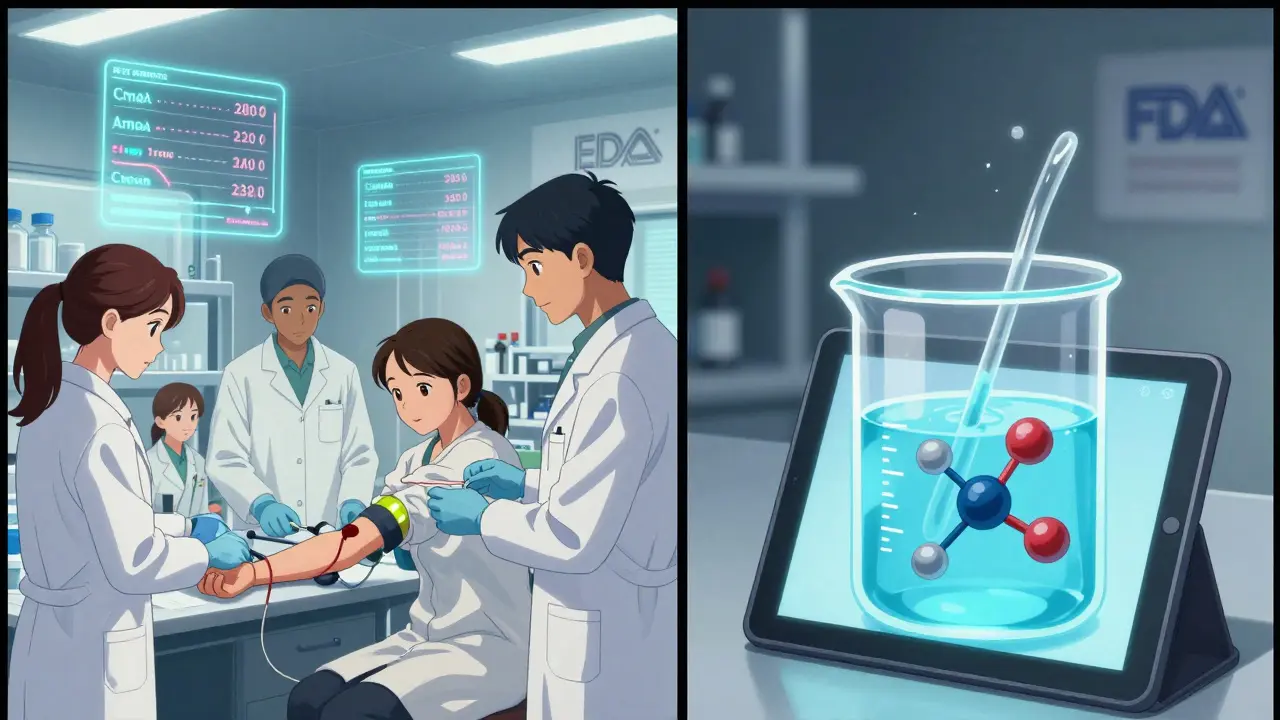
When a generic drug hits the shelf, you might assume it’s just a cheaper copy of the brand-name version. But behind that simple label is a rigorous scientific process designed to prove it works the same way in your body. That process is bioequivalence testing. And it’s not one-size-fits-all. Depending on the drug, regulators like the FDA and EMA rely on either in vivo or in vitro methods-or sometimes both. Knowing which one is used-and why-can help you understand why some generics are approved faster, cheaper, or with more confidence than others.
What Bioequivalence Really Means
Bioequivalence isn’t about looking the same or tasting the same. It’s about whether two versions of a drug-say, a brand-name pill and its generic copy-deliver the same amount of active ingredient into your bloodstream at the same rate. The goal? To make sure you get the same therapeutic effect, whether you’re paying $10 or $100 for it. The FDA sets the bar: the 90% confidence interval for the ratio of the test drug’s Cmax (peak concentration) and AUC (total exposure) must fall between 80% and 125% compared to the reference drug. For drugs with a narrow therapeutic index-like warfarin or levothyroxine-that window tightens to 90%-111%. That’s not a guess. It’s based on decades of clinical data showing what differences actually matter to patient outcomes.In Vivo Testing: The Gold Standard
In vivo bioequivalence testing means testing in living humans. It’s the traditional, go-to method. You recruit 24 healthy volunteers, give them one version of the drug, wait for a washout period, then give them the other. Blood samples are taken over hours or days to track how the drug moves through the body. This method directly measures what happens inside you. It accounts for everything: stomach acid, gut motility, liver metabolism, food effects. If a drug is absorbed differently when taken with a meal, in vivo testing catches it. That’s why it’s still required for drugs with complex absorption patterns or those that interact with food. But it’s expensive. A single in vivo study costs between $500,000 and $1 million. It takes 3-6 months to run, including screening, dosing, and data analysis. You need certified clinical units, trained staff, and strict compliance with 21 CFR Part 11 for electronic records. And ethically, it’s not ideal to expose people to repeated drug doses unless necessary. Still, for many drugs-especially those with poor solubility, variable absorption, or narrow therapeutic windows-there’s no substitute. About 95% of generic oral solid drugs still rely on in vivo testing. It’s the most reliable way to confirm real-world performance.In Vitro Testing: The Lab-Based Alternative
In vitro means “in glass.” No humans involved. Just lab equipment measuring physical and chemical properties of the drug product. Think dissolution testing: how quickly the tablet breaks down in simulated stomach fluid. Or particle size analysis for inhalers. Or droplet size distribution for nasal sprays. These methods are precise. Dissolution tests can have a coefficient of variation below 5%, compared to 10-20% in human studies. They’re faster, cheaper-often under $150,000-and can be done in weeks instead of months. They’re also repeatable, automated, and don’t raise ethical concerns. But here’s the catch: in vitro results don’t always predict what happens in the body. That’s why regulators only accept them under specific conditions. The most common is for BCS Class I drugs: those that are highly soluble and highly permeable. For these, the FDA grants biowaivers-meaning you can skip human testing entirely. In 2021, 78% of BCS Class I applications were approved this way. It’s not just pills. In vitro methods are now standard for inhalers, nasal sprays, and topical creams. Why? Because measuring blood levels for a lung or skin drug doesn’t tell you if it’s working where it’s supposed to. A metered-dose inhaler that delivers the right particle size to the lungs is more important than how much drug shows up in the bloodstream.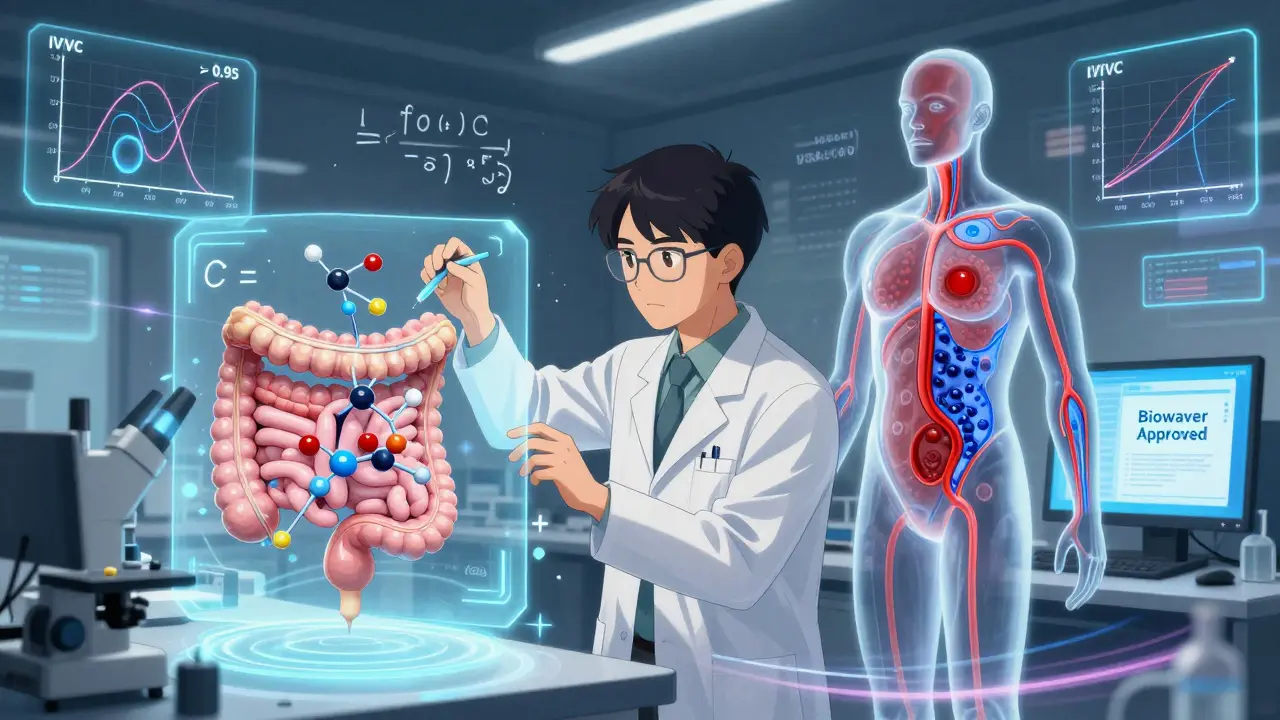
When In Vitro Works-and When It Doesn’t
In vitro testing shines in four key situations:- BCS Class I drugs (high solubility, high permeability): Think metformin or atenolol. Their absorption is predictable, so dissolution profiles match real-world performance.
- Locally acting products: Like nasal corticosteroids or topical antifungals. The goal isn’t systemic absorption-it’s local effect. In vitro tests can confirm dose delivery and particle size.
- Complex delivery systems: Inhalers, nebulizers, transdermal patches. Human testing is hard, expensive, or unethical. In vitro methods with cascade impactors or flow-through cells fill the gap.
- When IVIVC is proven: If you’ve built a validated model that links dissolution to absorption (called a Level A correlation, with r² > 0.95), regulators will trust it. This has been done successfully with modified-release theophylline and some antiretrovirals.
- Narrow therapeutic index drugs: Even tiny differences in absorption can cause toxicity or treatment failure. In vivo is still mandatory.
- Food effects: If a drug’s absorption changes with a meal, in vitro can’t simulate that.
- Nonlinear pharmacokinetics: When dose changes don’t scale linearly with blood levels, lab tests can’t predict it.
- BCS Class III drugs: Highly soluble but poorly permeable. In vitro dissolution might look perfect, but the drug still won’t cross the gut wall. Studies show in vitro predicts in vivo success in only 65% of these cases.
Real-World Trade-Offs
The pharmaceutical industry feels these trade-offs daily. One formulation scientist at Teva saved $1.2 million and 8 months by using an in vitro method for a BCS Class I drug. But it took them 3 months just to develop and validate the dissolution method to FDA standards. Another company, Mylan, got approval for a topical antifungal using in vitro testing. But after a few post-market reports of reduced effectiveness, they had to run an in vivo study. It cost $850,000 and delayed expansion by 11 months. The lesson? In vitro can be a shortcut-but if it’s wrong, the cost of correction is high. Equipment is another hurdle. A USP Apparatus 4 flow-through cell, needed for complex formulations, costs $85,000-$120,000. Not every lab can afford it. And training? Scientists need 6-12 months of specialized education to design reliable in vitro methods. Meanwhile, running an in vivo study requires clinical operations teams, ethics boards, and regulatory filings that take 4-8 months to set up.
The Future: Hybrid and Model-Driven Approaches
The field is shifting. The FDA’s 2023 draft guidance on nasal sprays says in vitro testing alone can be enough-if the method is physiologically relevant. In October 2022, the first generic budesonide nasal spray was approved based solely on in vitro data. That was a landmark. Now, companies are using in silico modeling-computer simulations that predict how a drug behaves in the body. Physiologically based pharmacokinetic (PBPK) models can simulate stomach pH, blood flow, enzyme activity. The FDA has started accepting these for modified-release products. The goal? A hybrid future. In vitro methods handle the bulk of routine approvals. In vivo studies are reserved for high-risk drugs: narrow therapeutic index, complex formulations, or when in vitro data is uncertain. The FDA’s GDUFA IV plan (2023-2027) commits to issuing two new guidances on in vitro testing for complex products by 2025. The European Medicines Agency approved 214 biowaivers in 2022-a 27% jump from 2020. Japan and the U.S. are aligning. Harmonization is happening. But regulators aren’t abandoning human testing. They’re just making smarter choices about when to use it.Bottom Line: It’s Not Either/Or-It’s Right/Right
There’s no universal winner between in vivo and in vitro bioequivalence testing. One isn’t better than the other. They’re tools for different jobs. Use in vivo when you need to know what happens in a human body-especially for tricky drugs. Use in vitro when you can prove the product’s physical behavior reliably predicts performance. And increasingly, use both, with modeling to bridge the gap. For patients, this means faster access to affordable generics. For manufacturers, it means smarter development paths. For regulators, it means more efficient reviews without compromising safety. The future of bioequivalence isn’t about replacing humans with machines. It’s about using the right tool for the right drug-and knowing when to trust the lab, and when to trust the body.Can in vitro testing replace in vivo testing for all generic drugs?
No. In vitro testing is only accepted for specific cases: BCS Class I drugs, locally acting products like inhalers or nasal sprays, or when a validated in vitro-in vivo correlation (IVIVC) exists. For drugs with narrow therapeutic indices, food effects, or nonlinear absorption, in vivo testing is still required by the FDA and EMA.
Why is in vitro testing cheaper and faster?
In vitro testing uses lab equipment to measure physical properties like dissolution or particle size-no human subjects needed. This eliminates costs for clinical sites, staff, ethics approvals, and long-term monitoring. A typical in vitro study takes 2-4 weeks and costs under $150,000, while an in vivo study can take 3-6 months and cost over $500,000.
What is a biowaiver, and how does it relate to in vitro testing?
A biowaiver is when regulators allow a generic drug to be approved without conducting a human bioequivalence study. It’s granted when in vitro data-usually dissolution profiles-prove the product behaves like the brand-name version. Biowaivers are most common for BCS Class I drugs, which are highly soluble and highly permeable. In 2021, 78% of BCS Class I applications received biowaivers from the FDA.
Are in vitro methods more accurate than in vivo studies?
Not necessarily. In vitro methods are more precise and reproducible in the lab, with lower variability. But accuracy depends on context. For BCS Class I drugs, in vitro correctly predicts in vivo performance about 92% of the time. For BCS Class III drugs, that drops to 65%. In vivo testing captures the full complexity of human biology-something no lab test can fully replicate.
What’s the role of IVIVC in bioequivalence testing?
IVIVC stands for in vitro-in vivo correlation. It’s a mathematical model that links lab-based dissolution data to actual human absorption. If the model has a Level A correlation (r² > 0.95), regulators accept it as proof that in vitro results predict real-world performance. This allows companies to skip human studies for certain drugs. IVIVC has been successfully used for modified-release theophylline and some antiretrovirals.
Which regulatory agencies accept in vitro bioequivalence methods?
The FDA (U.S.), EMA (Europe), and PMDA (Japan) all accept in vitro methods under specific conditions. Harmonization through the ICH has led to consistent guidelines for BCS Class I drugs. In 2022, the EMA approved 214 biowaivers based on in vitro data-a 27% increase from 2020. The trend is global: regulators are expanding acceptance for complex products like inhalers and nasal sprays.
Can a drug be approved using both in vitro and in vivo methods?
Yes. Many complex products require both. For example, a nasal spray might use cascade impactor testing (in vitro) to prove particle delivery to the lungs, plus a blood concentration study (in vivo) to confirm systemic exposure. The FDA’s 2022 data showed 63% of nasal spray applications needed both methods. This hybrid approach is becoming the norm for high-risk or complex formulations.




Brendan F. Cochran January 4, 2026
So let me get this straight-we’re trusting lab tests on pills to replace actual human trials? That’s how we end up with generics that make people sick but don’t get recalled for 3 years because the FDA is too busy sipping lattes. This isn’t science, it’s corporate cost-cutting dressed up as progress. We’re literally gambling with people’s lives because Big Pharma wants to turn $100 pills into $5 ones. Wake up.
jigisha Patel January 5, 2026
It is imperative to clarify that the regulatory acceptance of in vitro methods is predicated upon stringent validation protocols and adherence to International Council for Harmonisation (ICH) guidelines. The statistical power of dissolution profiles, particularly for BCS Class I compounds, demonstrates a coefficient of variation under 5%, which is statistically superior to inter-individual variability observed in in vivo studies (typically 10–20%). Therefore, the assertion that in vitro methods are inherently less reliable is empirically unfounded.
Jason Stafford January 5, 2026
They’re hiding something. Why else would they push in vitro so hard? Big Pharma owns the FDA. The same people who approved OxyContin are now signing off on dissolution curves like it’s a magic trick. You think they care if your blood levels are off by 12%? No. They care if the quarterly report looks good. And you? You’re just a number on a spreadsheet. They’re not saving money-they’re covering up failures. The data? Fabricated. The approvals? Fraud.
Cassie Tynan January 6, 2026
So we’ve replaced human bodies with beakers and called it innovation? Brilliant. Next they’ll replace therapists with chatbots and call it mental health reform. At least when you test on humans, you’re not pretending the body is just a vending machine that dispenses ‘absorption’ when you press the right button. Reality has texture. Algorithms don’t. We’re not upgrading science-we’re outsourcing empathy.
Rory Corrigan January 7, 2026
It’s funny how we’re so quick to trust machines but terrified of our own biology. We’ll let a robot measure particle size but won’t trust a gut that’s been evolving for 2 million years. Maybe the real question isn’t whether in vitro works-but why we’ve lost faith in our own bodies to tell us what’s real. We’re not just testing drugs anymore. We’re testing our willingness to surrender to convenience.
Connor Hale January 8, 2026
There’s a balance here. In vivo gives us the full picture-metabolism, food effects, individual variation. In vitro gives us speed, consistency, and scalability. Neither is perfect, but together? They’re powerful. The goal isn’t to replace one with the other-it’s to use each where it shines. And honestly, if we can approve a nasal spray based on particle size instead of forcing 24 people to swallow spray for months? That’s not laziness. That’s wisdom.
Joseph Snow January 8, 2026
Let’s be honest-this whole in vitro push is just a regulatory loophole for companies that can’t get their formulations right. The FDA doesn’t want to do the work. The industry doesn’t want to spend the money. So they invented a ‘biowaiver’ like it’s a get-out-of-jail-free card. And now we’re supposed to believe that a dissolution curve in a beaker is more reliable than real human pharmacokinetics? That’s not science. That’s corporate wishful thinking.
Siobhan Goggin January 9, 2026
This is actually really encouraging. Faster access to affordable meds means more people can actually take their prescriptions. I know someone who skipped their thyroid meds because the brand-name cost $400 a month. If in vitro testing helps get generics to $5 without sacrificing safety, that’s a win. Progress isn’t about clinging to old methods-it’s about making life better for real people.
Vikram Sujay January 10, 2026
It is noteworthy that the harmonization of regulatory standards across the FDA, EMA, and PMDA signifies a maturation of the global pharmaceutical landscape. The adoption of in vitro methodologies for BCS Class I compounds is not an abdication of scientific rigor but rather an evolution toward efficiency grounded in empirical evidence. The cumulative data from over 200 biowaivers approved by the EMA in 2022 underscores the robustness of this paradigm.
Jay Tejada January 11, 2026
My cousin’s asthma inhaler was approved in 6 weeks using in vitro. The brand-name version took 18 months. He’s breathing easier now. Sometimes the ‘old way’ is just slower, not better. I get the fear of cutting corners-but sometimes the corner leads to a shortcut that saves lives. Not every fight needs to be a war.
josh plum January 12, 2026
They’re lying to you. They say ‘in vitro is safe’ but they don’t tell you that 37% of the dissolution methods used for biowaivers were developed by the same company that makes the drug. No independent verification. No transparency. And you think that’s okay? Wake up. This isn’t science-it’s a rigged game. And your cheap generic? It’s a gamble with your life.