
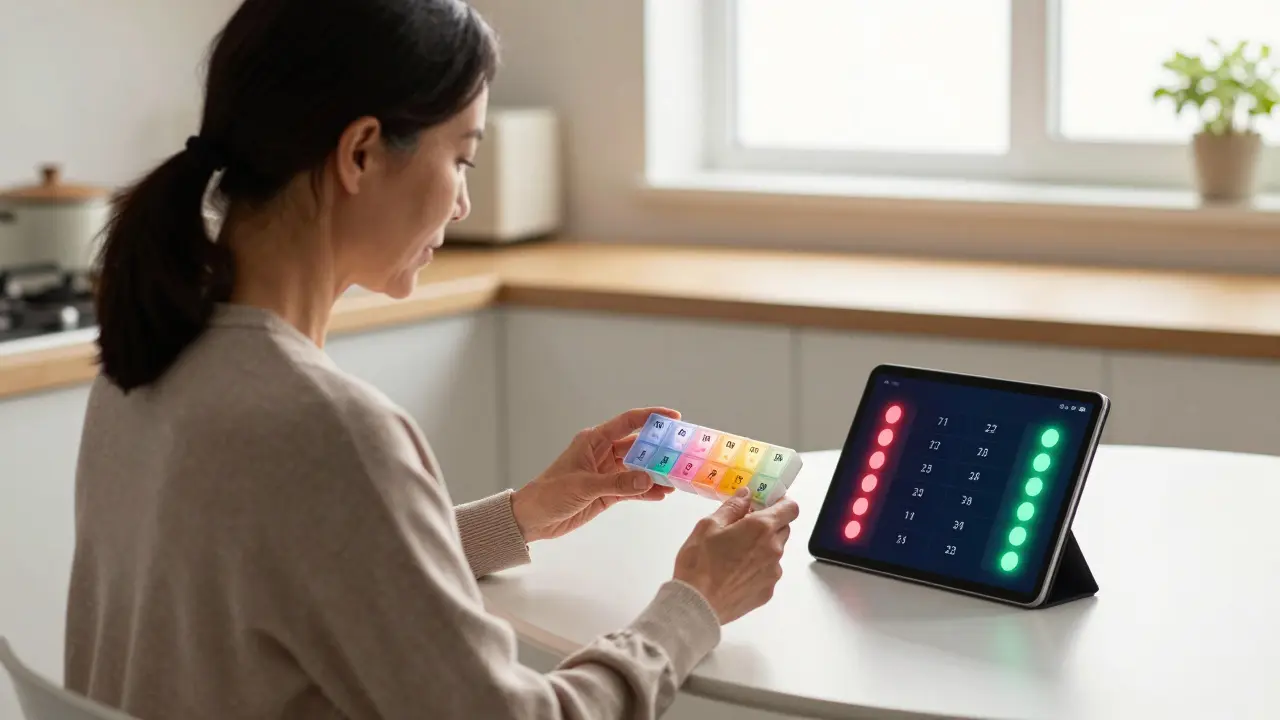
Missing a dose of your blood pressure pill isn’t just a slip-up-it’s a health risk. Studies show that nearly half of people with chronic conditions don’t take their meds as prescribed. That’s not laziness. It’s forgetfulness, confusion, cost, or just life getting in the way. But here’s the truth: if you’re trying to manage diabetes, heart disease, or depression, medication adherence isn’t optional. It’s the difference between staying out of the hospital and winding up in one. The good news? Tracking your pills doesn’t have to be a chore. You don’t need to be tech-savvy. You just need the right system.
Why Paper Logs Alone Don’t Work
For decades, the go-to method was a simple notebook: write down when you took each pill. Sounds easy, right? But here’s what happens in real life. A 2020 study of 1,200 patients found that 42% of paper logs were falsified-people checked off doses they never took. Why? Shame. Fear of judgment. Or just plain forgetting they didn’t take it. Even when people are honest, memory fails. The Annals of Internal Medicine found self-reported logs are only 27% accurate compared to electronic tracking. That means for every four pills you think you took, one was missed. And doctors can’t fix what they can’t see.
How Electronic Tracking Changed Everything
Enter the Medication Event Monitoring System (MEMS) a microelectronic cap that records when a pill bottle is opened. First introduced in 1991, it’s still the gold standard in clinical trials because it captures data with 97% accuracy. It doesn’t guess. It doesn’t rely on memory. It just logs every time the bottle opens. But you don’t need a clinical trial to use this tech. Today, consumer versions exist-like the Tenovi Pillbox an IoT-enabled smart pill container with LED reminders and cellular connectivity. It flashes red when a dose is due, turns green when you log it, and sends real-time updates to your doctor’s dashboard. No more guessing. No more missed calls.
What Works Best for Different People
Not everyone needs the same solution. For someone young, tech-savvy, and insured? A smartphone app like Medisafe or MyTherapy works great. They send alerts, let you log doses, and even share reports with caregivers. But what about an 80-year-old on Medicare who doesn’t own a smartphone? That’s where physical devices shine. The ReX dispenser an RFID-based system that mechanically dispenses pills into a tray and verifies intake is designed for this. It opens only when it’s time, releases the exact dose, and confirms the pill was taken. No buttons to press. No app to learn. Just medicine, on time, every time.
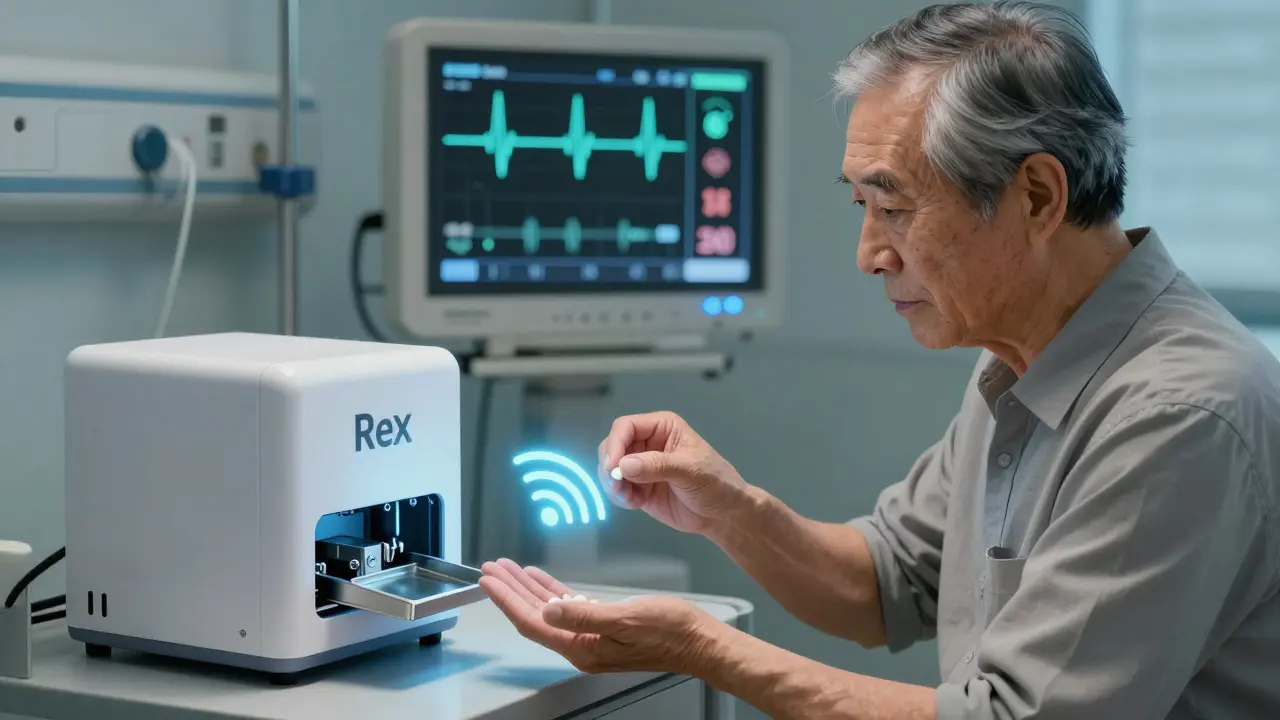
The Hidden Problem: Just Opening the Bottle Isn’t Enough
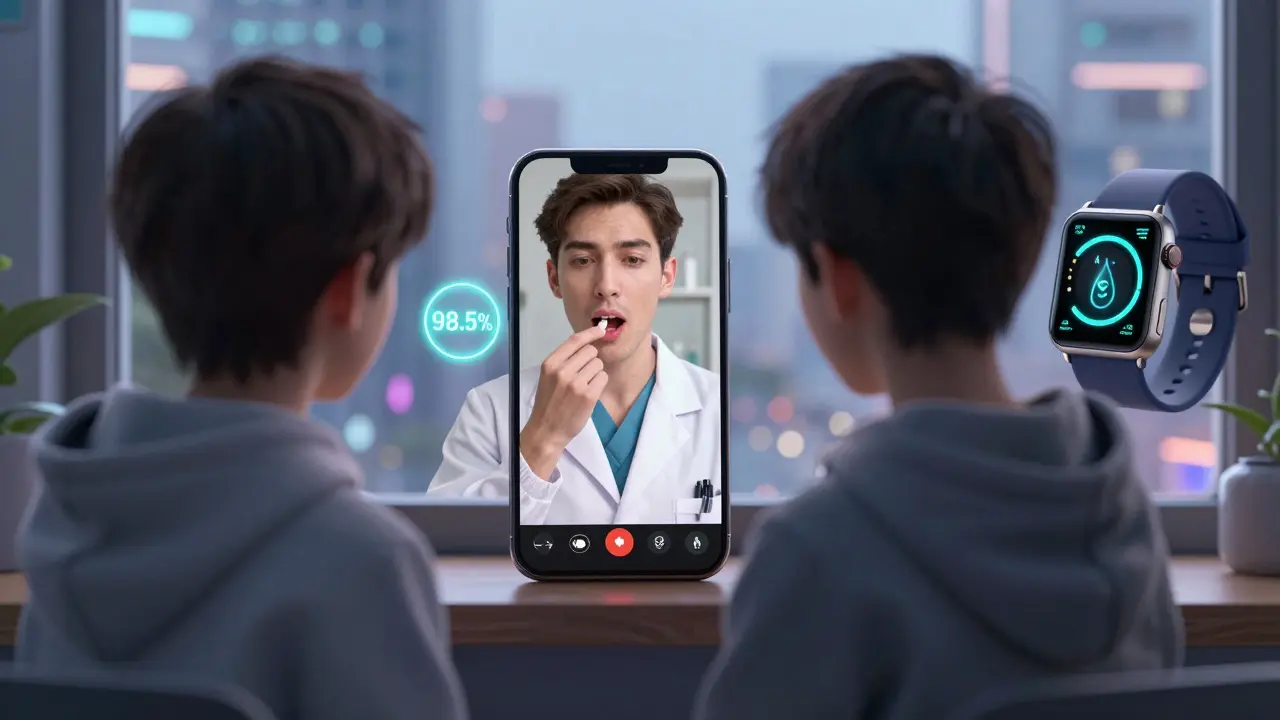
Here’s the catch most systems miss. If a pill bottle opens, does that mean the person swallowed the pill? Not always. Someone might pour out the pills and leave them on the counter. Or take one and spit it out later. A 2023 study in the Journal of Medical Systems found that 92% of current tracking tools can’t confirm actual ingestion. That creates a 12.3% false adherence rate-especially dangerous for psychiatric meds like antipsychotics or mood stabilizers. That’s why systems like Video Directly Observed Therapy (VDOT) a platform where patients take medication during a live video call with a clinician exist. They’re not perfect-each session takes over 17 minutes-but they’re the only way to be 98.5% sure the pill was swallowed. For high-risk patients, that matters.
Real-World Results: What Happens When You Track
When Cleveland Clinic rolled out its Connected Care Platform in 2022, combining Tenovi Pillboxes, Apple Watch vitals, and pharmacist check-ins, they saw something remarkable. Adherence for heart failure patients jumped from 76.2% to 89.4%. Hospital readmissions dropped by 23%. That’s not a theory. That’s 14,321 real patients. And it’s not just heart patients. A Kaiser Permanente study of 4,278 people with chronic conditions showed similar drops in ER visits and emergency care. The data doesn’t lie: when you track, you improve outcomes.
Who’s Using This and Why
It’s not just patients. Health systems are forced to adopt this tech. In 2022, Medicare made adherence tracking mandatory for reimbursement under chronic care programs. Now, 68% of U.S. healthcare providers use some kind of digital tracking-up from 32% in 2019. Companies like AARDEX dominate clinical trials. Tenovi leads in outpatient care. And Gaine Technology’s MDM platform is the go-to for university hospitals. Why? Because when patients take their meds, costs drop. The NIH estimates non-adherence costs the U.S. $300 billion a year. That’s emergency visits, hospital stays, and lost productivity. Tracking isn’t just good medicine-it’s good economics.
What’s Next: AI and Wearables
The next leap isn’t just about knowing when you took a pill. It’s about predicting when you won’t. The FDA cleared Medisafe Predict+ in May 2023-a system that uses 17 behavioral signals (sleep patterns, app usage, missed alerts) to forecast non-adherence 72 hours ahead. It’s 89.7% accurate. And by 2026, wearables like the Apple Watch may start detecting drug levels in your sweat or blood. Imagine your smartwatch telling your doctor: “Your patient took the pill, but their cortisol levels suggest it’s not working.” That’s not sci-fi. That’s the next 18 months.
Getting Started: What to Do Today
You don’t need to overhaul your life. Start simple:
- Make a list of every medication you take, including dose and time. Write it down. Keep it in your wallet.
- Use a pill organizer with compartments for morning, afternoon, night.
- Set phone alarms-label them clearly: “AM Blood Pressure,” “Evening Diabetic.”
- If you’re struggling, ask your pharmacist about low-cost smart pillboxes. Many are covered by insurance.
- Don’t be afraid to say: “I need help remembering.” Your doctor’s job isn’t to judge-it’s to help you stay healthy.
Adherence isn’t about perfection. It’s about progress. One pill, one day, one reminder at a time.
Can I just use a regular pill organizer without electronics?
Yes, a simple pill organizer with labeled compartments is a solid starting point. It helps you see what you’ve taken and what’s left. But it won’t alert you or notify your doctor if you miss a dose. For high-risk conditions like heart failure, epilepsy, or mental health disorders, adding an electronic tracker increases safety significantly.
Are smart pillboxes covered by insurance?
Some are. Medicare Advantage plans and many private insurers now cover devices like the Tenovi Pillbox under Remote Therapeutic Monitoring (RTM) codes, especially for chronic conditions like COPD, diabetes, or hypertension. Ask your pharmacist or care coordinator-they can check your plan’s benefits.
What if I live in a rural area with poor cell service?
Connectivity is a real issue. Some devices rely on cellular data and won’t work without it. Look for models with Bluetooth that sync to a hub or smartphone when you’re near Wi-Fi. Others, like the ReX dispenser, don’t need constant connectivity-they store data locally and upload when plugged in. Talk to your provider about low-tech options if you’re in an area with spotty signal.
Can family members help with tracking?
Absolutely. Many systems allow caregivers to receive alerts if a dose is missed. This isn’t about surveillance-it’s about support. A 2023 Kaiser study found that patients with family involvement had 31% higher adherence rates. Choose a system that lets you share updates with one trusted person.
Do I need to track every single pill?
Not necessarily. Focus on high-risk meds first: those with narrow therapeutic windows (like warfarin), psychiatric drugs, or ones you take multiple times a day. Once you’ve got those tracked, expand. You don’t need to monitor your daily vitamin unless it’s part of a larger plan.
What if I forget to log a dose?
Most digital systems allow you to log a dose retroactively. If you missed your alarm, take the pill as soon as you remember and mark it late. Don’t skip it. And don’t lie on your log. Your doctor needs honest data to adjust your treatment. If you’re consistently forgetting, it’s a sign you need a different system-not a reason to feel guilty.






Patrick Jarillon February 7, 2026
Let me guess-this whole 'smart pillbox' thing is just Big Pharma's way to track you.
They don't care if you take your meds. They care if you're *always* taking them. Why? Because if you're healthy, they stop making money.
MEMS caps? More like MEMS-SPY.
And don't get me started on VDOT. Video calls to prove you swallowed a pill? Next they'll demand a live-streamed bowel movement to confirm absorption.
They're not helping you. They're building a database.
And guess who owns it?
Google. Apple. Johnson & Johnson.
Wake up. This isn't healthcare. It's surveillance with a side of aspirin.
Catherine Wybourne February 9, 2026
I love how this post treats tech like it’s the only answer.
My mum’s 82, lives alone, and uses a plastic pillbox with morning/afternoon/night slots.
She doesn’t have a smartphone. Doesn’t want one.
But she has her neighbour, Brenda, who drops by every Tuesday with tea and checks the box.
That’s not ‘low-tech’-that’s human.
And Brenda doesn’t send data to a dashboard. She just says, ‘You look tired, love. Did you take your pills?’
Turns out, sometimes the algorithm is just a kind voice.
Ariel Edmisten February 10, 2026
Start simple. Pill organizer. Alarms. List in wallet.
That’s it.
No apps. No gadgets.
If you can’t do that, you need help-not a smart box.
Mary Carroll Allen February 10, 2026
I love this post but i think we’re missing the real issue: shame.
Like, i took my meds but i didn’t log it because i felt like a failure for forgetting.
So i just wrote it in like i did it.
Then i felt worse.
It’s a loop.
And the tech doesn’t fix that.
It just makes you feel watched.
My therapist says we need systems that say ‘it’s okay’ not ‘you failed.’
Also i typoed medisafe like medisafee. Sorry.
Jesse Lord February 11, 2026
I work in a clinic and this is 100% true
People dont miss meds because they're lazy
They miss them because life happens
Job shift, kid sick, bus broke down, bill due
And then they feel guilty
So they lie on the log
But if you make it easy, they’ll do it
Simple tools work
And if they don’t, ask why
Not blame
AMIT JINDAL February 12, 2026
OMG this is sooo relevant!!! 🤯
Like bro, in India we have this thing called 'Dadi ka dawa'-grandma’s way of tracking meds with chalk marks on the wall! 🎨
But now with AI predicting adherence? 😍
Imagine your watch reading your sweat and being like 'yo, you skipped your BP pill yesterday' 🤖💧
And guess what? My cousin in Delhi uses Tenovi and now his sugar is normal!
But why are we still using paper? We’re in 2025!
Also, if you’re not using AI, you’re basically a caveman with a pillbox. 🦍
Lakisha Sarbah February 12, 2026
I used to think tracking was overkill.
Then my dad had a stroke.
He was on warfarin.
One missed dose = ER.
One wrong dose = death.
We got him a ReX dispenser.
It clicked.
He didn’t have to think.
It just worked.
Now he says, 'I feel like I’m in control again.'
That’s not tech.
That’s dignity.
Niel Amstrong Stein February 13, 2026
I mean… yeah, tech helps
but honestly?
My grandma took her meds for 40 years with a coffee mug and a sticky note
She didn’t need an app
She needed to know someone cared
So every morning, my mom called her
‘Hey Ma, take your pills?’
‘Yep, honey. Done.’
That’s the real tracker
Love.
Not LEDs.
Paula Sa February 14, 2026
It’s interesting how we assume the solution is always more tech.
What if the problem isn’t forgetting?
What if it’s that the pills don’t make you feel better?
Or they make you nauseous?
Or you can’t afford them?
Tracking tells you if you took it.
But it doesn’t tell you if you should’ve taken it.
Maybe we need systems that ask: ‘Why are you struggling?’
Not just: ‘Did you take it?’
Joey Gianvincenzi February 15, 2026
The notion that 'tracking improves outcomes' is statistically misleading.
Correlation does not imply causation.
These studies are funded by device manufacturers.
There is no independent, double-blind, peer-reviewed validation of consumer-grade trackers.
Furthermore, the FDA clearance of Medisafe Predict+ is based on proprietary algorithms with no public audit trail.
This is not healthcare innovation.
This is predatory monetization disguised as medical advancement.
Do not be fooled.
Amit Jain February 17, 2026
LMAO this is so American.
You got a pillbox that talks to your doctor?
Who cares?
My cousin in Jaipur takes his BP pills with chai every morning.
No app. No Bluetooth.
Just a habit.
And he’s been fine for 12 years.
Why do you need a gadget to do what your brain can do?
Stop overcomplicating life.
Just take the damn pill.
And stop selling us this tech cult.
Sarah B February 18, 2026
This is why America is weak.
People need alarms to take medicine?
Grow up.
My dad took 12 pills a day after his heart attack.
No tech.
Just discipline.
Stop coddling people.
Medicine isn’t a game.
It’s a responsibility.
And if you can’t handle that, maybe you shouldn’t be on the pills.
Tola Adedipe February 18, 2026
I’m a nurse in Toronto and I’ve seen this firsthand.
One patient, 74, diabetic, on 7 meds.
She used a pill organizer.
Then her daughter moved away.
She started missing doses.
We gave her a Tenovi.
It beeped.
She took it.
Her A1C dropped.
But here’s the thing-she cried when she told me the device sent a message to her daughter.
‘She doesn’t have to worry anymore,’ she said.
That’s the real win.
Not the data.
The peace.