
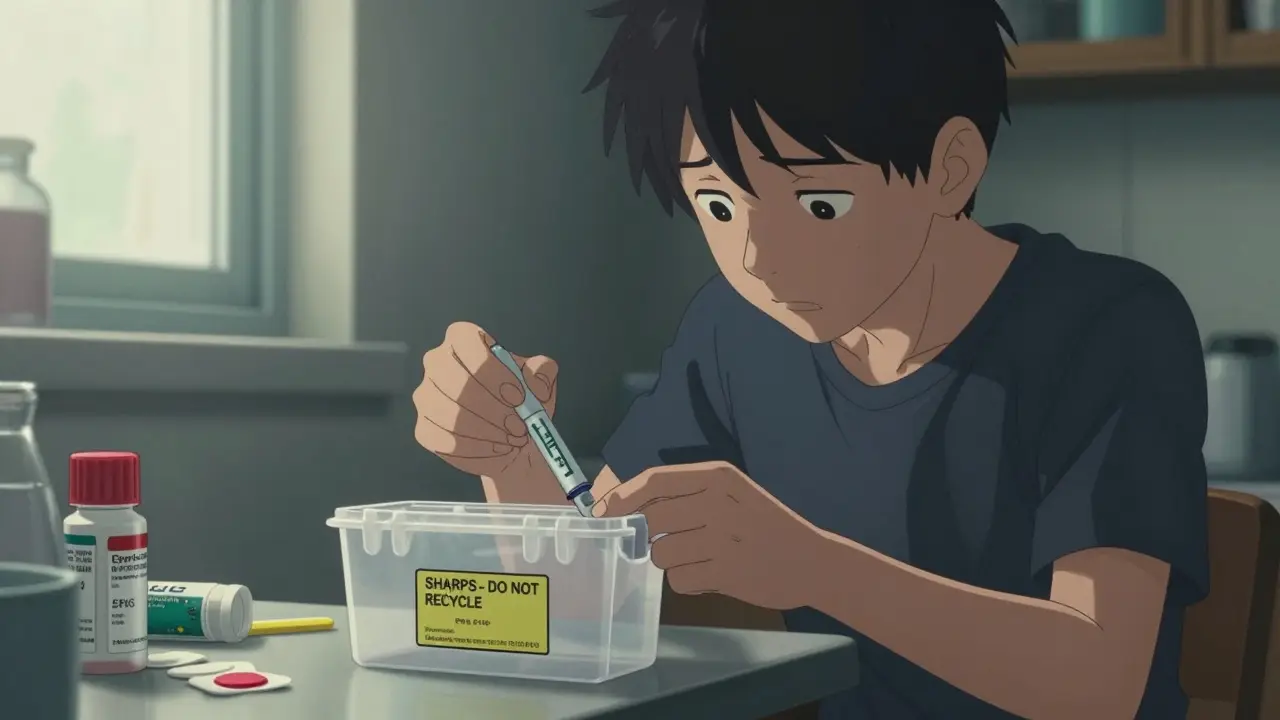
Why You Can’t Just Toss Expired EpiPens, Inhalers, or Patches in the Trash
You wouldn’t throw a used syringe in the kitchen bin. So why do so many people treat expired EpiPens, inhalers, and medicated patches the same way? These aren’t ordinary pills or empty wrappers. They contain potent drugs, pressurized gases, or sharp needles - and if handled wrong, they can hurt kids, pets, sanitation workers, or even pollute rivers.
In 2022, the FDA reported that 12% of accidental poisonings in children came from medications thrown carelessly in the trash. That’s not a small number. And it’s not just about safety. Inhalers release greenhouse gases when crushed or burned. Patches still hold enough medicine to kill someone if licked or stuck to skin. Proper disposal isn’t optional - it’s a responsibility.
How to Dispose of an Expired EpiPen
An EpiPen isn’t just a plastic device with a needle inside. It’s a medical sharp with life-saving medication still inside, even after it’s expired. The FDA classifies it as a sharps item, just like a used needle from a diabetic. That means it can’t go in your regular recycling or trash unless it’s completely empty and properly contained.
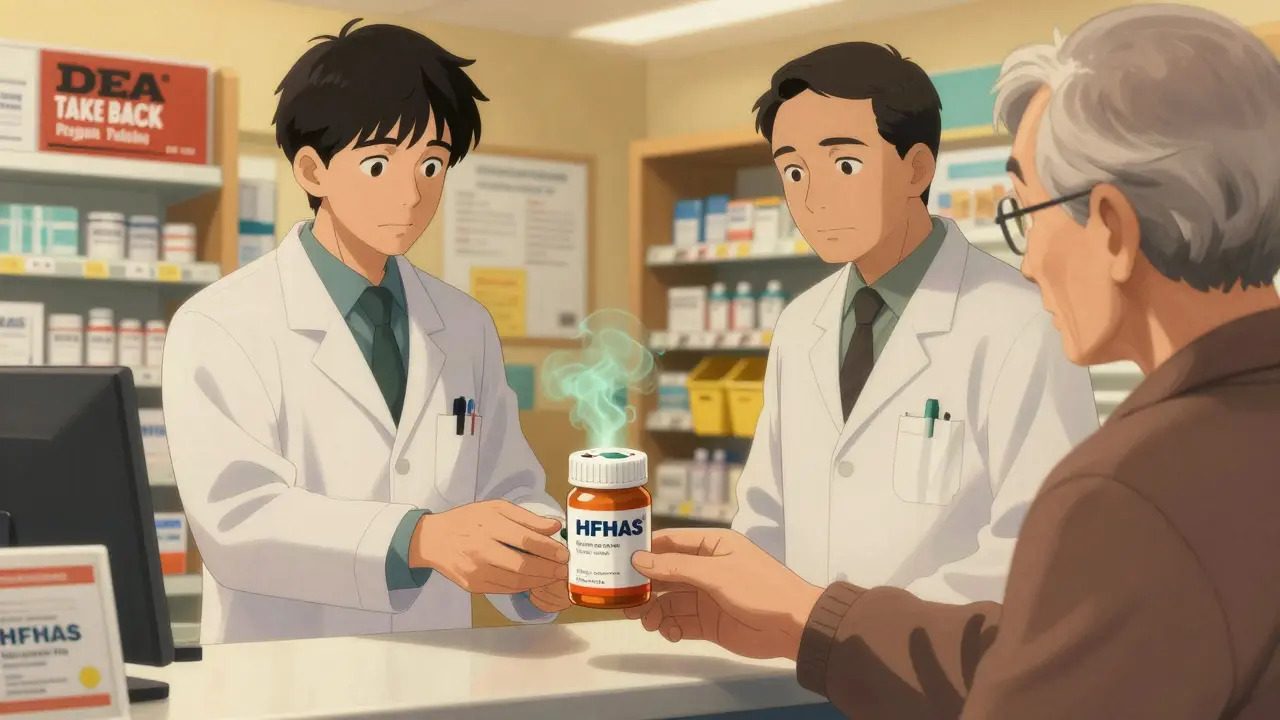
The safest way? Return it to your doctor’s office or pharmacy when you pick up your new prescription. Most allergists and clinics have sharps bins just for this. If yours doesn’t, ask. Many pharmacies - especially those with take-back programs - will accept them. CVS, Walgreens, and some hospital pharmacies offer this service, but it’s not universal. Call ahead.
If you can’t get to a drop-off point right away, store it safely at home. Put the EpiPen in a hard plastic container - like a clean laundry detergent bottle - with a tight lid. Label it clearly: “SHARPS,” “BIOHAZARD,” and “DO NOT RECYCLE.” Keep it out of reach of children and pets. Never try to take it apart. Removing the battery or needle can cause injury or release medication accidentally.
State rules vary. In California, you must use a certified sharps disposal program or mail-back service. In Texas, you can throw it in the trash if it’s in a labeled, puncture-proof container. Check your state’s health department website or call your local waste authority.
What to Do with Old Inhalers
Inhalers are tricky. They’re small, but they contain pressurized canisters with propellants like hydrofluoroalkanes (HFAs), which are powerful greenhouse gases. If you puncture them, toss them in a fire, or crush them in the trash, those gases leak into the air. Around 300 million inhalers are thrown away in the U.S. every year - and most end up in landfills or incinerators.
Don’t recycle them in your curbside bin. The pressure makes them dangerous for sorting machines. Instead, find a local drop-off. Some pharmacies, like Walgreens and CVS, accept inhalers at select locations - but only about half of them do. Check their website or call your local store before going.
Big cities like New York and Chicago have special Household Hazardous Waste (HHW) drop-off sites that take aerosols. Look up your city’s waste management site for details. If no program exists near you, the FDA recommends removing the metal canister from the plastic mouthpiece. Throw the plastic part in the trash (if it’s clean), and take the metal canister to a recycling center that accepts aerosols. Never puncture or burn the canister.
Disposing of Medicated Patches Correctly
Medicated patches - like nicotine, fentanyl, or testosterone patches - are sticky, silent hazards. Even after you’ve used them, they still hold up to half the original dose of medicine. A child or pet licking a discarded patch can overdose. That’s why the FDA says some patches, especially fentanyl, should be flushed immediately.
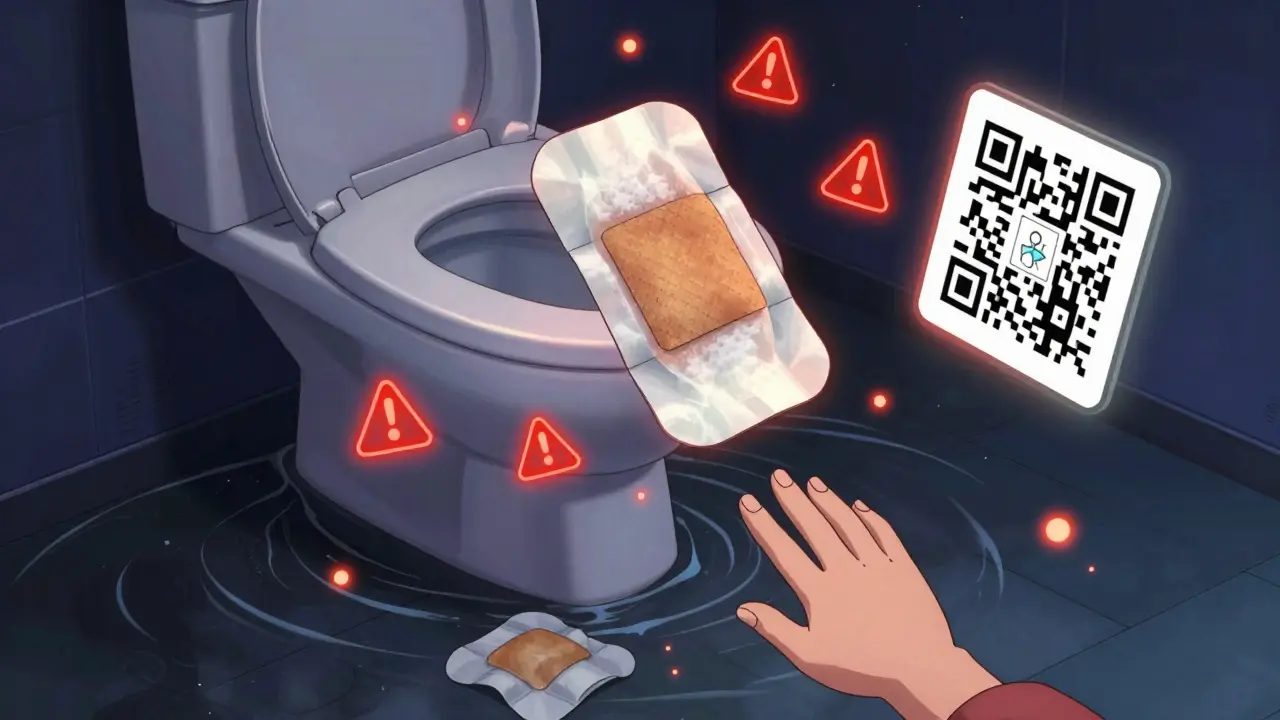
Check the label. If it says “flush,” do it. Flush it down the toilet right after use. This isn’t a suggestion - it’s a safety rule. The FDA maintains a “flush list” of medications that are dangerous enough to warrant this step. Fentanyl patches are on it. So are certain opioids. If it’s not on the list, fold the patch in half with the sticky sides together. This traps the medication inside. Then throw it in the trash. Never leave it unfolded or crumpled where someone might find it.
Some people try mixing patches with coffee grounds or cat litter before tossing them. That works for pills, but not for patches. The adhesive surface still leaks. Folding is the only reliable method for non-flush patches.
Use Take-Back Programs - They’re Free and Safe
The easiest, most reliable way to dispose of all three items? Use a DEA National Prescription Drug Take Back Day event. These happen twice a year - usually in April and October - at police stations, hospitals, and pharmacies across the country. In October 2022 alone, over 985,000 pounds of unused medications were collected.
You don’t need to wait for those days. The DEA’s website has a search tool that shows permanent drop-off locations near you. Enter your zip code and it lists pharmacies, hospitals, and law enforcement sites that accept expired medications year-round. There are over 14,000 locations nationwide.
These programs take EpiPens, inhalers, patches, pills, and more. No questions asked. No cost. And they’re designed to prevent misuse, accidental exposure, and environmental harm.
Many rural areas still lack access. A 2022 study found only 37% of rural counties had permanent drop-off sites, compared to 89% in cities. If you’re in a rural area, ask your doctor or pharmacist about mail-back programs. Some states offer free prepaid envelopes for safe disposal.
What NOT to Do
- Don’t flush EpiPens or inhalers unless instructed. Flushing them harms water systems and isn’t approved for these items.
- Don’t recycle them with plastic or metal. The residual medication contaminates recycling streams.
- Don’t disassemble EpiPens or inhalers. You risk needle sticks or gas leaks.
- Don’t throw patches in the trash unfolded. Always fold them sticky-side together.
- Don’t assume your local pharmacy takes them. Always call first.
How to Stay Prepared
Prevention beats cleanup. Keep track of expiration dates. Set a monthly reminder on your phone to check your EpiPen, inhaler, and patches. Most last 12-18 months. Replace them before they expire.
Keep a small sharps container at home - they cost $5-$15 at pharmacies. Use it for used or expired EpiPens. Label it. Store it out of reach. When full, take it to a drop-off location.
Ask your doctor or pharmacist for disposal instructions when you get a new prescription. Many don’t offer it unless you ask. If they don’t know, ask them to find out. You’re not being difficult - you’re helping them improve their service.
What’s Changing in 2026
More states are stepping up. California’s SB 212, which took effect in January 2024, requires drug makers to pay for disposal programs. That means more drop-off bins, more mail-back options, and better labeling on packaging. By 2026, you’ll likely see QR codes on EpiPen boxes that link directly to local disposal locations.
Pharmaceutical companies like Mylan are testing smart packaging that includes disposal instructions printed right on the box. The EPA is also pushing new rules to reduce pharmaceutical waste in waterways - which currently show traces of drugs in 80% of tested rivers.
It’s not perfect yet. But progress is happening. Your actions matter. Every properly disposed EpiPen, inhaler, or patch helps protect your community, your environment, and future generations.
Where to Find Help
- DEA National Take Back Day - www.dea.gov/takebackday
- SafeNeedleDisposal.org - Find local sharps disposal locations
- Medication Take Back Locator - Search by zip code at www.dea.gov
- Your state health department - Search “[Your State] pharmaceutical disposal guidelines”
- Your pharmacy - Ask if they accept sharps or inhalers

Monica Puglia January 12, 2026
I just threw my expired EpiPen in the trash last month 😅... now I'm panicking. Thanks for the wake-up call! Going to the pharmacy tomorrow to drop it off. 🙏
Cecelia Alta January 13, 2026
Okay but why are we even being told this like it's news? Like, I know people are dumb, but this is basic safety 101. The fact that we need a 2000-word guide to not throw a needle in the trash is just... sad. Also, who even still uses inhalers that aren't digital? This whole system is broken.
steve ker January 13, 2026
In Nigeria we just bury them in the backyard. Works fine. Why do Americans make everything so complicated
Faith Wright January 15, 2026
I love how this post doesn't judge. Like, we all made the mistake of tossing something dangerous. The fact that someone took the time to write this clearly? That's the kind of care we need more of. 🤍
Sonal Guha January 15, 2026
The FDA stats are misleading. 12% of poisonings from trash? That's 0.003% of total cases. You're being manipulated into guilt. Also patches? Fold them? Please. That's not science that's folklore
TiM Vince January 15, 2026
I'm from rural Montana. We don't have a single drop-off point within 80 miles. My pharmacist said 'just put it in a jar and wait'. I'm waiting. And wondering why the system fails people like me.
gary ysturiz January 16, 2026
This is so important. Seriously. I used to just toss my inhalers until I saw a dog pick one up last year. Don't wait for a tragedy. Do the right thing. It takes 5 minutes. You can do this.
Jessica Bnouzalim January 16, 2026
I just got a new EpiPen!! And I'm already thinking about how to dispose of the old one!! I bought a sharps container!! I'm so proud of myself!! I even labeled it!! 🎉💕 I'm gonna take it to CVS next week!!
laura manning January 17, 2026
The assertion that folding patches is the only reliable method for non-flushable transdermal agents is not substantiated by peer-reviewed toxicological studies. Furthermore, the EPA's 2023 pharmaceutical waste report indicates that adhesive penetration remains statistically significant even after folding, thereby rendering the recommended protocol insufficient for containment. One must consult the Material Safety Data Sheet (MSDS) for each specific formulation.
Bryan Wolfe January 17, 2026
You're not alone if you didn't know this. I didn't either until my neighbor's kid got into an old patch. Now I'm the guy who brings extra sharps containers to family gatherings. Small actions, big impact. Keep going!
Sumit Sharma January 18, 2026
The regulatory fragmentation is a systemic failure. Federal guidelines are non-binding, state jurisdictions are inconsistent, and corporate responsibility is absent. The DEA take-back program is a Band-Aid on a hemorrhage. Pharmaceutical manufacturers must be held liable under extended producer responsibility frameworks. This is not consumer education-it is institutional negligence.
Lawrence Jung January 19, 2026
We throw things away because we live in a world that tells us to consume and discard. The real problem isn't how we dispose of EpiPens. It's why we need them in the first place. Why do we live in a society where anaphylaxis is so common that it's normal to carry a needle?
Alice Elanora Shepherd January 20, 2026
In the UK, we have NHS take-back schemes at all community pharmacies. No questions asked. It's free, simple, and integrated. Why can't the US adopt this model? It's not rocket science. Just policy and willpower.
Prachi Chauhan January 21, 2026
I used to think patches were safe if you folded them. Then I read a study about fentanyl absorption through skin even when folded. Now I flush. Always. I don't care what people say. My nephew is 3. I'd rather be called crazy than risk it.