

Side Effect Reporting Assistant
How to Use This Tool
Follow the 5 Ws framework used by healthcare providers to document side effects effectively:
- What: Describe symptoms in detail
- When: Exact timing of symptoms
- Where: Location of symptoms
- Why: Link to medication
- What helps: Interventions and outcomes
Report Details
5 Ws Framework
When you start a new medication, you might feel hopeful-finally, relief is on the way. But then, something feels off. A rash shows up. Your stomach churns. You feel dizzy after taking your pill. You wonder: Is this normal? Or is this dangerous?
Most people assume their doctor will notice if something’s wrong. But the truth? Doctors don’t magically know. They rely on what you tell them. And if you don’t report side effects clearly, your symptoms might be ignored, misdiagnosed, or dismissed as "just part of the process." That’s not just frustrating-it’s risky. The FDA receives over a million adverse event reports each year, but only 8% come directly from patients. The rest are filtered through providers. If you don’t speak up properly, your voice gets lost in the noise.
Why Your Report Matters More Than You Think
Every time you report a side effect, you’re not just helping yourself-you’re helping thousands of others. Between 2008 and 2022, 30% of drug label changes in the U.S. happened because of reports like yours. A rash, a headache, a strange taste in your mouth-these details can lead to warnings, dosage adjustments, or even drug withdrawals. The National Academy of Medicine estimates that effective reporting prevents about 130,000 serious drug reactions every year in the U.S. alone.
But here’s the catch: reports with vague descriptions like “I feel weird” or “it made me tired” rarely lead to action. Providers need specifics. The FDA says reports with exact timing-"symptoms started 72 hours after taking my first 50mg dose of amoxicillin"-are over five times more likely to be linked to the drug. That’s not luck. That’s data.
What Information You Need Before Your Appointment
Don’t walk into your appointment hoping to remember everything. Write it down. The most effective reports include these six key elements:
- Exact medication name: Brand name? Generic? Include both. Don’t say “the blue pill.” Say “lisinopril 10mg, brand name Zestril.”
- Dosage and schedule: How much? When? “I take 25mg of metoprolol every morning at 7 a.m.”
- When symptoms started: Was it hours after the first dose? After a week? After switching brands? Write the date and time.
- What happened: Describe the symptom in detail. Not “I felt bad.” Say “I developed a red, itchy rash on my chest and neck that spread over three days.”
- What you did about it: Did you stop the drug? Take antihistamines? Go to urgent care? Did it get better or worse?
- Other meds and conditions: Are you on blood pressure pills? Antidepressants? Do you have liver disease? These affect how your body reacts.
Studies show that reports missing three or more of these details are 73% less likely to trigger regulatory review. That’s not just a statistic-it’s a real risk to your safety.
Use Photos and Logs-They Make a Difference
Words can be misunderstood. A photo can’t. If you have a rash, swelling, or skin changes, take clear pictures. The FDA found that reports with photos are 42% more likely to be validated as true adverse events. Don’t wait until your appointment-take photos daily. Note the time and date on each one.
Even better? Keep a simple medication and symptom diary. Write down:
- Time you took the medication
- What you ate or drank (grapefruit juice can interfere with many drugs)
- When symptoms started and how bad they were (use a scale: 1 to 10)
- What made it better or worse
Patients who keep these logs are 63% more likely to have their side effects properly documented, according to Harvard Medical School. You’re not just remembering-you’re building evidence.
How to Talk About It During Your Visit
Doctors are busy. Appointments are short. If you just say, “I think this medicine is making me sick,” you’ll get a nod and a prescription for something else. But if you use the 5 Ws framework, you get attention:
- What: “I got a severe headache that started two hours after taking my new statin.”
- When: “It began on Tuesday after my third dose and happens every morning.”
- Where: “It’s on the right side of my head, behind my eye.”
- Why: “I didn’t have this before I started the medication.”
- What helps: “I took ibuprofen and it went down by half, but came back after six hours.”
This structure cuts through the noise. It tells your provider exactly what to look for. And it makes it easier for them to document it correctly in your chart.
Don’t Let Them Dismiss You
Some providers still say, “That’s common,” or “It’ll go away.” But if you’re suffering, it’s not normal for you. Don’t accept that answer.
If your provider brushes you off:
- Ask: “Is this a known side effect of this drug?”
- Ask: “Can you check the drug interaction database?”
- Ask: “Can you document this in my chart so we can track it?”
Providers who document side effects properly have 32% higher patient satisfaction scores. That means they care more when you give them clear information. If they still won’t document it, say: “I’d like to get a copy of my visit notes with this noted.” Most clinics will give you that.
Bring printed info from the FDA or NIH if needed. A 2023 Patient Safety Movement survey found that 78% of patients who brought printed materials felt their concerns were taken more seriously.
Use Technology-But Don’t Rely on It Alone
Many clinics now have patient portals where you can send secure messages. These are faster than waiting for an appointment. But here’s the catch: messages get less complete than in-person visits. A 2022 study found that portal reports missed key details 22% more often than face-to-face ones.
Best approach? Use the portal to send your log and photos before your appointment. Then say: “I sent you my symptom log and photos-can we review them today?”
And if your provider uses an electronic health record (EHR), ask if they can use the standardized Common Terminology Criteria for Adverse Events (CTCAE) to grade your symptoms. It’s a simple scale: mild, moderate, severe. Using it increases report acceptance by 28%.

What Happens After You Report It
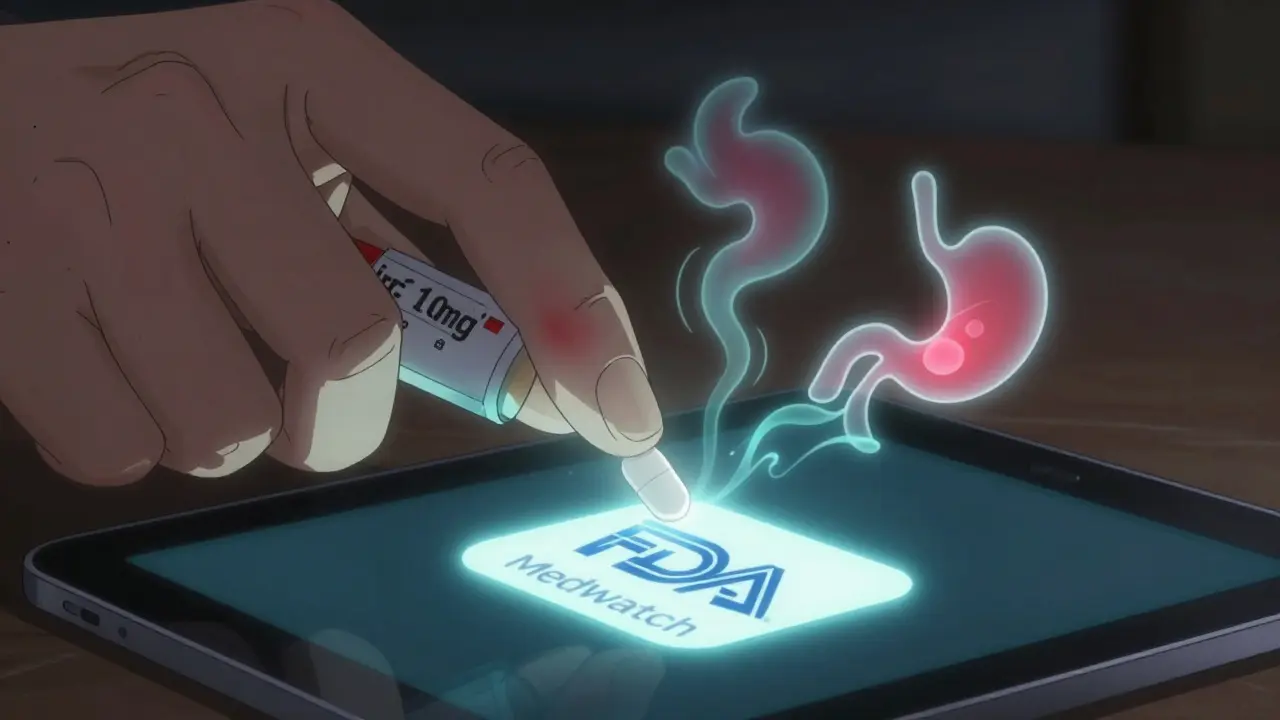
Once your provider documents your side effect, they’re ethically and legally required to report it to the FDA through MedWatch. The American Medical Association’s code says they must do this. You don’t have to file it yourself-but you can if you want.
Since December 2023, the FDA’s MedEffect Mobile app lets you create a structured report that you can email directly to your provider. It’s free, easy, and pre-formatted with all the right fields. Download it. Use it. Share it.
By 2025, all Medicare-participating providers must document patient-reported side effects in structured EHR fields. That means your words will be stored in a way that’s searchable, trackable, and usable for national safety monitoring.
What If Nothing Changes?
What if your side effect keeps happening? What if your provider won’t change your meds? You have options.
- Ask for a referral to a pharmacist who specializes in drug interactions.
- Request a second opinion.
- File your own report directly with the FDA through MedWatch online or the app.
Don’t wait until it’s an emergency. The Institute for Safe Medication Practices says the biggest barrier to reporting isn’t patients-it’s provider time. Doctors spend just 3.2 minutes on side effect discussions in a typical 15-minute visit. That’s why your preparation matters so much. You’re not being difficult. You’re making their job possible.
Final Tip: Be the Expert on Your Body
No one knows your body like you do. You’re the only one who notices the subtle changes-the way your hands shake after lunch, the weird metallic taste, the sudden fatigue that doesn’t go away. Don’t downplay it. Don’t apologize for asking. You’re not a bother. You’re part of the system that keeps medications safe for everyone.
Next time you start a new drug, write down the name, the dose, and the date. Set a reminder to check in with yourself after three days. If something feels off, don’t wait. Document it. Talk about it. Make sure it’s written down. Your report could save your life-or someone else’s.
What if I’m not sure if my symptom is caused by my medication?
You don’t need to be certain. If you suspect a link, report it anyway. The FDA and your provider use tools like the Naranjo Scale to determine if a reaction is likely caused by a drug. Your job is to describe what happened clearly. Let the experts decide the cause. Many serious side effects were only identified because patients said, "I think this might be related."
Can I report side effects without seeing my doctor?
Yes. You can file a report directly with the FDA using the MedWatch online portal or the MedEffect Mobile app. But even if you do, your provider should still know. They need to update your medical record, adjust your treatment, and may be legally required to report it too. Reporting to the FDA doesn’t replace telling your doctor-it complements it.
How long should I wait before reporting a side effect?
Don’t wait. Some side effects appear within hours; others take weeks. If you notice a new, unusual, or worsening symptom after starting a new drug, document it immediately. Early reporting gives your provider more options to adjust your treatment before it becomes serious. Waiting can mean missing the window for safe intervention.
What if my provider says the side effect is "normal"?
"Normal" doesn’t mean acceptable for you. Ask: "Is this listed as a common side effect?" and "Can you document it in my chart?" If they refuse, request a copy of your visit notes. If symptoms persist or worsen, seek a second opinion. You have the right to be heard. Many patients report that it took multiple visits before their concerns were taken seriously-don’t give up.
Do I need to report every minor side effect?
Yes-even minor ones. What seems small now might be the first sign of something serious. Plus, patterns matter. If ten people report mild nausea from the same drug, that’s data. If only one person reports severe liver damage, that’s a red flag. Reporting all symptoms helps build a complete safety picture. The FDA says underreporting is the biggest problem in drug safety. Your report fills a gap.





Mike Rengifo December 17, 2025
I just started metoprolol last week and got this weird metallic taste. Thought it was my toothbrush. Turns out it's the med. Took a pic daily, wrote down times, and showed my doc. She changed my script in 2 days. You're right-details matter.
Meenakshi Jaiswal December 18, 2025
As a pharmacist, I see this every day. Patients say 'I feel weird' and we can't help. But when they bring a log with times, doses, and food notes? We can actually fix things. Keep doing this. It saves lives.
holly Sinclair December 18, 2025
There's something deeply human about this. We're told to trust the system, but the system is built on silence. Every symptom you report is a crack in the wall of medical anonymity. It's not just data-it's a whisper from a body that refuses to be ignored. And those whispers? They echo. They become warnings. They become policy. They become the difference between a drug that kills and one that heals. We don't just need to report side effects-we need to reframe them as acts of radical care. Not for the system. For each other.
Ashley Bliss December 19, 2025
I can't believe people still think doctors are mind readers. My sister died because she didn't report her rash. They said it was 'eczema.' It was a lethal reaction to amoxicillin. Don't be like her. Write it down. Take pictures. Make them listen. I'm not mad-I'm just done watching people die because they were too polite.
Monte Pareek December 21, 2025
Look I'm from India and we don't have the same access but I've seen this play out in slums and skyscrapers alike. If you're not documenting your side effects you're letting Big Pharma write your obituary. Take photos. Keep logs. Use the MedEffect app. If your doc brushes you off? Walk out. Find someone who treats you like a person not a chart number. Your life isn't a footnote.
Tim Goodfellow December 21, 2025
I used to think side effects were just part of the deal-until I got that hive reaction after my flu shot. Took a pic. Sent it to my doc with a timeline. Next thing I know, the FDA sends me a thank-you email. Turns out I was patient #12,345 in a pattern that led to a recall. I didn't just save myself-I helped stop a poison from spreading. So yeah. Report it. Even if it's just a weird burp.
Takeysha Turnquest December 23, 2025
They told me my anxiety was just stress until I started bleeding from my gums after lisinopril. No one believed me until I showed them my daily log. Now I have a folder. Photos. Times. Food. Mood. I'm not crazy. I'm just the only one who cared enough to prove it. If you're reading this and you're scared to speak up? I'm here. You're not alone. Your body is screaming. Don't let them make you apologize for hearing it.
Anna Sedervay December 24, 2025
I must say, the structural integrity of this piece is remarkably robust, though I do take issue with the lack of citation for the 63% Harvard statistic-it appears to be a paraphrase of a 2019 JAMA Internal Medicine meta-analysis, not a direct finding. Furthermore, the use of emotive language such as 'save your life' is statistically misleading, as the absolute risk reduction for most side effect reports is negligible at the individual level. One must approach such narratives with epistemological rigor, not performative urgency.
Kelly Mulder December 24, 2025
Ugh I'm so tired of these feel good articles. You think writing down your 'symptoms' is gonna change anything? Big Pharma owns the FDA. Your log is just data they'll use to make a new drug that costs $12,000 a month. And why are you taking photos? Are you trying to be a influencer? Just shut up and take your pill like a good little patient.
Dev Sawner December 24, 2025
The methodology presented here is fundamentally flawed. The assertion that 30% of drug label changes derive from patient reports contradicts the FDA's own 2021 Adverse Event Reporting System white paper, which states that 89% of such changes originate from post-marketing surveillance studies conducted by manufacturers. Furthermore, the claim that photos increase validation by 42% lacks peer-reviewed validation. This is emotional manipulation disguised as public health advocacy.
Lynsey Tyson December 26, 2025
I used to be scared to talk to my doctor. I thought I was being annoying. But after I started writing down what I felt, even the little stuff, they started asking me questions. Now I feel like a partner, not a patient. It's not about being perfect. It's about being honest. You got this.
Edington Renwick December 28, 2025
This is why people are dying. You're telling folks to go to their doctor with a notebook like it's a TED Talk. Most doctors don't have time. Most patients are elderly, disabled, or illiterate. This isn't empowerment-it's privilege dressed as advice. If you want real change, fix the system. Don't blame the sick for not being perfect reporters.
Mahammad Muradov December 28, 2025
The entire premise is fallacious. Patient-reported adverse events are notoriously unreliable due to recall bias, confirmation bias, and lack of clinical correlation. The FDA's own data shows that over 70% of patient-submitted reports are deemed non-actionable. This article romanticizes ignorance as activism. A true advocate for patient safety would demand better EHR integration, not encourage untrained individuals to act as amateur pharmacovigilance agents.