

When people talk about vitiligo treatment, you’ll often hear two things: phototherapy and depigmentation. But here’s the truth most websites get wrong - these aren’t used together. They’re opposites. Phototherapy tries to bring color back. Depigmentation removes what’s left. You don’t mix them. You pick one based on how much of your skin is affected.
What Vitiligo Really Is
Vitiligo isn’t just a skin condition. It’s an autoimmune disease where your body’s own immune system attacks the melanocytes - the cells that make your skin color. This leads to patches of white skin. It can show up anywhere, but it’s most common on the face, hands, arms, and around body openings. About 1 in 50 people worldwide have it. In some places, like India, the rate is even higher.
There are two main types: segmental and non-segmental. Segmental vitiligo stays on one side of the body and moves fast. Non-segmental is more common, spreads slowly, and shows up symmetrically. Most people with vitiligo have the non-segmental kind. And if more than 80% of your skin is affected? That’s when depigmentation becomes an option.
Phototherapy: The Gold Standard for Repigmentation
If you have less than 80% of your skin affected, phototherapy is the first-line treatment. And among all the light therapies, narrowband ultraviolet B (NB-UVB) is what most dermatologists recommend. It uses a specific wavelength - 311 to 313 nanometers - that’s proven to restart melanocyte activity without the dangerous side effects of older methods.
How does it work? The UVB light doesn’t just hit your skin. It calms down the immune attack and wakes up the melanocytes hiding in your hair follicles. These cells start moving up to the surface, slowly bringing back color. The best part? It’s non-invasive. No pills. No injections. Just light.
Studies from the Journal of the American Medical Association Dermatology show clear results: after six months of twice-weekly NB-UVB sessions, about 37% of patients see at least half their white patches repigment. After a year? That jumps to over 56%. And nearly 36% get 75% or more color back. But location matters. Your face? It responds fast - up to 80% improvement in six months. Your fingers? Only 15-20%. That’s why some people quit - they get hopeful on their face, then feel stuck when their hands stay white.
Why Depigmentation Is Not a Combination Therapy
Depigmentation sounds scary, but it’s actually a deliberate choice. It’s not for people with a few patches. It’s for those with vitiligo covering more than 80% of their body. When there’s almost no pigment left, doctors may suggest removing the remaining color from unaffected skin. The goal? Make your skin tone even. It’s not about curing. It’s about acceptance.
The treatment uses a topical cream called monobenzone. It permanently destroys melanocytes in pigmented areas. It takes months. It’s irreversible. And once you start, you can’t go back. You’ll need to avoid the sun forever - your skin has no natural protection left.
So why do some people think phototherapy and depigmentation go together? Probably because both are used in advanced cases. But they’re never done at the same time. You either try to restore color… or you remove what’s left. One is about hope. The other is about peace.

Types of Phototherapy - NB-UVB, PUVA, and Excimer Laser
Not all light therapy is the same. There are three main types:
- NB-UVB (Narrowband Ultraviolet B): The most common. Requires 2-3 sessions per week. Each session lasts under 10 minutes. Doses start low and increase by 10-20% each time. No chemicals. Minimal side effects. Safe for kids and pregnant women.
- PUVA (Psoralen + UVA): Older method. You take a pill or apply a lotion with psoralen, then get UVA light. Works well, but causes nausea in up to 30% of users. Long-term use raises skin cancer risk - 13 times higher after 200 treatments. Rarely used today unless NB-UVB fails.
- Excimer Laser (308 nm): For small patches. Targets only the white areas. No need to shield healthy skin. Faster results - you can see color return in 8-12 weeks. But it’s expensive and impractical for large areas. Best for face, neck, or hands with fewer than 10% body coverage.
Most clinics now use NB-UVB. It’s safer, cheaper, and just as effective. PUVA is fading out. Excimer laser is a niche tool - great for small spots, useless for full-body cases.
Combining Phototherapy With Topical Creams
Here’s where things get real. Phototherapy doesn’t have to work alone. The best results come when it’s paired with topical treatments. Specifically, calcineurin inhibitors like tacrolimus or pimecrolimus. These creams calm the immune system right where the skin is affected.
Studies from Mayo Clinic show that combining NB-UVB with tacrolimus boosts repigmentation by 25-30%. You get faster, darker color return - especially on the face and arms. Some dermatologists even use ruxolitinib cream (FDA-approved since 2021) with phototherapy. A 2023 trial showed 54% of patients hit 50%+ repigmentation in just 24 weeks with this combo - compared to 32% with light alone.
Why does this work? The cream handles the immune attack. The light wakes up the melanocytes. Together, they create a one-two punch. Most patients don’t know this. They think light therapy is the whole story. But the real breakthroughs are in the combination.
Home Phototherapy: A Game-Changer for Adherence
Going to the clinic twice a week for a year? That’s a lot. Many people start strong, then drop out. A 2020 study found 68% of patients missed at least 25% of their sessions. Why? Time. Travel. Work. Life.
Home phototherapy units changed everything. You can buy a Philips TL-01 device for $2,500-$5,000. Medicare covers 80% if you qualify. And results? Just as good as clinic sessions. One study found 78% of home users got over 50% repigmentation - compared to 82% in clinics.
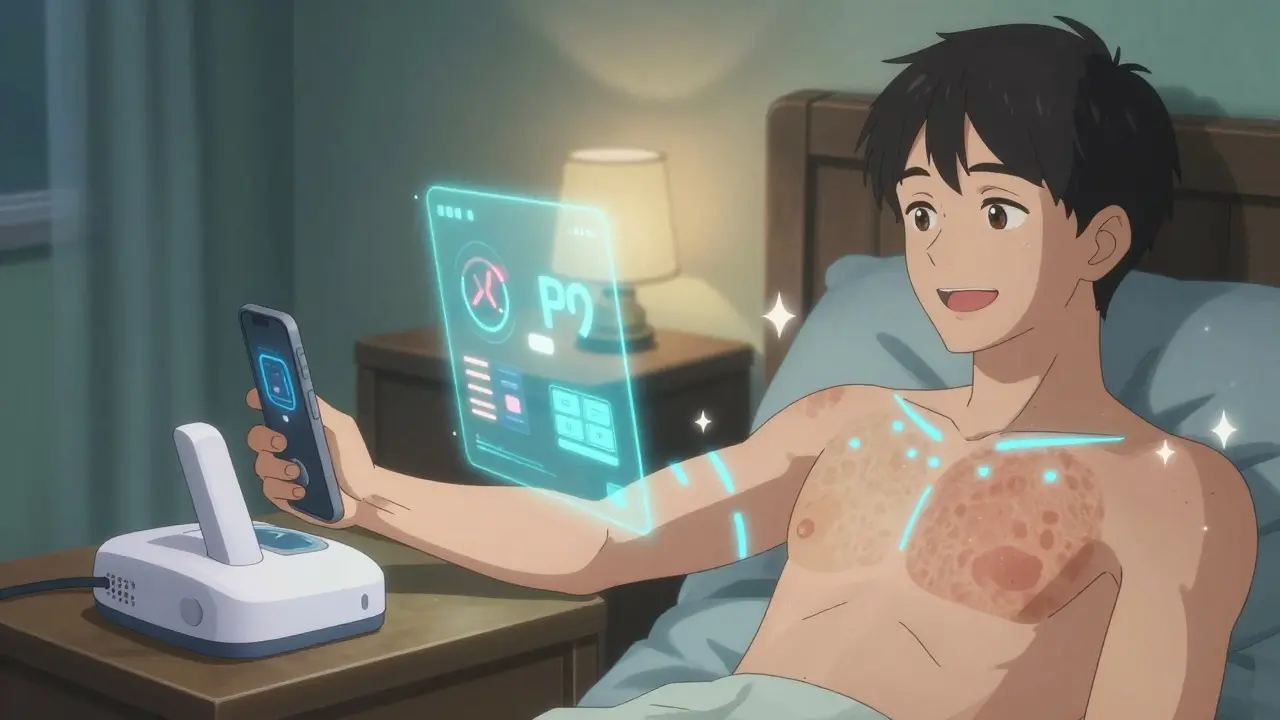
But here’s the catch: 22% more home users got burns. Why? They guessed the dose. They skipped the MED test. They didn’t use eye protection. The solution? New AI devices like Vitilux AI (cleared by the FDA in October 2023). It uses your smartphone camera to scan your skin, then calculates the exact dose. Error rates dropped by 37%. Compliance jumped.
Patients using smartphone apps to track sessions had 92% adherence. That’s not magic. That’s structure.
What Really Works - And What Doesn’t
Let’s cut through the noise:
- Works: NB-UVB 2-3 times a week for 6+ months. Add tacrolimus or ruxolitinib cream. Use home unit with AI dosing. Protect your eyes. Be patient.
- Doesn’t work: Trying to combine phototherapy with depigmentation. Using PUVA unless absolutely necessary. Quitting after 3 months. Skipping sessions. Not tracking progress.
And don’t believe the hype about “miracle cures.” No cream, no supplement, no laser you buy online will fix vitiligo. Real progress takes time, consistency, and medical guidance.
Cost, Insurance, and Accessibility
Phototherapy is surprisingly affordable. A full year of clinic-based NB-UVB costs $1,200-$2,500. Topical ruxolitinib? Over $5,000 a year. That’s why phototherapy is still the backbone of treatment.
Insurance is tricky. Some plans cover 100%. Others cap sessions. In 2022, 43% of insured patients in the U.S. paid over $1,000 out of pocket. Home units are expensive upfront, but they pay for themselves in travel time and missed work.
Medicare now covers 80% of home phototherapy costs. Private insurers are catching up. If you’re eligible, ask your dermatologist about the paperwork. It’s worth it.
What’s Next? The Future of Vitiligo Treatment
The field is moving fast. In 2024, the VITCURE-2 trial starts - testing NB-UVB with afamelanotide implants to speed up repigmentation. Researchers are also looking at genetic markers to predict who responds best to light therapy. Imagine a blood test that tells you if NB-UVB will work for you.
And new devices? They’re getting smarter. AI-powered dosing. Wearable UV monitors. Apps that sync with your calendar. The goal isn’t just treatment - it’s sustainability.
For now, the best approach is simple: get diagnosed early. Start NB-UVB. Add a topical cream. Stick with it. Track your progress. Don’t quit before six months. And if your hands don’t improve? That’s normal. Focus on the areas that respond. Your face, your chest, your arms - those can change. And that’s enough.
Can phototherapy and depigmentation be used together for vitiligo?
No, they are not used together. Phototherapy aims to restore skin color by stimulating melanocytes, while depigmentation removes remaining pigment from unaffected skin. These are opposite goals. Depigmentation is only considered when over 80% of the body is already depigmented, and the goal is to create an even skin tone. Using both at once would be contradictory and medically inappropriate.
How long does it take to see results from NB-UVB phototherapy?
Most people start seeing repigmentation after 3-4 months, but meaningful results typically take 6-12 months. A 2017 JAMA Dermatology study found that 37% of patients achieved at least 50% repigmentation by 6 months, and 56% did so by 12 months. Treatment should continue for at least 6 months before judging effectiveness, as earlier results are often misleading.
Is home phototherapy as effective as clinic-based treatment?
Yes, studies show home phototherapy is just as effective as clinic-based NB-UVB. A 2020 study found 78% of home users achieved over 50% repigmentation after 6 months, compared to 82% in clinics. Home devices improve adherence by eliminating travel, though users must follow dosing instructions carefully to avoid burns. AI-assisted devices now reduce user error by 37%.
Why doesn’t phototherapy work well on hands and feet?
Hands and feet have fewer hair follicles, which is where melanocytes hide and regrow from. The skin is also thicker and receives less UV penetration. Studies show only 15-20% repigmentation even after 12 months of treatment. This is why many patients become discouraged - not because the treatment failed, but because the anatomy of these areas naturally resists repigmentation.
What’s the safest phototherapy option for children?
Narrowband UVB (NB-UVB) is the safest and most commonly used phototherapy for children. Unlike PUVA, it doesn’t require photosensitizing drugs and has no proven link to skin cancer in long-term studies. Mayo Clinic data shows 85% of children with vitiligo receive NB-UVB as first-line treatment. It’s also safe during pregnancy, making it ideal for teens and young adults.






trudale hampton March 22, 2026
I started NB-UVB six months ago and honestly? My face is back to normal. Hands? Still white as hell. But I stopped stressing about it. The cream helps. The light helps. Just don’t quit before six months. You’ll thank yourself later.
Desiree LaPointe March 22, 2026
Oh sweet mercy. Another person who thinks phototherapy is some magical cure. Let me guess-you skipped the MED test, used a $300 Amazon device, and now your chest looks like a lobster. Congrats. You’re the poster child for why home units need AI. Or a goddamn lifeguard.
Thomas Jensen March 23, 2026
They’re hiding something. Why is PUVA still in use if it raises cancer risk 13x? Who profits? Pharma. The FDA? Complicit. And don’t even get me started on how monobenzone is banned in the EU but sold here like candy. Wake up, sheeple.
Natali Shevchenko March 24, 2026
I think what’s beautiful about vitiligo treatment isn’t the science-it’s the quiet rebellion. Choosing to repigment is a statement: I refuse to disappear. Choosing depigmentation is another: I refuse to be ashamed. Both are acts of self-reclamation. We reduce it to protocols and percentages, but it’s really about identity. The skin doesn’t define you, but the choice to reclaim it? That does.
Johny Prayogi March 24, 2026
Just got my Vitilux AI device today 😍🔥 My first session went perfect. No burns. No guesswork. Just science. If you’re doing home phototherapy and not using AI, you’re basically playing Russian roulette with your skin. Do better.
matthew runcie March 25, 2026
I’ve been on NB-UVB for 11 months. My arms are 70% back. My knees? Still ghost white. But I’m not mad. I just focus on the good. And I wear sunscreen like it’s my job. You don’t need perfection. You just need consistency.
Allison Priole March 26, 2026
I used to think the hands thing was just me being unlucky. Then I read that study about hair follicles. That’s it? That’s the whole reason? It’s not about the treatment failing-it’s just anatomy being a jerk. I feel less broken now. Also, ruxolitinib + light? Game changer. My face went from ‘creamy white’ to ‘oh hey, that’s my skin again’ in 12 weeks.
Chris Dwyer March 27, 2026
You’re not alone. I started this journey thinking I’d be ‘cured’ by now. But here’s the truth: it’s not about being fixed. It’s about learning to live with it on your terms. The light, the cream, the app tracking-I do it for me. Not to impress anyone. Just to feel like me again. Keep going. You’re doing better than you think.
Casey Tenney March 29, 2026
Depigmentation isn’t giving up. It’s choosing peace over chaos. If your whole body is white, why torture yourself trying to paint back patches that won’t stick? I did it. My skin is even. I don’t hide. I don’t apologize. And I’m finally free.
Jackie Tucker March 29, 2026
I’m sorry, but calling NB-UVB the ‘gold standard’ feels like calling a flip phone the pinnacle of mobile tech. We’re talking about a treatment that requires you to show up three times a week for a year. Meanwhile, afamelanotide implants are in phase 3 trials. The future is here. Why are we still clinging to 1990s light boxes like they’re holy relics?
Solomon Kindie March 29, 2026
Ive been on the cream and light combo for 5 months and my neck is almost back to normal but my wrists are still ghostly and i keep wondering if its worth it because the clinic is so far and my job is crazy and i just want to be done with this but then i look in the mirror and i see my face and its like i got my color back and i think maybe i can do this for one more month
Sandy Wells March 31, 2026
Phototherapy combined with topical agents is not a breakthrough. It’s basic pharmacology. Combining an immunomodulator with a stimulus to enhance cellular response is textbook. The real story here is how long it took for dermatology to catch up to what every other medical field figured out decades ago.