
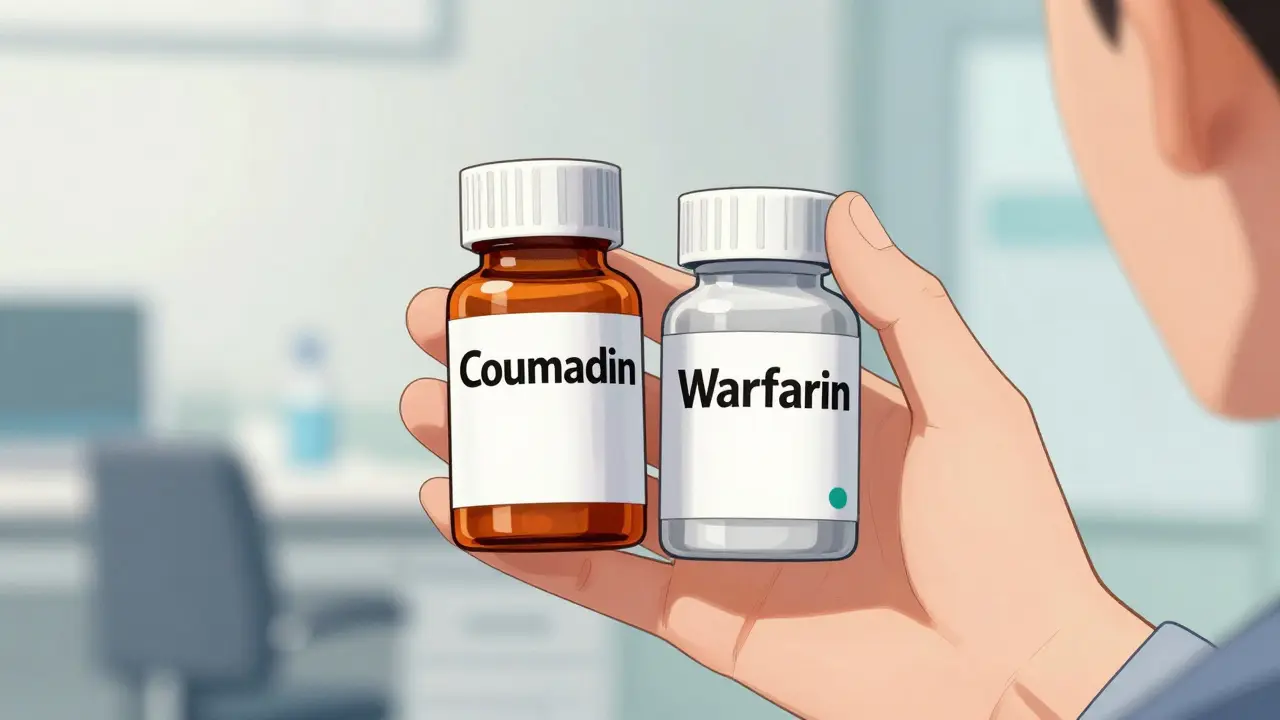
Switching from a brand-name medication to a generic version usually feels like a simple way to save money. But when you're dealing with a Warfarin is a vitamin K antagonist anticoagulant used to prevent blood clots and thromboembolic events, the stakes are much higher. Because this drug has a narrow therapeutic index, even a tiny change in how your body absorbs it can lead to dangerous results-either your blood becomes too thick (increasing clot risk) or too thin (increasing bleeding risk).
If you or a loved one are moving from brand-name Coumadin to a generic version, you aren't alone. Over 90% of prescriptions for this medication are now generics. While they are designed to be therapeutically equivalent, the transition requires a specific strategy to keep your INR monitoring on track and your health safe.
The Risk of the Narrow Therapeutic Index
Most medications have a wide "safety window," meaning you can take a bit more or less without a major change in effect. Warfarin doesn't work that way. It is what doctors call a narrow therapeutic index (NTI) drug. This means the difference between a dose that prevents a stroke and a dose that causes a stomach bleed is very small.
To manage this, doctors use the International Normalized Ratio (or INR), a standardized measurement of how long it takes for your blood to clot. For most people, the goal is an INR between 2.0 and 3.0. However, if you have a mechanical heart valve in the mitral position, your target might be higher, between 2.5 and 3.5. If your INR jumps to 4.0 or 5.0, you're at high risk for hemorrhage; if it drops below 2.0, you're at risk for a clot.
Does Generic Warfarin Actually Work the Same?
The short answer is yes, but with a caveat. The FDA requires generic drugs to show 80-125% equivalence in terms of how much drug reaches the bloodstream (AUC) and the peak concentration (Cmax). For most drugs, this is plenty. For Warfarin, some experts argue that this window is still too wide.
Research generally supports the safety of generics. A study of 182 patients switching from Coumadin to a generic version found no significant difference in INR control or the rate of bleeding and clotting events. A larger systematic review of 40,000 patients also showed that the mean difference in INR after switching was tiny-between -0.05 and 0.12 units. So, for the vast majority of people, the switch is seamless.
| Feature | Generic Warfarin | DOACs (e.g., Apixaban) |
|---|---|---|
| Monthly Cost | $4 - $10 | $300 - $500 |
| Monitoring Needs | Frequent INR tests (12-18/year) | Periodic renal checks (1-2/year) |
| Reversibility | Highly reversible (Vitamin K) | Complex/Expensive reversal agents |
| Dietary Restrictions | High (Vitamin K intake matters) | Minimal to none |

How to Handle the Switch: A Monitoring Protocol
You shouldn't just swap your pills and wait for your next scheduled check-up in a month. Because individual responses vary, the first few weeks after a switch are the "danger zone." To navigate this safely, follow a structured monitoring approach.
In the first one to two weeks after switching brands, you should expect more frequent blood tests. While stable patients usually only check their INR every four to six weeks, a transition requires a tighter leash. Some clinics recommend testing every other day or even daily until your INR stays within the target range for two consecutive days. This ensures that if the generic version hits your system slightly differently, your doctor can adjust the dose immediately rather than waiting weeks and risking a complication.
If your INR starts swinging wildly, don't panic, but do investigate. It's rarely just the brand of the pill. Check for these common culprits:
- Dietary Shifts: Did you suddenly start eating more spinach or kale? A change of 100-150 mcg of Vitamin K daily can throw your levels off.
- New Medications: Warfarin interacts with over 300 different drugs. Even some over-the-counter meds can change your INR by 20-50% within 72 hours.
- Consistency: Are you taking the pill at the exact same time every day? Even small shifts in timing can cause fluctuations.

Who Should Avoid Switching?
While most people (about 80%) transition to generics without any issues, a small group might struggle. If you have a history of "labile INR"-meaning your levels are always bouncing around regardless of what you do-switching brands might add unnecessary instability. In these cases, staying on one specific manufacturer's version is safer than saving a few dollars.
It's also worth noting that if you have a mechanical heart valve or severe renal impairment, Warfarin is often the only safe choice. In these high-stakes scenarios, the priority is absolute stability. If you are perfectly stable on Coumadin, talk to your doctor about whether the cost savings of a generic are worth the risk of a temporary INR spike.
The Long-Term Outlook: Warfarin in a DOAC World
You've probably heard about Direct Oral Anticoagulants (or DOACs), a newer class of blood thinners that don't require constant blood monitoring. They've taken over a huge chunk of the market because they're easier to manage. However, Warfarin isn't going anywhere.
Because it's so cheap and so effectively reversible in emergencies, it remains the gold standard for specific medical needs. We're also seeing new research into pharmacogenetics. By looking at your CYP2C9 and VKORC1 genes, doctors might soon be able to predict exactly how you'll react to a generic switch, potentially reducing the number of blood tests you need during the transition.
Is generic warfarin as safe as brand-name Coumadin?
Yes. Multiple clinical studies and FDA bioequivalence standards indicate that generic warfarin is therapeutically equivalent to Coumadin. Most patients experience no difference in clinical outcomes, though a small percentage may require dose adjustments during the initial switch.
Why do I need more blood tests when I switch generics?
Because warfarin has a narrow therapeutic index, small variations in how different manufacturers formulate the drug can lead to different absorption rates in some patients. Frequent INR testing in the first 1-2 weeks ensures your dose remains safe and effective during the transition.
What is a normal INR range for someone on warfarin?
For most conditions, like atrial fibrillation or venous thromboembolism, the target range is 2.0 to 3.0. For those with mechanical heart valves in the mitral position, the target is usually 2.5 to 3.5, and certain high-risk aortic valves may require 3.0 to 4.0.
Can my diet affect my INR after switching to a generic?
Absolutely. Vitamin K (found in leafy greens) works directly against warfarin. Whether you are on a brand or generic version, a significant increase or decrease in your daily Vitamin K intake can cause your INR to fluctuate, requiring a dose adjustment.
What should I do if my INR is unstable after the switch?
Contact your healthcare provider immediately. They will likely investigate potential causes, such as new medications, dietary changes, or adherence issues. If no cause is found, they may implement a weekly dose adjustment (typically 5-10%) to bring your levels back into the therapeutic range.




Tama Weinman April 18, 2026
Funny how the 'FDA' says generics are fine. I bet they aren't telling us about the actual fillers they use in the generic versions to save a buck while we're the ones taking the risk with our blood clotting. Just follow the money and you'll see why they push these switches
Agatha Deo April 18, 2026
Oh, how quaint that people still trust the 80-125% equivalence window as if it's some divine law of science.
It's absolutely adorable that anyone believes a pharmaceutical company's 'bioequivalence' data when the real-world application for an NTI drug is practically a gamble. But please, keep believing the brochure while your INR swings like a pendulum because some corporate suit decided a 20% variance was 'close enough' for the peasants
Cheryl C April 19, 2026
USA made is the way to go!! 🇺🇸 don't trust those cheap imorts from overseas’ if u can help it 💊💪
Nell O'Leary April 19, 2026
The pharmacogenetic approach to CYP2C9 and VKORC1 polymorphism is definitely the future of precision dosing :) It would drastically reduce the trial-and-error phase during a brand-to-generic transition by identifying slow metabolizers early on
Rob Schlautman April 21, 2026
honestly who even has the time to go to the clinic every other day for a blood draw it sounds like an absolute nightmare for anyone with a real job and the way the medical system is set up now you just know the waiting rooms are going to be packed with people who were told to switch to generics just to save the insurance company a few pennies while the patient suffers the anxiety of a potential bleed
Randall Barker April 22, 2026
The real issue here isn't the pill but the lack of personal discipline in the modern patient. If you cannot manage a simple diet of leafy greens and show up for a blood test, you simply lack the moral fortitude to handle a lifelong medication. We treat health as a convenience rather than a duty to one's own existence and that is why the system is failing
Jon lee April 24, 2026
It's totally normal to feel anxious about this switch. Just remember to stay in close contact with your care team and don't hesitate to reach out if you notice any unusual bruising or bleeding during those first two weeks