
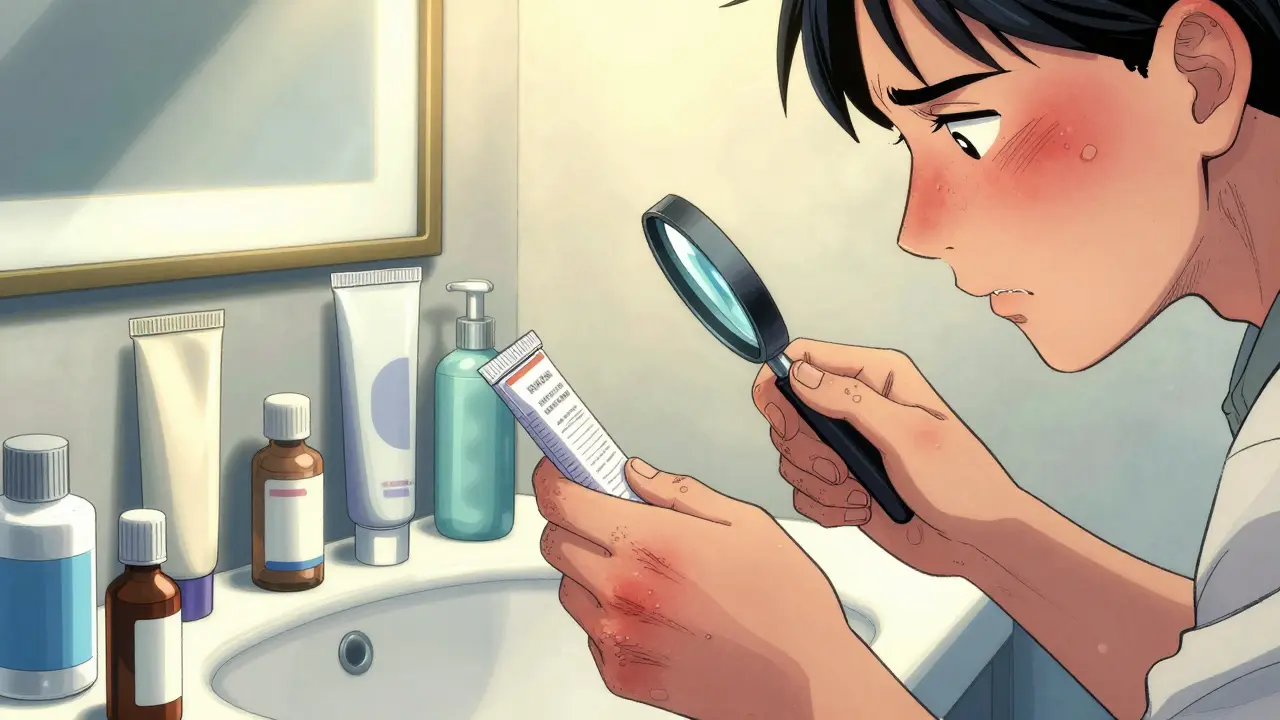
Did you know? 23% of people with chronic hand eczema actually have undiagnosed reactions to topical medicines. Most doctors test for common allergens first-often missing medication triggers hiding in your daily creams and ointments.
Understanding Skin Reactions to Medicated Products
When your skin rashes after applying medicated creams, it's usually one of two things happening. Contact dermatitis is either a simple irritation (like soap drying out your hands) or a true immune response to chemicals. Allergic contact dermatitis works differently than typical hives-it's a delayed reaction where redness and itching appear days after exposure. This explains why switching to a new antibiotic cream can flare up old eczema spots unexpectedly.
| Characteristic | Irritant Type | Allergic Type |
|---|---|---|
| Onset | Within hours | 48+ hours later |
| Common Triggers | Frequent washing, harsh solvents | Neomycin, benzocaine |
| Symptom Pattern | Burning sensation | Intense itch with blisters |
Culprit Medications You Might Overlook
Your bedside moisturizer could contain hidden allergens. Prescription topicals rank higher as offenders than most people realize:
- Antibiotics: Neomycin shows up in 9.9% of positive patch tests-check triple-antibiotic ointments carefully
- Steroid Creams: Yes, even anti-inflammatory steroids cause allergies (affecting 0.5-2.2% users)
- Numbing Agents: Benzocaine in sunburn gels triggers reactions in 2.1% of patients
- Pain Relief Gels: Ketoprofen-based formulas account for 1.8% of positive results
A Reddit discussion from May 2023 revealed shocking insights: 68% of people who blamed worsening eczema on weather conditions actually reacted to their prescribed corticosteroid ointment.
Proven Diagnostic Approaches
Regular allergy shots won't catch these reactions-you need specialized testing. Patch testing involves sticking tiny doses of potential allergens onto your back for 48 hours. Medical teams then examine those spots again at 48 and 96 hours to spot delayed responses.
"Complete resolution occurs in 89% of cases when we identify and remove the trigger" - Dr. Sarah Chen, Cleveland Clinic Dermatologist
Recent breakthroughs matter here:
- New dilution methods reduce false negatives by 23% in sensitive patients
- Digital tracking apps now link 3,500+ products with known allergens
- Cross-reactivity charts guide safe alternatives for steroid-sensitive patients

Treatment Pathways That Actually Work
If patch testing confirms a medication allergy, three-step healing begins:
- Stop Exposure: Discontinue ALL products containing identified allergens (even OTC remedies!)
- Immediate Relief: Apply gentle emollients instead of scratch-damaged skin
- Targeted Therapy: Rotate between non-triggering options based on body location
| Condition | Mild Cases | Severe Flare-ups |
|---|---|---|
| First Choice | Oatmeal baths + calamine lotion | Oral prednisone taper |
| Second Line | Low-potency steroid (desonide) | Topical tacrolimus (0.1%) |
| Special Areas | Eyelids: Hydrocortisone 0.5% | Face: Pimecrolimus cream |
Note the critical nuance: Using high-strength steroids on thin skin areas (face/genitals) risks permanent damage. One study found 35% developed skin thinning after just 14 days of improper application.
Preventing Future Outbreaks
Smart label reading saves years of misery. Here's what to watch for:
- Fragrance compounds: Even "unscented" labels may hide masking agents
- Preservatives: Methylisothiazolinone appears in 43% of aqueous formulations
- Cross-reactions: Group D steroids work if allergic to group A types
- Hidden sources: Occupational exposures affect 18% of healthcare workers
The American Contact Dermatitis Society app helps scan product barcodes against 3,500 flagged ingredients-but don't skip manual checks on prescription vials.

What Doctors Often Miss
Four warning signs indicating possible medication allergy:
- Recurrent rashes appearing exactly where you apply topical treatments
- Symptoms worsen despite regular medication use
- Similar reactions across different "brands" of same drug class
- Unexplained eczema flares during stress-free periods
Dr. Anton de Groot emphasizes: "Avoidance beats prolonged treatment every time." With proper identification, 89% achieve complete recovery within one month versus just 32% continuing original medications.
Future Prevention Tools
2023 developments show exciting progress:
- Molecular Screening: New blood tests predict risk before first exposure (NIH-funded trial underway)
- Barrier Enhancers: Microbiome-friendly creams reduce allergen penetration by 73%
- Registry System: National database tracks emerging reaction patterns across regions
Three new barrier creams entering Phase III trials promise earlier intervention strategies-stay tuned for FDA approvals expected mid-2026.
How soon do medication allergies show up?
Symptoms typically appear 24-96 hours after initial contact. Repeat exposures can trigger reactions faster-sometimes within 12 hours.
Can I switch to another steroid safely?
Yes, through cross-reactivity mapping. If allergic to hydrocortisone (Group A), methylprednisolone aceponate (Group D) usually works without issues.
Why did my doctor miss this before?
Up to 60% get misdiagnosed initially because clinicians assume topical treatments can't cause problems. Always request patch testing for recurring rashes.
Are home remedies effective?
For mild cases, cold compresses and colloidal oatmeal help temporarily. But persistent symptoms always need professional evaluation.
Can children develop these allergies?
Yes, pediatric cases involve different considerations. Fragrance and preservative reactions occur more often in younger patients.






Rocky Pabillore April 1, 2026
Most people walk around like zombies applying poison to their dermis without understanding the basic pharmacology involved. It is astounding how little consideration is given to the molecular composition of daily ointments. The public remains blissfully unaware of potential allergens hidden in plain sight. Ignorance regarding contact dermatitis causes unnecessary pain for countless individuals.
Owen Barnes April 3, 2026
Its really important to check labels carefully before using any new cream. Ther are so many hidden ingredients that can cause problems later on. Please take the time to read the fine print ther might be preservatives you react too. Safety should always be the priority with skincare products.
Callie Bartley April 4, 2026
I literally screamed when my dermatologist said the hydrocortisone was making me bleed internally! It was a nightmare situation that took weeks to resolve properly. The betrayal of trust in prescribed medications is absolutely devastating for anyone experiencing flare-ups. Never trusting a tube again after what happened during my treatment phase.
James DeZego April 4, 2026
Glad someone shared this info :) Neomycin is definitely a silent killer for sensitive skin types :) Patch testing saves lives every day for sure!
Jenny Gardner April 6, 2026
The statistics regarding neomycin exposure are absolutely frightening!!! Everyone needs to stop using those generic tubes immediately!!!! The data speaks loudly about cross reactivity risks!!!! We must demand better labeling standards now!!!
Cara Duncan April 7, 2026
You're being harsh 😊 But yes, reading labels is key 📝 We should all support each other ❤️ Knowledge is power in managing skin health conditions 🌿
Molly O'Donnell April 9, 2026
Group A steroids cross-react with Group D types so your premise lacks nuance entirely.
Christopher Beeson April 10, 2026
Society treats our bodies like disposal bins until the immune system finally revolts against the chemical assault. Modern medicine prioritizes symptom suppression over holistic biological integrity. We ignore the warning signs of cellular resistance until damage becomes irreversible.
Sharon Munger April 12, 2026
yeah i felt the same way with my eczema flares. keep calm and moisturize.
Eleanor Black April 12, 2026
It is truly disheartening to witness how many individuals suffer in silence due to misdiagnoses. When considering the sheer volume of ingredients present in modern formulations, the risk factor skyrockets. Many patients assume safety based on brand reputation rather than actual content analysis. This negligence leads to chronic inflammation that could easily be managed with proper avoidance protocols. We must consider the systemic impact of these delayed reactions on overall quality of life. The emotional toll of recurring rashes cannot be overstated in clinical settings. Families often struggle to understand why simple applications cause such intense distress. Education remains the primary defense against these pervasive hidden allergens. Healthcare providers need to prioritize patch testing over standard empiricism. Only through rigorous diagnostic methods can we hope to see long term healing. Ignoring the nuances of cross reactivity charts invites further suffering for vulnerable populations. We owe it to ourselves to demand better transparency from pharmaceutical manufacturers. The future of dermatology relies on recognizing these subtle warning signs early on. Prevention strategies must become commonplace knowledge in every household. Let us strive for a safer environment for all skin types everywhere. Continuous vigilance ensures longevity in treatment outcomes.
Arun Kumar April 12, 2026
Let's focus on solutions rather than fear! We can manage this together with the right tools. Stay positive and informed about your body signals.
Julian Soro April 14, 2026
Great breakdown of the symptoms here. Definitely sharing with my family doctor.
Cullen Zelenka April 14, 2026
Maybe that means we are paying closer attention now though. Progress comes from awareness.
Russel Sarong April 15, 2026
The timing of onset!! The delayed response mechanism!!! It defies immediate intuition!!!
Rod Farren April 16, 2026
Specifically regarding protein haptenization mechanisms, the molecular weight dictates epidermal penetration rates significantly.