

Ever looked at your prescription bottle and wondered why there are two different dates on the label? One says "Exp: 05/2025" and another says "Refill By: 11/2025". You might think they mean the same thing - but they don’t. Mixing them up could mean throwing away perfectly good medicine… or taking something that’s no longer safe. This isn’t just confusing - it’s dangerous. And you’re not alone. Over half of people who take prescription meds can’t tell the difference between these two dates.
What the Expiration Date Actually Means
The expiration date on your prescription is a science-backed deadline. It’s not just a suggestion. It’s the last day the drug manufacturer guarantees the medication will work as intended and remain safe to use. This date comes from rigorous testing done by the drugmaker under controlled heat, light, and humidity conditions. The FDA requires this testing under ICH Q1A(R2) guidelines. If you take the medicine after this date, you can’t be sure it’ll still lower your blood pressure, fight infection, or control your diabetes the way it should.Here’s the twist: studies show that 88% of medications still work fine months or even years after their expiration date - if stored properly in a cool, dry place. But here’s the catch: pharmacists are legally required to follow the label. Even if your pills are still potent, the pharmacy can’t refill or dispense them past the expiration date. That’s why your bottle says "Do not use after [date]." It’s not about waste - it’s about legal safety.
What the Refill-By Date Is Really For
The refill-by date has nothing to do with how strong your medicine is. It’s an administrative rule. Think of it like a gift card with an expiration. Your doctor gave you permission to refill your prescription a certain number of times - but only for a limited time. Once that window closes, you need a new prescription.For most medications, the refill-by date is one year from when you first filled the prescription. But there are exceptions. If you’re on a controlled substance - like opioids, ADHD meds, or certain sleep aids - federal law limits refills to six months. Some states go even further. In New York, certain drugs can’t be refilled after six months. In California, it’s 12 months. Your insurance plan might also have its own rules, which can add another layer of confusion.
Here’s the real problem: patients often think the refill-by date means the medicine is bad. So they toss out pills that are still good. One Reddit user reported throwing away $300 worth of unexpired insulin because they confused the refill date with the expiration date. That’s not just expensive - it’s risky. People with chronic conditions like diabetes, heart disease, or asthma can’t afford gaps in treatment.
Why the Confusion Is So Common
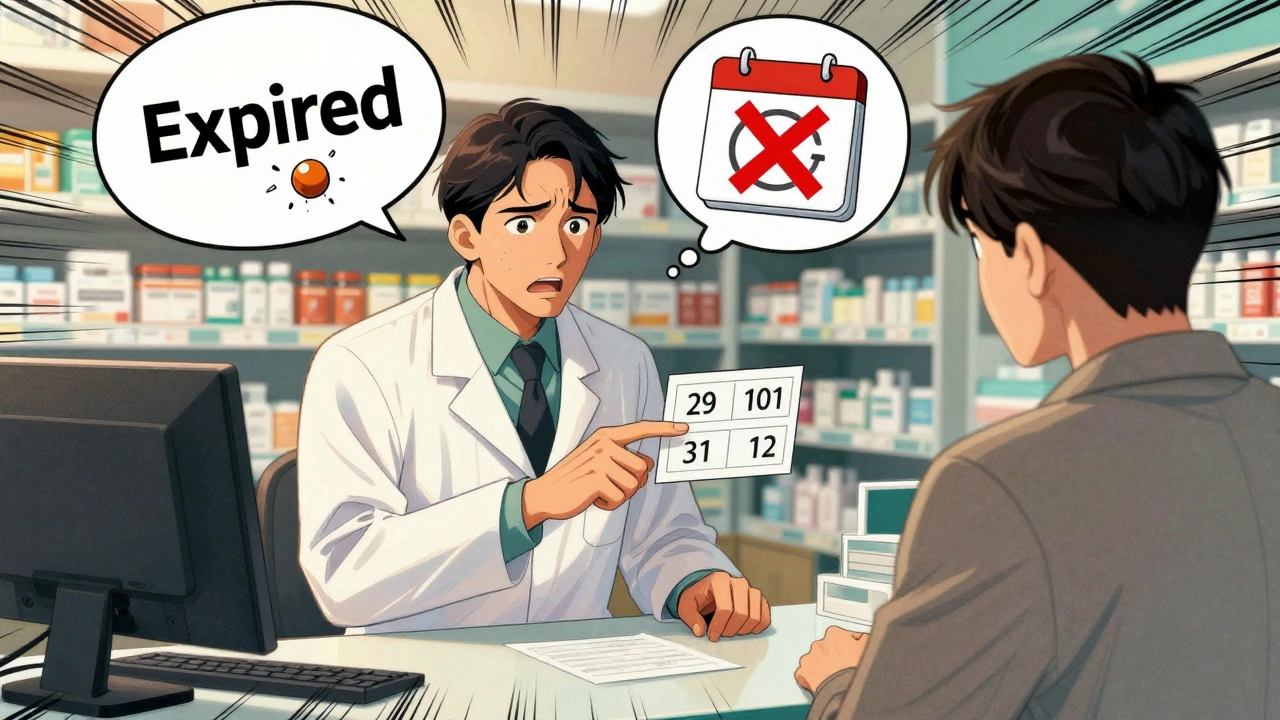
Pharmacies don’t make it easy. The two dates are printed side by side, often in similar fonts. Many labels use vague terms like "Discard by" or "Use by" instead of clearly labeling them as "Expiration" and "Refill By." A 2023 Consumer Reports survey found that 54% of people couldn’t tell the difference between the two. Even worse, 29% admitted to throwing away medicine they thought had expired - but hadn’t.Pharmacists say this is the #1 question they get: "Can I still refill this?" It’s not about whether the pills work - it’s about whether the prescription is still active. And if you miss the refill-by date, you’re not out of luck. You just need to call your doctor. But that takes time. Geisinger Health System found it takes an average of 3.2 business days to get a new prescription approved. That’s three days without your meds.
What Happens When You Get It Wrong
Getting these dates mixed up has real consequences. If you use medicine past its expiration date, you risk it not working. A study from the FDA found that 37% of medication errors in pharmacies are tied to people taking expired drugs. That’s not just a small risk - it’s a major safety issue.On the other hand, if you stop taking your medicine because you think the refill-by date means it’s expired, you’re putting your health at risk. Medicare data shows that 24% of patients on long-term medications have treatment interruptions because they didn’t refill in time. For someone with high blood pressure or epilepsy, even a few days without medication can lead to hospitalization.
One patient on Healthgrades wrote: "Knowing the difference between my refill date and expiration date has kept me from gaps in my hypertension treatment for five years." That’s the kind of clarity that saves lives.
How to Read Your Prescription Label Like a Pro
Here’s how to decode your label in under 10 seconds:- Find the "Exp" or "Expiration Date" - this is your safety cutoff. Never use medicine past this date.
- Find the "Refill By" or "Refill Expires" - this tells you when you need to call your doctor for a new script. It’s usually one year from your first fill.
- Check the refill count - it’s usually listed as "Refills: 3" or "Refills Remaining: 1." If it says "0," you’re out of refills - even if the refill-by date hasn’t passed.
- Look for color cues - CVS and Walgreens now use red for expiration dates (safety) and blue for refill dates (admin). If your label doesn’t have colors, assume the later date is refill-by.
Pro tip: Write both dates in your phone calendar. Set a reminder for 7 days before your refill-by date. That gives you time to call your doctor without running out.
What’s Changing - and What’s Coming
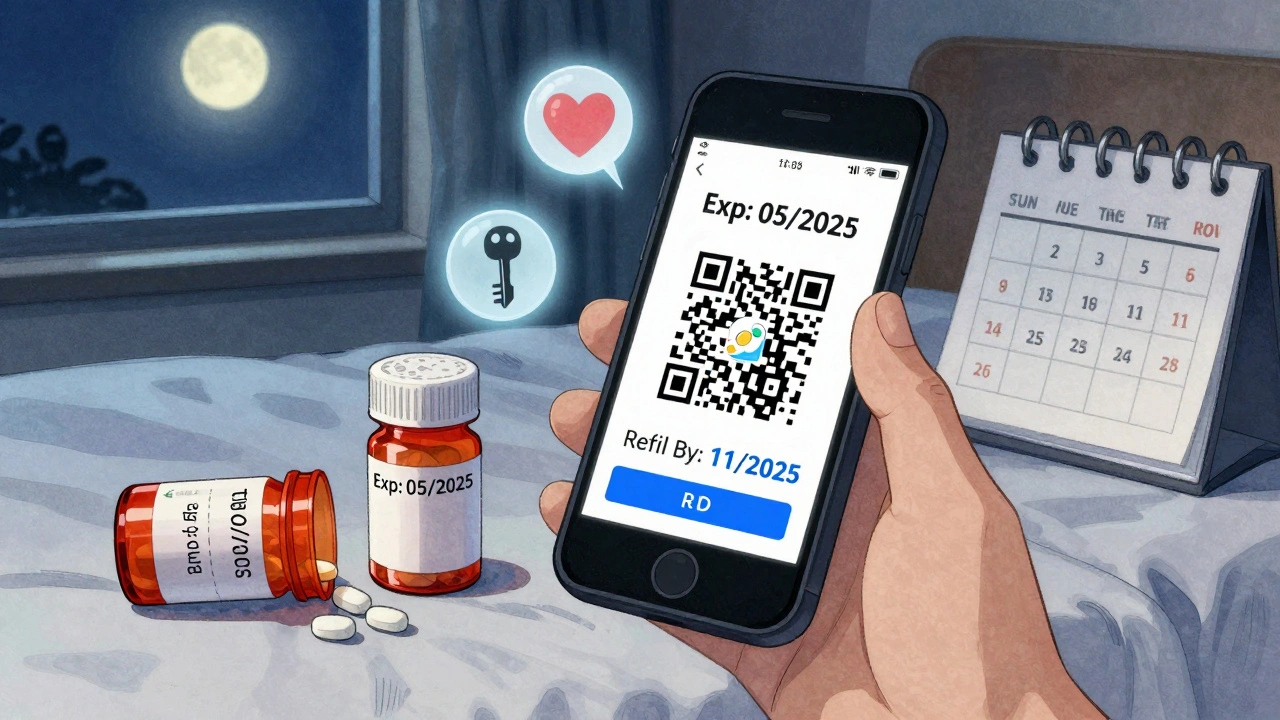
The system is slowly getting better. In 2023, CVS started putting QR codes on labels. Scan it, and a short video explains the difference between the two dates. They’ve seen a 48% drop in patient confusion. The FDA is pushing for standardized labeling language - no more "Discard by," just clear "Expiration" and "Refill By" labels. By 2025, most prescriptions will have digital labels you can scan on your phone to see explanations, storage tips, and even dosage reminders.But until then, you need to be your own advocate. Don’t assume. Don’t guess. If you’re unsure, call your pharmacy. Ask: "Is this date for when the medicine stops working, or when I need a new prescription?"
Bottom Line: Two Dates. Two Rules.
- Expiration Date = Safety. Don’t use after this. Ever. Even if the bottle still has pills. - Refill-By Date = Permission. You can’t refill after this - but your medicine is still good. Just call your doctor.Knowing the difference isn’t just helpful - it’s essential. It saves money, prevents dangerous gaps in care, and keeps you safe. And it only takes a few seconds to check your label the right way.





Erin Nemo December 2, 2025
Wow, I had no idea refill-by wasn't the same as expiration. I've tossed out so much stuff over the years. Thanks for finally making this clear.
Rachel Stanton December 4, 2025
As a pharmacist's assistant, I see this daily. Patients think 'discard by' means the meds are toxic. It's not just confusion-it's a public health blind spot. The FDA's 88% potency stat post-expiration is legit, but we're bound by liability. The real villain? Poor labeling design. No color coding, no icons, just tiny text. It's a systemic failure disguised as compliance.
Edward Hyde December 5, 2025
Oh great, another article telling me to read the fine print while my insurance won't cover a $12 doctor visit just to renew a script I've been on for 8 years. The system is rigged. They want you to panic, call your doc, waste time, and then pay more. Meanwhile, your insulin sits in the fridge like a time bomb labeled 'use by 11/2025'-even though it's perfectly fine. Who wrote this? A pharmacy lobbyist with a thesaurus?
Kenny Leow December 6, 2025
Interesting perspective. In Japan, we have a similar issue with over-the-counter meds-expiration dates are treated as absolute, even though studies show stability beyond them. But here, the refill-by date is more of a bureaucratic tool than a safety one. Still, I'm glad to see efforts like QR codes being adopted. A little tech goes a long way in reducing fear-based waste.
Scotia Corley December 8, 2025
It is regrettably evident that the American pharmaceutical regulatory apparatus has failed to implement standardized, intelligible labeling protocols. The conflation of administrative deadlines with pharmacological integrity constitutes a negligent abdication of duty. Patients are being deliberately misled by ambiguous nomenclature. This is not an oversight-it is institutional incompetence.
Kelly Essenpreis December 8, 2025
why do we even have refill by dates if the medicine is still good? its just another way to make people go back to the doctor and spend more money. the system is broken and everyone knows it
Margaret Stearns December 10, 2025
i always thought the refill date was when it went bad. i just threw out my blood pressure pills last month because the date passed. now im scared i might need them again. maybe i should call my doc?
amit kuamr December 11, 2025
in india we dont have refill by dates. doctor gives script for 6 months. you refill when you run out. no confusion. maybe america needs less bureaucracy and more common sense.
Debbie Naquin December 12, 2025
The expiration date is a metaphysical boundary-constructed by corporate liability, reinforced by regulatory inertia, and internalized as divine law by the public. Yet chemically, the molecule persists. The refill-by date is the administrative ghost in the machine: a temporal constraint imposed not by nature, but by protocol. We treat time as a substance. We are mistaken.
Alexander Williams December 13, 2025
Let’s be real-the ‘refill by’ date exists because insurers want to force periodic re-evaluations. It’s not about safety. It’s about cost control. Pharma and insurers profit when you’re constantly re-prescribed. The ‘expiration’ date? That’s the only one that matters. Everything else is a distraction engineered to keep you dependent on the system.
Suzanne Mollaneda Padin December 14, 2025
My mom has type 2 diabetes and used to panic every time her refill date passed. I sat down with her and explained the difference. Now she sets phone alerts 10 days before refill-by and checks the expiration date first. She’s been stable for two years. Small changes save lives. If you’re unsure, ask your pharmacist-they’re usually happy to explain.
Amber-Lynn Quinata December 14, 2025
People need to stop being lazy. If you can’t read a label, you shouldn’t be taking prescription meds. This isn’t rocket science. It’s basic literacy. And if you’re too busy to call your doctor for a refill, maybe you shouldn’t be on chronic meds at all. Your health is your responsibility. 😒
Lauryn Smith December 15, 2025
This is such an important topic. I wish every pharmacy had a small card next to the pickup counter explaining this. I’ve seen people cry because they thought their insulin was expired. You’re not alone if you’re confused. Just ask. Seriously. No judgment. We all need help sometimes. ❤️
Bonnie Youn December 15, 2025
STOP THROWING AWAY MEDS JUST BECAUSE THE REFILL DATE PASSED. I’VE BEEN ON THE SAME BP MED FOR 7 YEARS. THE EXPIRATION DATE IS 2027. I REFILL WHEN I NEED TO. YOUR DOCTOR ISN’T A GOD. BE YOUR OWN ADVOCATE. 🚀
Rachel Stanton December 16, 2025
Just saw someone in the pharmacy ask if they could still take their antibiotic because the refill-by date was next month. I had to gently explain that expiration was 3 months ago. They looked horrified. This isn’t just about confusion-it’s about fear, lack of education, and systemic silence. We need mandatory labeling education in high school health classes. Not just for meds, but for all health literacy.