

Every year, over 1.3 million adverse drug events are reported to the FDA through MedWatch. But experts estimate that only 1% to 10% of actual reactions are ever reported. That means thousands of harmful side effects go unnoticed - until it’s too late. If you’ve experienced an unexpected reaction to a medication, whether you’re a patient, caregiver, or healthcare provider, reporting it isn’t just helpful - it could save a life.
What Is MedWatch and Why Does It Matter?
MedWatch is the U.S. Food and Drug Administration’s official system for tracking safety problems with prescription drugs, over-the-counter medicines, medical devices, and other regulated products. It started in 1993 to give doctors, pharmacists, and everyday people a simple way to report side effects that didn’t show up in clinical trials. The data collected helps the FDA spot dangerous patterns, update warning labels, or even pull dangerous drugs off the market.For example, in 2022, MedWatch reports led to a new black box warning on SGLT2 inhibitor diabetes drugs after 1,247 cases of a rare but deadly infection called Fournier’s gangrene were linked to them. Without these reports, that risk might have gone unnoticed for years.
MedWatch doesn’t just track prescription pills. It covers OTC meds, supplements, medical devices like insulin pumps, and even some cosmetics. But it doesn’t handle vaccines - those go to VAERS. Animal drug issues? Those go to the Center for Veterinary Medicine. If you’re unsure, report it anyway. The FDA will redirect it.
Who Should Report and How?
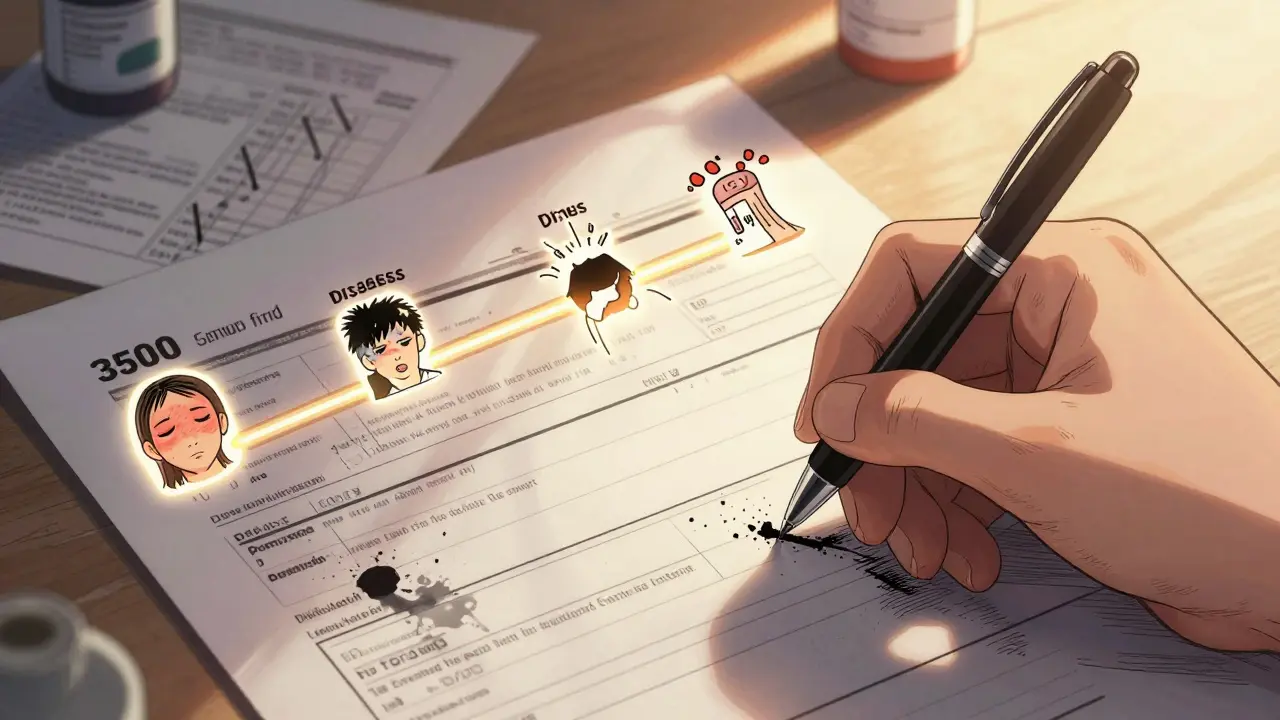
Anyone can report an adverse event to MedWatch - patients, family members, nurses, doctors, pharmacists, and even hospital staff. But the process changes depending on who you are.Healthcare professionals use FDA Form 3500. It’s a five-page form with 45 fields. You’ll need details like the patient’s age, sex, weight, medical history, exact drug name and dose, when the reaction happened, symptoms, lab results, and whether stopping the drug helped. Most providers submit this online or through their electronic health record (EHR) system. Hospitals like Massachusetts General and the Indian Health Service use EHR templates that auto-fill the form when a clinician logs an “adverse reaction” note.
Patients and caregivers use FDA Form 3500B. It’s shorter - just three pages with 30 fields. You don’t need medical training to fill it out. The form asks for the same basic info: what drug you took, what happened, when, and how you felt. You can use your initials instead of your full name. No Social Security number is required.
Manufacturers, importers, and hospitals are legally required to report serious events within 10 days using FDA Form 3500A. This version demands more technical details like lot numbers, device model IDs, and manufacturing info. They also must report any death or hospitalization linked to their product.
How to Submit a Report Online
The easiest way to report is through the FDA’s secure online portal at FDA.gov/MedWatch. Here’s how:- Go to FDA.gov/MedWatch and click “Voluntary Reporting.”
- Choose Form 3500 (for professionals) or Form 3500B (for consumers).
- Fill in the required fields: suspected drug name, description of the event, patient age and sex, and your contact info (you can remain anonymous if you prefer).
- Include the timeline: When did you start the drug? When did symptoms begin? Did they improve after stopping?
- Describe symptoms clearly. Instead of “felt weird,” write “severe dizziness and blurred vision within 2 hours of taking the pill.”
- Click “Submit.” You’ll get an email confirmation within 21 days.
You don’t need to prove the drug caused the reaction. The FDA just needs to know it happened. Even if you’re not sure, report it. If multiple people report the same issue, patterns emerge.
What If You Don’t Want to Use the Website?
Not everyone is comfortable online. That’s okay. You have other options:- Call 1-800-FDA-1088 - The FDA’s toll-free line answers 95% of calls within 30 seconds. A representative will take your report over the phone and mail you a form to sign.
- Download and mail the form - Get Form 3500 or 3500B from the FDA website, print it, fill it out, and mail it to: MedWatch, FDA, 5600 Fishers Lane, Rockville, MD 20852.
- Ask your provider - If you’re a patient, ask your doctor or pharmacist to file the report for you. Many EHR systems let them do it with one click.
Don’t wait for the perfect form. If you’re worried, report now. You can always send more details later.
What Makes a Good Report?
Not all reports are created equal. The FDA gets thousands of vague submissions like “I felt sick after taking this.” Those are hard to act on. Here’s what makes a report useful:- Specific drug name - Use the brand and generic name. “I took Advil” isn’t enough. Say “Ibuprofen 200mg, Advil brand, taken at 8 AM.”
- Clear timeline - “Started drug on Jan 3. First symptom (rash) appeared Jan 5. Rash worsened by Jan 7. Stopped drug on Jan 8. Rash faded by Jan 12.”
- Details on symptoms - “Nausea” is okay. “Vomiting 5 times a day, unable to keep fluids down for 48 hours” is better.
- Relevant medical history - “I have kidney disease and take lisinopril.”
- Lab or test results - If you had blood work or imaging, include key numbers: “ALT 180 U/L (normal: 7-55).”
Don’t worry about being perfect. The FDA’s AI assistant pilot program now auto-fills 40% of fields from clinical notes. Even a rough report helps.
Common Problems and How to Fix Them
People often avoid reporting because they think:- “It’s not serious enough.” - Wrong. Even mild reactions matter if others have them too. The FDA tracks trends, not just emergencies.
- “I don’t know if it was the drug.” - You don’t have to prove causation. Just report the event.
- “It’ll take too long.” - Online forms take 15-20 minutes. With EHR integration, some providers report in under 8 minutes.
- “I can’t attach my medical records.” - True, you can’t upload files. But you can summarize key results in the free-text box.
One of the biggest complaints? The form asks for too much medical jargon. The FDA is fixing that. In 2023, they updated Form 3500B to include clearer language and new fields for cannabis-related reactions, which have jumped 327% since 2020.

What Happens After You Report?
Once submitted, your report goes into the FDA Adverse Event Reporting System (FAERS), which receives about 2 million reports yearly. Over 95% are electronic now. The FDA uses standardized medical terminology (MedDRA v26.1) to group similar events. If 10 or more people report the same rare side effect, analysts flag it for review.Most reports lead to no immediate action. But if enough similar reports pile up, the FDA may:
- Add a warning to the drug label
- Require a Risk Evaluation and Mitigation Strategy (REMS)
- Issue a safety alert to doctors and pharmacies
- Require new clinical studies
- Remove the drug from the market
You’ll get a confirmation email in 21 days. That’s it - no follow-up, no phone call. That doesn’t mean your report didn’t matter. It means the system is working quietly behind the scenes.
Why Reporting Still Falls Short
Despite its power, MedWatch struggles with underreporting. A 2022 AMA survey found 78% of doctors say they don’t report because it’s too time-consuming. Only 28% of consumers even know the system exists. The Government Accountability Office estimates 90-99% of adverse events go unreported.That’s why the FDA is pushing changes. By January 2025, all healthcare facilities will be required to report electronically under the 21st Century Cures Act. A new “MedWatch Everywhere” campaign is putting QR codes on prescription bags at 30 major pharmacy chains so patients can report with one scan. A mobile app pilot in 15 teaching hospitals cut reporting time by 65%.
But progress depends on you. Every report adds to the puzzle. A single report might seem small. But when thousands of patients report the same reaction, it becomes impossible to ignore.
Next Steps: What You Can Do Today
If you’ve had a bad reaction to a drug:- Write down what happened - drug name, date, symptoms, timeline.
- Go to FDA.gov/MedWatch and click “Voluntary Reporting.”
- Fill out Form 3500B if you’re a patient, or Form 3500 if you’re a provider.
- Submit it. No waiting. No excuses.
If you’re a healthcare professional:
- Check if your EHR has a MedWatch integration (Epic, Cerner, RPMS).
- Use it. It saves you time and ensures accuracy.
- Encourage patients to report too. Many don’t know they can.
MedWatch isn’t perfect. But it’s the best tool we have to make drugs safer. And it only works if people use it.
Can I report an adverse event if I’m not sure the drug caused it?
Yes. You don’t need to prove the drug caused the reaction. The FDA collects all suspected adverse events, even if the connection isn’t clear. Many safety signals are discovered because multiple people report the same unusual symptom after taking the same medication.
Do I need to give my real name when reporting?
No. You can report anonymously. The form asks for your contact information so the FDA can follow up if they need more details, but it’s optional. You can use initials or a pseudonym instead of your full name. Your personal information is protected under federal privacy rules.
Can I report side effects from over-the-counter (OTC) drugs?
Yes. MedWatch accepts reports for all FDA-regulated products, including OTC medicines like pain relievers, allergy pills, and antacids. In fact, 5% of all MedWatch reports involve OTC drugs. Don’t assume they’re safe just because they don’t require a prescription.
How long does it take for the FDA to act on a report?
There’s no set timeline. Most reports are reviewed within weeks, but action can take months or years. The FDA looks for patterns - one report won’t trigger a change. But if 50 people report the same rare side effect, analysts will investigate. Your report adds to the data pile that leads to safety updates.
Can I report a reaction to a supplement or herbal product?
Yes. The FDA regulates dietary supplements as food products, and adverse events from them can be reported through MedWatch. This includes products like turmeric, CBD oils, weight-loss teas, and energy boosters. Since supplements aren’t tested like drugs, your report may be one of the few clues the FDA has about potential dangers.
What if I made a mistake after submitting my report?
You can submit a new report with updated information. Include your original report number if you have it, and note that this is an update. The FDA combines related reports into a single case file. Don’t wait - better to report late than not at all.
Is there a mobile app for reporting?
Yes - the MedWatch Express mobile app is currently being piloted in 15 major teaching hospitals. It lets providers report in under 5 minutes by syncing with EHRs. A public-facing version is expected in 2025. Until then, the online portal works on phones and tablets. Just visit FDA.gov/MedWatch on your mobile browser.
Can I report a reaction to a vaccine?
No. Vaccine reactions must be reported to VAERS (Vaccine Adverse Event Reporting System), not MedWatch. Go to vaers.hhs.gov to file a report. The FDA separates vaccine data because they’re given to healthy people and require different monitoring standards.





Gregory Parschauer January 15, 2026
Let me be crystal clear - if you're not reporting every single weird symptom after taking a pill, you're complicit in the pharmaceutical industry's cover-up. I reported my mild headache after taking ibuprofen and got a form letter back. That's not accountability, that's negligence. The FDA's system is a joke - 99% of reports get buried in a digital landfill while people die from preventable reactions. You think your ‘mild dizziness’ doesn’t matter? Try telling that to the guy who lost his liver because no one spoke up until it was too late. This isn't a suggestion. It's a moral obligation. If you're not reporting, you're part of the problem.
Damario Brown January 15, 2026
ok so i tried to report my rash from that new blood pressure med but the form kept crashing. i think its because i used chrome. also i dont know what meddra v26.1 is but i think its a typo? i just typed ‘my skin turned red and itched’ and hit submit. no confirmation email. maybe the system is broken? or am i just too dumb to use it? lol
sam abas January 15, 2026
Look, I get the enthusiasm, but let’s not romanticize MedWatch. The system is a data swamp. Over 90% of reports are noise - people reporting ‘felt tired’ or ‘my dog barked after I took Tylenol.’ The FDA’s AI tries to filter, but it’s like trying to find a needle in a landfill. And don’t get me started on the 3500B form - it still asks for ‘patient’s occupation’ and ‘preferred pronouns’ like this is a census survey. Real signal detection requires structured, high-fidelity data, not emotional anecdotes from people who don’t know the difference between an ALT and a CT scan. The real fix? Mandatory EHR integration with auto-flagging of clinically significant events. Everything else is performative activism.
Clay .Haeber January 17, 2026
Oh wow. A 12-page guide on how to ‘save lives’ by filling out a form. How noble. Meanwhile, the same FDA that’s asking you to report your ‘slight nausea’ just approved a new opioid with a 1 in 500 chance of sudden cardiac death. You think your little report is going to change that? Please. The system isn’t broken - it’s designed to make you feel like you’re doing something while the real power brokers laugh all the way to the bank. Next time, instead of filling out Form 3500B, just send your prescription bottle to the CEO’s mailbox. That’s the only language they understand.
Priyanka Kumari January 17, 2026
I just want to say thank you for writing this. As a nurse in Delhi, I’ve seen too many patients suffer because they didn’t know they could report side effects. I’ve helped over 40 patients submit reports - even those who couldn’t read used my phone to fill out 3500B. One woman reported a reaction to her herbal blood pressure tea, and two months later, the FDA issued a warning. That’s real impact. You don’t need to be a doctor to make a difference. Just speak up. Your voice matters. And if you’re unsure, ask someone - a pharmacist, a friend, a community health worker. We’re all in this together.
Avneet Singh January 19, 2026
MedWatch is a bureaucratic mirage. The entire premise assumes that laypeople can accurately attribute causality - which they can’t. You don’t know if it was the drug, the stress, the sleep deprivation, or the gluten you ate three days prior. The FDA’s reliance on spontaneous reporting is archaic. Real pharmacovigilance requires prospective cohort studies, not crowd-sourced anecdotes from Reddit users who think ‘brain fog’ is a clinical diagnosis. And don’t even get me started on the 327% increase in cannabis reports - that’s not a safety signal, that’s a regulatory failure to classify it properly in the first place.
laura Drever January 20, 2026
why bother. no one reads these. i reported my husband’s anaphylaxis to amoxicillin. 6 months later got a form email saying ‘thank you for your input.’ he’s fine now. but the drug’s still on the market. the system is a joke. waste of time.
Rosalee Vanness January 22, 2026
I just want to say - if you’ve ever had a bad reaction and didn’t report it, please don’t beat yourself up. You’re not alone. I waited two years after my weird tingling hands from metformin because I thought ‘it’s probably nothing.’ But then I read about someone else who had the same thing - and it turned out to be a rare nerve reaction. That’s when I submitted my report. It took 17 minutes. I cried while doing it. Not because I was scared - but because I realized I had been silent for too long. You don’t need to be perfect. You just need to be brave enough to speak up. And if you’re reading this right now - go ahead. Hit submit. Your story could be the one that saves someone’s life. I’m rooting for you.
lucy cooke January 22, 2026
MedWatch is the modern-day oracle - a digital Delphi where the voices of the suffering are whispered into the void, hoping the gods of bureaucracy will hear. We are not just reporting side effects - we are offering blood sacrifices to the altar of pharmaceutical capitalism. Each form is a psalm of pain, each symptom a stanza in the epic of human vulnerability. And yet, the system remains indifferent. It does not weep. It does not rage. It merely logs, classifies, and files. In this age of algorithmic apathy, to report is to resist. To submit is to say: ‘I was here. I felt. I am not invisible.’ So go ahead. Fill out the form. Let the machines have your tears. They will never understand them - but perhaps, someday, they will be forced to act.
Trevor Davis January 23, 2026
Hey, just wanted to say I reported my son’s reaction to his ADHD med last week. Took me 20 minutes on my phone while waiting at the pediatrician’s office. Didn’t even use my real name - just ‘Dad of Eli, Ohio.’ Got the confirmation email yesterday. Honestly? Felt good. Not because I think it’ll change the world - but because I didn’t stay quiet. If you’re reading this and thinking ‘it’s too much work,’ just do it for the person who might read your report in 5 years and say, ‘Thank God someone told them.’ That’s all it takes.