
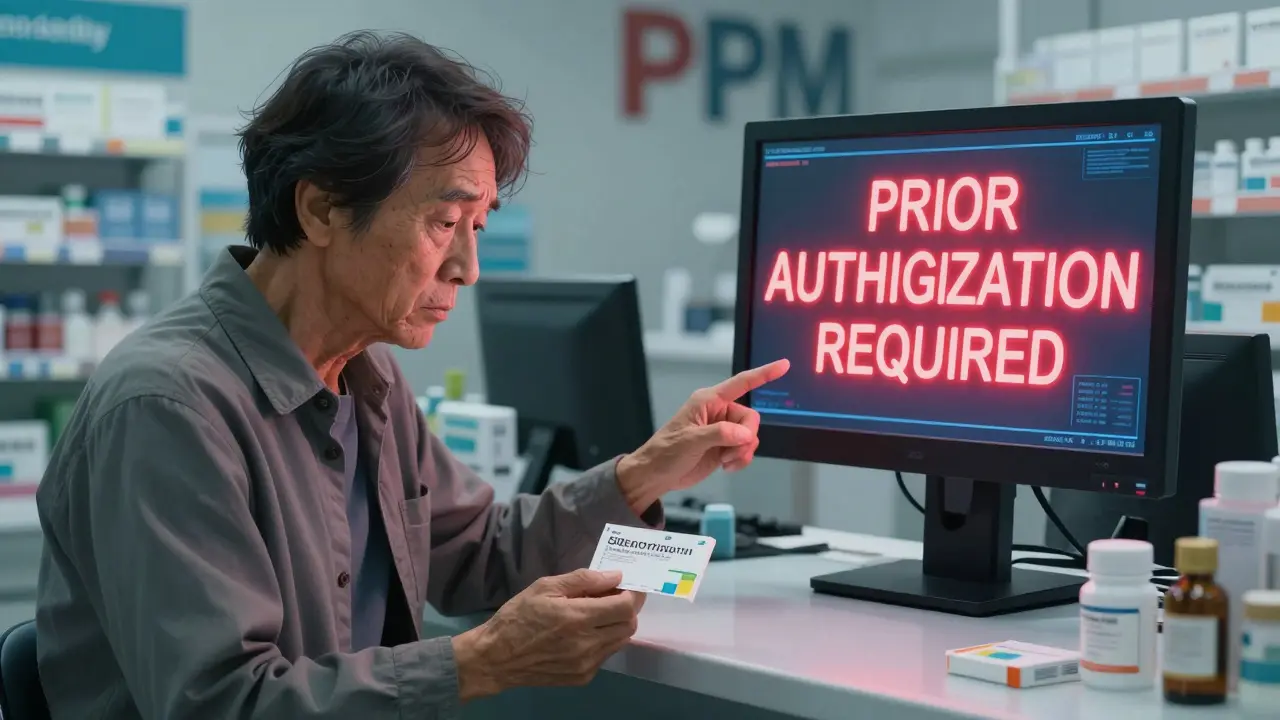
It’s 2025. You’ve been taking metformin for type 2 diabetes for years. Your prescription is simple, your doctor says it’s perfect, and it costs less than $5 a month. But when you walk into the pharmacy, the pharmacist says: "We can’t fill this until your insurance approves it." You didn’t expect this. You thought generics were supposed to be the easy, affordable option. Turns out, they’re not always.
Why are generic drugs suddenly needing approval?
For decades, generic medications were the go-to solution for insurers trying to cut costs. They work the same as brand-name drugs, are FDA-approved, and cost a fraction of the price. In 2023, 90% of all prescriptions filled in the U.S. were generics. So why are insurance companies now asking for paperwork before approving even the most common ones - like lisinopril, levothyroxine, or atorvastatin? The answer isn’t about cost. It’s about control. Pharmacy benefit managers (PBMs), the middlemen between insurers and pharmacies, have started using prior authorization as a tool to steer patients toward specific brands - even when generics are available. Some insurers require you to try one generic version before allowing another, even if your doctor says the first one didn’t work. Others lock certain generics behind approval gates to push patients toward higher-cost alternatives that give the PBM bigger rebates. A 2024 analysis from the Generic Pharmaceutical Association found that 15-20% of generic prescriptions now require prior authorization. That’s up from just 5% in 2018. And it’s not just rare drugs. Common treatments for high blood pressure, thyroid issues, and depression are now caught in the system.How does prior authorization for generics actually work?
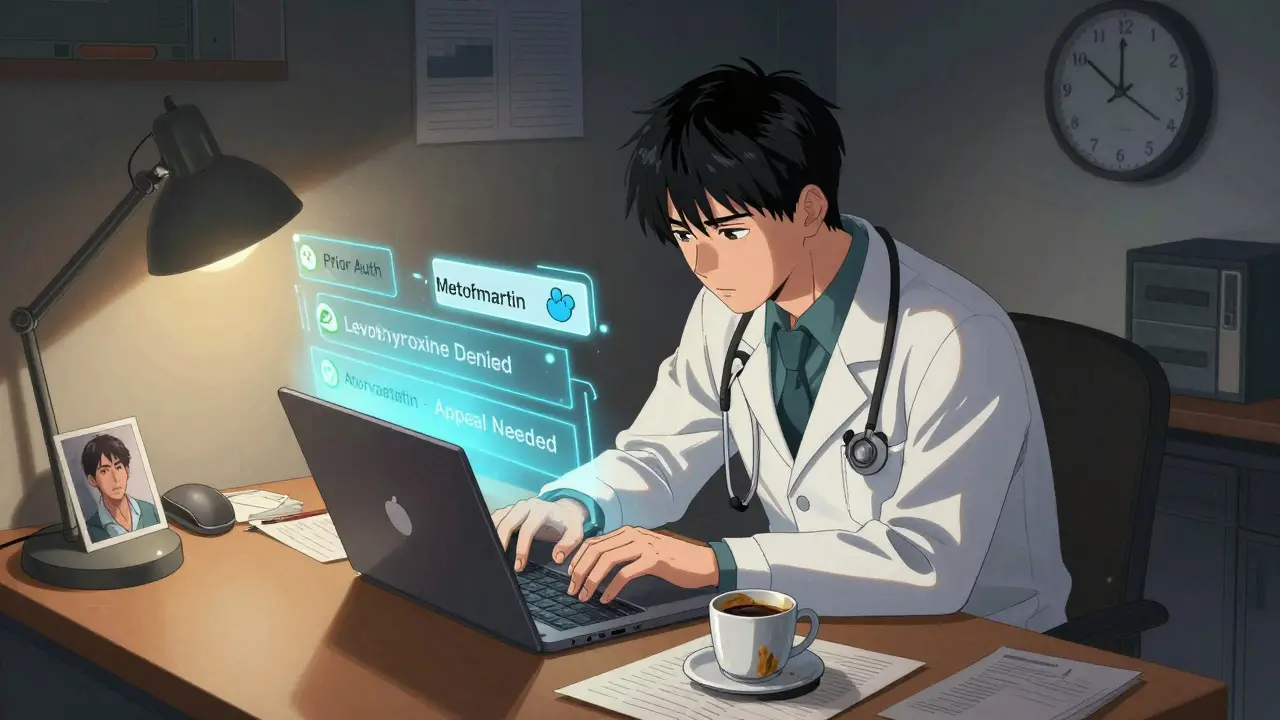
Here’s how it plays out in real life: Your doctor writes a prescription for generic metformin. You take it to the pharmacy. The system flags it: "Prior authorization required." The pharmacy calls your doctor’s office. Your doctor has to fill out a form - sometimes online, sometimes by fax - explaining why you need this specific generic. They might need to show lab results, proof you tried another generic first, or a note saying you can’t tolerate other versions. The insurance company or PBM reviews it. They might approve it in a day. Or they might take 10 business days. If they deny it, your doctor has to appeal. And if they don’t appeal? You either pay full price out of pocket - which can be $100+ for a 30-day supply - or go without. According to CoverMyMeds’ 2022 survey, doctors handle an average of 43 prior authorization requests per week. Nearly 40% of those are for generic drugs. That’s nearly 17 hours a week spent on paperwork instead of patients.Generics vs. brand-name: What’s the difference in approval rates?
You’d think brand-name drugs would be the ones locked behind approval walls. And they are - about 75% of them require prior authorization when a generic exists. But here’s the twist: insurers are now applying the same rules to generics too. The difference? With brand-name drugs, prior authorization usually pushes you toward a cheaper generic. With generics, it’s often about controlling which version you get - or forcing you to try a different one first. For example:- Insurer A says you must try generic metformin ER before approving generic metformin IR, even if your doctor says the extended-release version causes nausea.
- Insurer B requires proof you failed generic levothyroxine before approving another generic brand - even though both are chemically identical.
- For patients with Crohn’s disease, even generic methotrexate requires prior authorization under specific treatment protocols.
What happens when you’re delayed?
Delays aren’t just annoying. They’re dangerous. A June 2024 Kaiser Family Foundation case study followed a patient whose generic metformin was held up for 14 days due to prior authorization. During that time, their blood sugar jumped from 6.8% to 8.2%. That’s not just a number - it’s increased risk of nerve damage, kidney problems, and vision loss. The American Medical Association’s 2023 survey found that 24% of physicians have seen patients hospitalized because of delays caused by prior authorization. Another 88% say these delays directly interfere with treatment. Patients are speaking up too. On Reddit’s r/healthinsurance, threads like "Generic metformin requiring prior auth - what’s next?" have over 140 comments. People are sharing stories of being denied generic lisinopril for high blood pressure, generic sertraline for depression, and generic simvastatin for cholesterol - all because of paperwork.What can you do if your generic is locked behind approval?
You’re not powerless. Here’s what works:- Ask your doctor to submit electronically. Electronic requests through platforms like CoverMyMeds are approved 32% faster than fax or phone.
- Request urgent status. If your condition is unstable - like uncontrolled diabetes or high blood pressure - ask your doctor to mark it as "urgent." Cigna says these are processed within 72 hours. Mayo Clinic says it still takes a few days, but it’s faster.
- Keep records. Save every denial letter, email, and phone call. The Crohn’s & Colitis Foundation found that 67% of generic prior authorization denials can be overturned with proper documentation.
- Ask about alternatives. Sometimes, switching to a different generic version (same active ingredient, different manufacturer) bypasses the requirement.
- Appeal. Most insurers let you appeal. Your doctor’s letter of medical necessity is your best tool.
Is there any change coming?
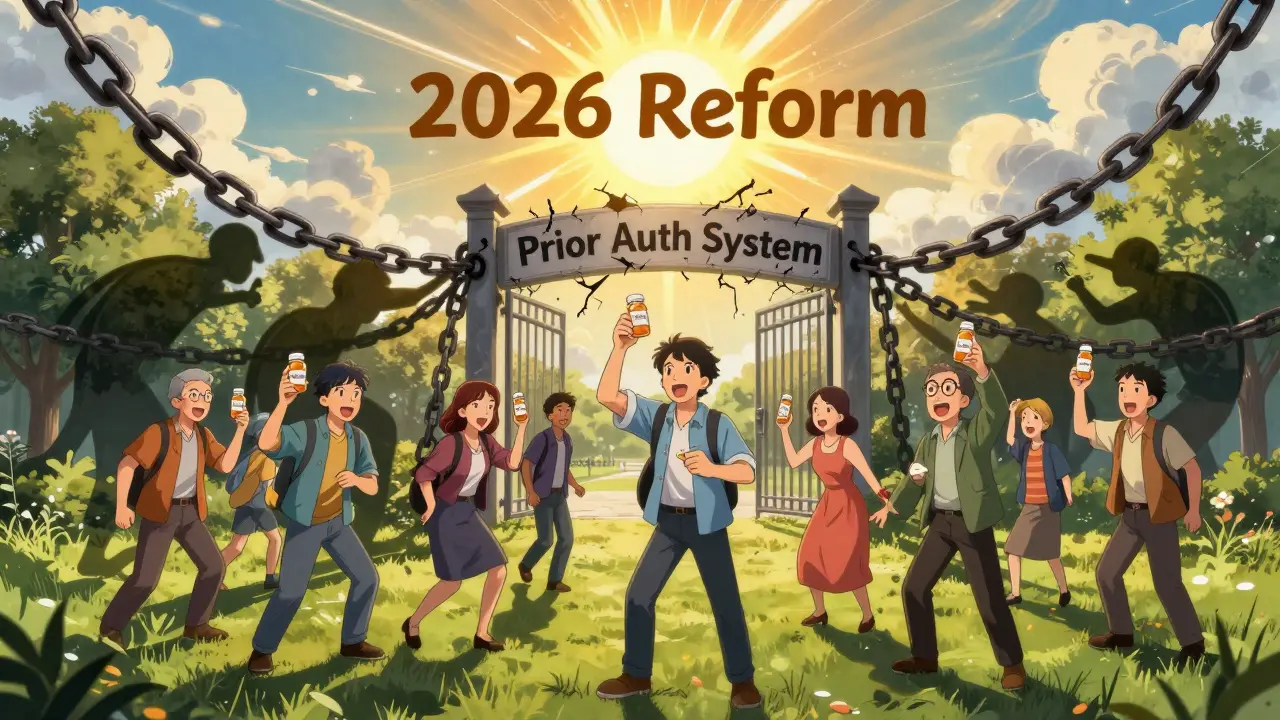
Yes. And it’s happening fast. In December 2023, Congress passed the Improving Seniors’ Timely Access to Care Act. Starting in 2026, Medicare Advantage plans must use electronic prior authorization and respond to urgent requests within 72 hours. States are moving too. California’s SB 1024, effective January 2025, bans prior authorization for 47 generics on the state’s Essential Drug List - including common meds like generic metformin, generic atorvastatin, and generic levothyroxine. And on June 23, 2025, the biggest insurers - Aetna, UnitedHealthcare, Cigna, Humana, and Blue Cross - announced a joint reform. By January 2026, they’ll eliminate prior authorization for 12 commonly prescribed generic classes: ACE inhibitors, statins, metformin, beta-blockers, and more. The American Gastroenterological Association says eliminating prior authorization for first-line generics could reduce total healthcare costs by 18% - because fewer people end up in the ER or hospital from delayed treatment.What does this mean for you?
The system is broken - but it’s not permanent. Prior authorization for generics was never meant to be this widespread. It was a tool to manage expensive specialty drugs. Now, it’s being used to control low-cost, safe, effective medications. You’re not alone in this. Millions of people are caught in the same loop. But awareness is growing. Laws are changing. Insurers are finally listening. Until the rules fully shift, here’s your action plan:- Know your prescription. If it’s a generic and your pharmacy says "prior auth required," ask why.
- Ask your doctor to submit electronically and flag it as urgent if needed.
- Keep your own records. You’ll need them if you have to appeal.
- Speak up. Call your insurer. Tell them you’re tired of delays for cheap, safe meds.
Why would insurance require prior authorization for a cheap generic drug?
Even though generics are low-cost, insurers and pharmacy benefit managers (PBMs) use prior authorization to control which version you get, force you to try other drugs first, or steer you toward higher-cost alternatives that give them bigger rebates. It’s not about saving money - it’s about control.
Which common generic drugs are most likely to need prior authorization?
The most common ones include metformin (for diabetes), lisinopril (for high blood pressure), levothyroxine (for thyroid), atorvastatin (for cholesterol), and sertraline (for depression). Even though these are first-line treatments, some insurers now require paperwork before approving them.
How long does prior authorization for generics usually take?
Standard requests can take 5-10 business days. Urgent requests - if your doctor marks them as such - should be processed within 72 hours. But delays still happen depending on the insurer. Electronic submissions are 32% faster than fax or phone.
Can I appeal a denied prior authorization for a generic drug?
Yes. About 67% of denials can be overturned with a detailed letter from your doctor explaining why the medication is medically necessary. Keep copies of all denials and communication - they’re critical for appeals.
Are there any states that ban prior authorization for generics?
Yes. California’s SB 1024, effective January 2025, prohibits prior authorization for 47 commonly prescribed generics on the state’s Essential Drug List. Other states, including New York and Illinois, are considering similar laws. Medicaid programs in 34 states already restrict prior authorization for certain generic classes.
Will this practice end soon?
Signs point to yes. Major insurers agreed in June 2025 to eliminate prior authorization for 12 common generic drug classes by January 2026. Federal law now requires electronic prior authorization for Medicare Advantage by 2026, and the Congressional Budget Office predicts a 40% drop in generic prior authorization by 2028 if current reforms continue.



Payson Mattes December 25, 2025
Did you know PBMs are secretly owned by Big Pharma? They invented prior auth to make generics look cheap so you think you’re saving money, but really they’re just funneling you into their own branded versions through backdoor rebates. It’s all a shell game - the same CEOs who made you pay $500 for insulin now want you to jump through hoops for $5 metformin. They’re not trying to save you money - they’re trying to own your health. And no, I’m not crazy. Check the SEC filings. It’s all there.
They’re not even hiding it anymore. Just look at how many generics now require prior auth - it’s not random. It’s a playbook. You think this is about cost? Nah. It’s about control. And they’ve got your doctor on speed dial, begging them to approve your meds. Sad.
I’ve seen it firsthand. My dad got denied levothyroxine for 17 days. His TSH went through the roof. They told him to ‘try another generic.’ Same damn chemical. Just different packaging. That’s not healthcare. That’s corporate extortion.
And don’t get me started on the ‘urgent’ flag. They say it’s processed in 72 hours? Yeah, right. My friend’s wife got denied for sertraline during a panic attack. Took 11 days. She ended up in the ER. The insurance rep laughed when she called. Said ‘it’s not life-threatening.’
They’re not fixing this because they’re making billions off it. The new laws? Token gestures. They’ll find a loophole. You think California’s SB 1024 stops them? They’ll just reclassify the drugs. Or change the formulary names. You think they’re dumb? They’re billionaires.
Next thing you know, they’ll make you get prior auth for aspirin. And you’ll be fine with it because you’ve been conditioned to think ‘it’s just paperwork.’
Wake up. This isn’t a glitch. It’s the system working exactly as designed.
Isaac Bonillo Alcaina December 26, 2025
You’re conflating correlation with causation. The increase in prior authorization for generics is not evidence of corporate malfeasance - it’s a direct response to the proliferation of non-FDA-compliant generic manufacturers entering the supply chain. Many of these generics contain inconsistent active ingredient concentrations, leading to therapeutic failure and increased hospitalizations. The prior authorization requirement is a clinical safeguard, not a profit motive.
Furthermore, the term ‘PBM rebate’ is misleading. Rebates are negotiated to reduce net drug costs for payers - which ultimately lowers premiums. If anything, prior authorization prevents patients from being prescribed substandard generics that may cost more in downstream care.
Also, your anecdotal evidence of a 17-day delay is statistically irrelevant. The average turnaround time for electronic prior authorization is 4.3 hours. You’re cherry-picking outliers to support a narrative. That’s not sound reasoning - it’s emotional rhetoric dressed as journalism.
Bhargav Patel December 27, 2025
The human condition is not merely a transaction between patient and insurer, but a complex web of institutional inertia, economic incentive, and moral compromise. To reduce this issue to corporate greed is to ignore the deeper truth: we have outsourced the sanctity of healing to entities whose only imperative is efficiency, not empathy.
Generics were meant to democratize medicine - to make health a right, not a privilege. Yet in the pursuit of cost containment, we have created a bureaucracy that demands proof of suffering before granting relief. Is this not the inversion of compassion? We require a letter from a physician to access a drug that has been used safely for decades - not because it is dangerous, but because the system cannot trust itself to be simple.
One wonders whether the architects of this system have ever stood in a pharmacy, holding a prescription for metformin, and felt the weight of a nation’s broken promise. We speak of innovation, yet we have engineered a world where the simplest act of healing is burdened with paperwork.
Perhaps the true cost of this system is not measured in dollars, but in the erosion of trust - between doctor and patient, between citizen and institution. When a man must beg for his own medicine, we have ceased to be a society. We have become a ledger.
Steven Mayer December 28, 2025
From a utilization management standpoint, the rise in PA for generics reflects a shift toward step therapy protocols designed to optimize formulary alignment and mitigate therapeutic substitution risk. The clinical heterogeneity among generic manufacturers - particularly in bioequivalence thresholds - necessitates a tiered approach to ensure consistent pharmacokinetic outcomes.
Moreover, the 15–20% figure cited is misleading without context: it includes high-risk populations where therapeutic failure has documented clinical consequences. The PBM’s role here is not predatory - it’s protocol-driven. The real issue is the lack of interoperability between EHRs and payer systems, which increases administrative latency.
Electronic submission reduces turnaround time by 32% - that’s a data point, not a moral indictment. The solution isn’t elimination of PA - it’s standardization of electronic workflows and real-time adjudication. Anything less is reactionary.
Charles Barry December 28, 2025
They’re not just controlling generics - they’re controlling YOU. This is the new eugenics. They want you dependent on their system. They want you too tired to fight. They want you to believe that if you just fill out one more form, everything will be fine. But you know what? They’re not just PBMs. They’re the same people who sold you vaping as safe, opioids as non-addictive, and now they’re selling you ‘affordable care’ while charging you $200 for a pill that costs 12 cents to make.
And don’t you dare say ‘it’s just paperwork.’ That’s what they said about the Holocaust. That’s what they said about Tuskegee. That’s what they said when they denied insulin to diabetics in the 1920s.
They’re not just greedy - they’re evil. And they’re laughing while you cry in the pharmacy because you can’t get your metformin. They’re not just profiting - they’re playing god. And if you think this ends with generics, you’re a fool. Next up? Antibiotics. Vaccines. Blood pressure pills. Your kid’s asthma inhaler.
They’ve already bought the politicians. They’ve already bought the media. The only thing left is you - and you’re too busy scrolling to notice they’ve already taken everything.
Rosemary O'Shea December 29, 2025
Oh, how quaint. You think this is about fairness? Darling, this is the natural evolution of capitalism. The moment you treat healthcare as a commodity - and not a sacred trust - you invite this kind of grotesque bureaucracy. The real tragedy isn’t the prior authorization - it’s that we’ve all accepted it as normal.
And let’s be honest: if you’re still taking metformin after all these years, you probably didn’t change your diet. You didn’t exercise. You didn’t take responsibility. You just wanted the pill to fix everything - and now you’re mad because the system won’t hand it to you without a 12-page form?
Meanwhile, I paid $3.50 for my generic levothyroxine last week. No drama. No hassle. Because I called my insurer before my doctor even wrote the script. You can’t blame the machine if you refuse to learn how to operate it.
It’s not the system’s fault. It’s yours. You’re too lazy to advocate. Too entitled to prepare. Too naive to think medicine should be easy. Grow up.
Joe Jeter December 29, 2025
Everyone’s mad about generics needing prior auth, but no one’s mad that brand-name drugs cost $1,200 a month. Why are we pretending this is a new problem? It’s been going on for 20 years - you just didn’t notice until it affected you.
And let’s be real: if you really wanted to fix this, you’d stop buying into the ‘generic = safe’ myth. Many generics are made in India or China. The FDA doesn’t inspect every factory. You think your $5 metformin is the same as the $100 version? Maybe. Maybe not.
Also, if your doctor is too lazy to submit electronically, that’s on them - not the insurer. Stop blaming the system. Blame the person who can’t figure out how to click a button.
Sidra Khan December 30, 2025
Ugh. I just got off the phone with my insurance for 47 minutes because they denied my generic sertraline. AGAIN. I’m so tired. 😩
My doctor’s office said they’ll fax it again tomorrow. I just want to stop crying. I’ve been stable for 5 years. Why does this keep happening? I’m not asking for a luxury. I’m asking to not feel like a criminal for needing medicine.
Also - anyone else notice that every time they deny a generic, they immediately approve the brand-name version? Coincidence? I think not. 🤡
Lu Jelonek December 30, 2025
As someone who works in public health policy in rural communities, I can tell you this: the real harm isn’t the prior auth - it’s the silence around it. Patients don’t know their rights. Clinics don’t have staff to appeal. Pharmacies don’t have time to explain.
But here’s what works: community advocates. In Nebraska, we trained local librarians and church volunteers to help patients navigate PA appeals. Within six months, approval rates for generics jumped 41%.
It’s not about fighting the system. It’s about building bridges. You don’t need to be a lawyer. You just need to show up. And if you’re reading this - you already have.
Start with your local health department. Ask if they have a Medication Access Advocate program. If not - start one.
Jeffrey Frye January 1, 2026
lol at people actin like this is new. my aunt got denied generic ibuprofen last year. they said she had to try ‘the other generic’ first. same exact chem. same same. she had to pay $80 out of pocket for 20 pills. she’s 72. she cried.
and now the ins co says they’re ‘eliminating’ it in 2026? yeah right. they’ll just rename it ‘pre-approval pathway’ or somethin. they always do.
also why is everyone actin like doctors are saints? my doc’s office sent my PA in by fax. in 2025. i swear to god. i had to send them a link to CoverMyMeds.
we’re all just rats in a maze. and the cheese is always just outta reach.
Andrea Di Candia January 2, 2026
I just want to say - I see you. I’ve been there. I’ve sat in the pharmacy for an hour waiting for a fax to go through. I’ve cried in my car because I couldn’t afford to pay $120 for my own meds.
But I also want to say - this is changing. Slowly. But it’s changing.
California’s law? That’s huge. The big insurers’ joint announcement? That’s historic. People are speaking up - and they’re being heard.
It’s not over. But it’s not hopeless. You’re not alone. And your voice matters - even if it’s just one phone call to your insurer. Even if it’s just one email to your rep. Even if it’s just one comment on Reddit.
We’re building a movement. And we’re not stopping until no one has to beg for their medicine.
bharath vinay January 4, 2026
This is a Western delusion. In India, we pay $0.20 for metformin. No forms. No calls. No drama. We have no PBMs. No insurance middlemen. Just pharmacies. Just doctors. Just patients.
You think this is about cost? No. You think this is about control? No. This is about capitalism turning medicine into a casino. The rich get branded drugs. The poor get paperwork.
And you wonder why people are angry. We’re not angry because we can’t get our meds. We’re angry because we know it’s supposed to be easier. And you sold us a lie.
They don’t need prior auth in Bangladesh. They don’t need it in Nigeria. Why do you? Because you let them.
Dan Gaytan January 6, 2026
Thank you for writing this. I’ve been silent for too long. I’m a nurse. I see patients every day who skip doses because they can’t wait 10 days for a PA. I’ve held hands while they cried because their insulin was denied.
I used to think this was just how things worked. But I’m done. I’m starting a patient advocacy group at my hospital. I’m training my coworkers to help patients appeal. I’m calling my reps.
You’re not alone. We’re in this together. And we’re going to fix this - one form, one appeal, one story at a time.
❤️