

HIT Risk Assessment Tool
This tool helps assess your risk of Heparin-Induced Thrombocytopenia (HIT) using the clinically validated 4Ts scoring system. The 4Ts score calculates the probability of HIT based on four key factors. A score of 4 or higher indicates you should be tested for HIT.
HIT Assessment Form
Enter your data above to see your HIT risk score.
Most people think of heparin as a safety net - a blood thinner that keeps clots from forming after surgery, during dialysis, or in the hospital. But for a small number of patients, that safety net turns into a trap. Heparin-induced thrombocytopenia, or HIT, is a rare but life-threatening reaction where the body starts attacking its own platelets, triggering dangerous clots instead of preventing them. It’s not just a lab anomaly. It’s a medical emergency that can lead to amputations, strokes, or death - all from a drug meant to save lives.
What Exactly Is HIT?
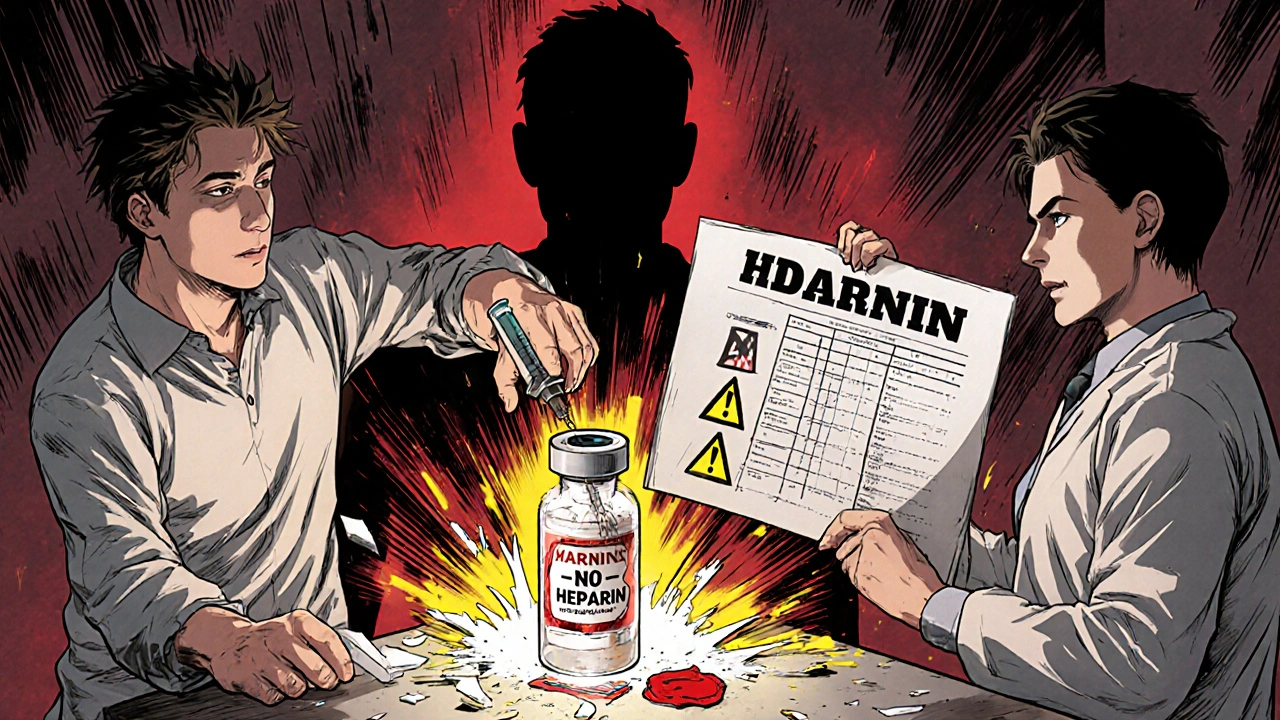
HIT isn’t just a low platelet count. It’s an immune system mistake. When you get heparin, your body sometimes makes antibodies against a protein called platelet factor 4 (PF4) that binds to heparin. These antibodies stick to your platelets, making them clump together and activate. That’s why your platelet count drops - they’re being used up. But here’s the twist: activated platelets also flood your bloodstream with clotting signals. So even though you have fewer platelets, you’re at higher risk for clots. That’s the paradox of HIT.
There are two types. Type I is mild and harmless - platelets dip slightly in the first two days and bounce back on their own. Type II is the dangerous one. That’s the immune-driven form that shows up 5 to 14 days after starting heparin. If you’ve had heparin before in the last 100 days, it can hit even faster - sometimes within 24 hours. That’s because your body already has the antibodies waiting.
Who’s Most at Risk?
Not everyone gets HIT. But some people are far more likely to. Women are 1.5 to 2 times more likely than men. People over 40 face two to three times the risk of younger patients. The biggest red flag? Orthopedic surgery. After a hip or knee replacement, up to 10% of patients develop HIT. That’s ten times higher than in medical patients. Cardiac surgery patients aren’t far behind, with 3-5% risk.
The type of heparin matters too. Unfractionated heparin - the older, stronger version - carries a 3-5% risk. Low molecular weight heparin (LMWH), like enoxaparin, is safer but still risky - about 1-2%. Even small doses, like the flushes used in IV lines or catheters, can trigger it. About 15-20% of HIT cases come from these hidden sources. That’s why doctors now check platelets even if the patient is only getting a heparin flush.
How Do You Know If You Have It?
There’s no single symptom. But there are patterns. The classic sign is a sudden drop in platelets - usually 30-50% below your baseline. That’s why hospitals check platelet counts every 2-3 days between days 4 and 14 of heparin therapy. If your count falls below 150,000 or drops sharply, that’s a red flag.
But the real danger comes with clots. About half of HIT patients develop thrombosis - and that’s when it becomes HITT, or HIT with thrombosis. Deep vein thrombosis (DVT) happens in 25-30% of cases. You might feel swelling, warmth, or sharp pain in your leg. Pulmonary embolism (PE) shows up in 15-20%. That means sudden shortness of breath, chest pain, or a racing heart. Some patients report dizziness, sweating, or anxiety - not because they’re nervous, but because their body is in crisis.
One of the most telling signs? Skin changes. Around the injection site, you might see bruising, bluish patches, or even blackened skin. That’s necrosis - tissue death from blocked blood flow. It can also show up on fingers, toes, nose, or nipples. If you notice this, don’t wait. Call your doctor immediately.

The 4Ts Score: A Simple Tool That Saves Lives
Doctors don’t guess. They use the 4Ts score - a quick, four-part checklist that tells you how likely HIT is.
- Thrombocytopenia: How low are your platelets? (More than 50% drop = 2 points)
- Timing: When did the drop happen? (5-10 days after heparin = 2 points)
- Thrombosis: Are you developing clots? (New clot = 2 points)
- Other causes: Is there another reason for low platelets? (None = 2 points)
A score of 6-8 means high probability. 4-5 is intermediate. 0-3 is low. The key? Don’t run lab tests unless the score is 4 or higher. Too many false positives lead to unnecessary treatments and delays. That’s why the American Society of Hematology says every patient on heparin should get this score before any blood test.
What Happens If You’re Diagnosed?
Step one: Stop all heparin. Immediately. That includes IV flushes, heparin-coated catheters, even topical heparin gels. Every drop counts.
Step two: Start a non-heparin blood thinner. You can’t use warfarin yet - it can cause deadly skin necrosis in HIT patients. Instead, you get one of these:
- Argatroban: Given through IV. Best if your liver is weak.
- Bivalirudin: Used mostly in heart surgery patients.
- Fondaparinux: A once-daily shot. Now recommended as first-line for non-critical cases.
- Danaparoid: Available in some countries, not the U.S.
These drugs don’t trigger the same immune reaction. They stop clots without making your platelets worse.
Warfarin can come in later - but only after your platelets recover to at least 150,000 and you’ve been on the alternative drug for at least 5 days. Jumping straight to warfarin is a known mistake - and it’s deadly.
How long do you stay on treatment? If you had no clots, you’ll be on it for 1-3 months. If you had a clot - HITT - you’ll need 3-6 months. Some people need lifelong anticoagulation if they’ve had multiple events.
Why This Is So Hard to Diagnose
Even with all the tools, HIT is tricky. About 1 in 100 tests gives a false negative. That means you could have HIT and the test says no. That’s why doctors rely on clinical signs - not just labs.
Another problem? Delay. Some patients don’t get checked until they’re already having a stroke or pulmonary embolism. That’s because HIT doesn’t always look like HIT. Some people have no skin changes. Some have no pain. Some only have a slight drop in platelets. That’s why 25% of cases are missed at first.
And then there’s the fear. Patients who survive HIT often live in dread of future procedures. They’re terrified of getting heparin again. And they’re right to be. Once you’ve had HIT, you’re at risk for life. Even a single flush from a heparin-coated catheter can trigger a full-blown reaction.
The Bigger Picture
Every year, over a million Americans get heparin. That means 50,000 to 100,000 people could develop HIT. About half of them will get clots. Without treatment, 20-30% die. With treatment, that drops to under 5%. But the cost? A single HITT case adds $35,000 to $50,000 to hospital bills. That’s not just money - it’s lost time, lost mobility, lost life.
Heparin products now carry FDA black box warnings. Hospitals are required to monitor platelets. But the real fix? Better tools. New tests are coming - ones that look only at PF4, not the heparin-PF4 combo. These could cut false positives from 15% down to 5%. And researchers are testing new drugs that mimic heparin’s benefits without triggering the immune system. Two candidates are already in Phase II trials.
For now, the best defense is awareness. If you’re on heparin for more than four days, ask your nurse to check your platelets. If you feel sudden pain, swelling, or see skin changes - speak up. HIT is rare. But when it happens, it doesn’t wait.
Can you get HIT from low-dose heparin flushes?
Yes. Even small amounts of heparin - like the flushes used to keep IV lines open - can trigger HIT. About 15-20% of HIT cases come from these sources. That’s why hospitals now check platelets even in patients receiving only flushes, especially after day 4 of treatment.
Is HIT the same as heparin allergy?
No. A heparin allergy causes hives, itching, or breathing problems - an immediate immune reaction. HIT is different. It’s a delayed immune response that targets platelets and causes clots. It doesn’t show up on standard allergy tests. You can have HIT without ever having had an allergic reaction to heparin.
Can HIT come back after you’ve recovered?
Yes. Once you’ve developed HIT antibodies, they can stay in your body for years - sometimes for life. Even a single exposure to heparin after recovery can trigger a rapid, severe reaction. That’s why patients with a history of HIT are marked in their medical records and should avoid all heparin products permanently.
Why can’t you use warfarin right away for HIT?
Warfarin can cause a rare but deadly complication called warfarin-induced skin necrosis in HIT patients. It happens because warfarin temporarily increases clotting factors before reducing them. In HIT, your blood is already primed to clot. Adding warfarin too early can trigger massive skin death or organ damage. You must wait until platelets recover and you’re on a safe alternative anticoagulant for at least 5 days.
How long does it take to recover from HIT?
Platelet counts usually bounce back within 1-2 weeks after stopping heparin and starting the right treatment. But recovery from clots - like DVT or PE - takes much longer. Most people need 3-6 months of anticoagulation. Some need lifelong therapy if they’ve had multiple clots. Full recovery depends on how much damage was done before treatment started.





stephen idiado November 30, 2025
HIT isn't even a real diagnosis-it's just lab panic wrapped in jargon. Platelets dip? Big deal. Most cases resolve without intervention. They're overtesting, overtreating, and turning a statistical blip into a life sentence. Heparin flushes? Please. That's fear-mongering disguised as medicine.
Subhash Singh November 30, 2025
It is imperative to underscore the clinical significance of the 4Ts scoring system as a validated, evidence-based tool for risk stratification in suspected heparin-induced thrombocytopenia. The temporal correlation between heparin exposure and platelet decline remains a cornerstone of diagnostic criteria, and adherence to this protocol mitigates the risk of iatrogenic harm through inappropriate anticoagulation.
Peter Lubem Ause November 30, 2025
Hey, I know this sounds scary-but hear me out. HIT is rare, yes, but it’s also preventable. If you’re in the hospital and on heparin for more than 4 days, just ask for your platelet count. Seriously. It takes 30 seconds. I had a cousin who had a hip replacement, and they missed the drop until she got a pulmonary embolism. Now she walks with a cane. Don’t wait for the pain. Don’t wait for the bruising. Ask. Speak up. Your life isn’t a gamble.
Sullivan Lauer December 2, 2025
Let me tell you something that keeps me up at night-HIT doesn’t knock. It doesn’t say ‘excuse me’ before it shatters your life. One day you’re getting a simple flush after surgery. The next? You’re in the ICU with a clot in your lung, your skin turning black around the IV site, and your doctors scrambling because they didn’t check your platelets on day 6. This isn’t a ‘maybe.’ This is a ‘when,’ not an ‘if.’ And the worst part? It’s 100% avoidable. Why are we still letting this happen? Because we’re lazy? Because we think ‘rare’ means ‘not my problem’? Wake up. Someone’s mother, someone’s brother, someone’s best friend is sitting in a hospital right now, praying their platelet count doesn’t crash. Don’t be the reason they didn’t make it.
Steven Howell December 3, 2025
The distinction between HIT and heparin allergy is critical and often misunderstood. HIT is an immune-mediated prothrombotic condition, not an IgE-mediated hypersensitivity. Consequently, standard allergy testing protocols are irrelevant. The presence of anti-PF4/heparin antibodies, confirmed via serotonin release assay or ELISA, remains the diagnostic gold standard, though clinical correlation via the 4Ts score remains indispensable in resource-limited settings.
Robert Bashaw December 4, 2025
Imagine this: you’re in the hospital after knee surgery. You’re just trying to heal. Then-BAM. Your leg swells like a balloon. Your skin turns purple. Your doctor says, ‘Oh, you’ve got HIT.’ Not ‘maybe.’ Not ‘we’re checking.’ ‘You’ve got it.’ And now you’re stuck on IV drugs that cost $2,000 a day, terrified to ever get a shot again-even a damn saline flush. Heparin was supposed to save you. Instead, it turned your body into a warzone. And the worst part? They could’ve caught it. They just didn’t check. So yeah. I’m mad. And you should be too.
Geoff Heredia December 5, 2025
They say HIT is rare. But why is it always the people who can’t afford lawyers who get it? Why are the tests so expensive and slow? Why are patients with insurance getting screened daily while the rest get a ‘we’ll check if we feel like it’? This isn’t medicine-it’s a profit game. Pharma makes billions off heparin. The alternative drugs? Patent-protected, overpriced, and only available in ‘elite’ hospitals. And the FDA? They slap on a black box warning like that fixes everything. Meanwhile, nurses are told to ‘watch for signs’-but they’re working 12-hour shifts with 12 patients. This isn’t negligence. It’s systemic murder.
linda wood December 7, 2025
So let me get this straight-you’re telling me that a tiny flush in an IV line can cause a blood clot so bad you lose a limb… and doctors don’t always check platelets? And we’re supposed to just trust them? 😒 I mean, I get it, it’s rare. But so is winning the lottery. And people still buy tickets. Shouldn’t we be checking for the thing that kills people instead of hoping they don’t get it? Also… why is warfarin dangerous here? I thought warfarin was the OG blood thinner? 🤔
LINDA PUSPITASARI December 7, 2025
OMG this is so important I’m crying 😭 I had a friend get HIT after a C-section and they didn’t catch it until she had a stroke… she’s fine now but she can’t walk right and she’s scared of every needle 🤕 please please please if you’re in the hospital and on heparin ask for your platelets like right now 🙏 even if you think it’s fine just ask 🙏 it’s 30 seconds and it could save your leg or your life 💪 #HITawareness
gerardo beaudoin December 8, 2025
Just wanted to say this post nailed it. I’m a nurse, and I’ve seen this happen. We check platelets every 2-3 days now on all heparin patients-even the ones with just a heparin flush. It’s not hard. It’s not expensive. It’s just common sense. And yeah, warfarin is dangerous here. I’ve seen it. Don’t skip the step. Wait. Trust me.
Joy Aniekwe December 9, 2025
Oh wow, so we’re just supposed to believe that a drug that’s been around for 80 years is now suddenly a silent killer because… science? 🙄 And yet the same people who scream about HIT never mention how many people die from *not* getting heparin because they’re too scared. You want to save lives? Stop scaring people into refusing life-saving meds. Maybe the real problem is the fear, not the drug.