

When you're on blood thinners, even a simple dental cleaning can feel risky. You might have been told in the past to stop your medication before a procedure. But that’s not what experts recommend anymore. In fact, stopping your blood thinner for a routine dental visit could be more dangerous than keeping it. The real question isn’t whether to stop - it’s how to stay safe while keeping your treatment going.
Why You Don’t Need to Stop Your Blood Thinners
For years, dentists and patients assumed that blood thinners like warfarin or DOACs (direct oral anticoagulants) had to be paused before any dental work. The logic was simple: less thinning = less bleeding. But research has flipped that idea on its head. The American Dental Association (ADA) updated its guidelines in 2022 and made it clear: for most dental procedures, you should keep taking your blood thinner. Why? Because the risk of a blood clot is often greater than the risk of bleeding. Stopping warfarin or a DOAC for just a few days can trigger a stroke, heart attack, or pulmonary embolism - especially in people with atrial fibrillation, mechanical heart valves, or a history of clots. Studies show that minor bleeding from dental work is almost always controllable. Major bleeding? Extremely rare. Meanwhile, the chance of a clot from stopping therapy? Up to 5% in some cases.Not All Dental Procedures Are the Same
The key is matching the procedure to the risk level. Not every dental visit needs the same precautions. Experts group procedures into three categories:- Low-risk: Routine cleanings, X-rays, fillings, crowns, root canals. No need to adjust your medication. You can keep taking your blood thinner without worry.
- Low-moderate risk: Deep cleaning (scaling and root planing), single tooth extraction, gum surgery. Still, most patients don’t need to stop. Just make sure your INR (if on warfarin) is under 3.5.
- Moderate risk: Removing three or more teeth, complex oral surgery, bone removal. Here, some caution is needed. Your dentist may suggest holding your medication for 1-3 days - but only if your doctor agrees.
What About Your INR Level?
If you’re on warfarin, your INR (International Normalized Ratio) tells your doctor how thin your blood is. It’s not a one-size-fits-all number. Here’s what’s considered safe:- Low-risk procedures: INR under 3.5 - go ahead
- Low-moderate risk: INR under 3.0 - no changes needed
- Moderate risk: INR under 3.5 - okay if local hemostatic measures are used
DOACs Are Different - Here’s What You Need to Know
Direct oral anticoagulants (DOACs) like apixaban, dabigatran, or edoxaban are now the most common blood thinners prescribed. They’re easier to manage than warfarin because they don’t need regular blood tests. But they still need smart handling. For DOACs:- Low-risk procedures: No hold needed
- Single tooth extraction: Skip the dose on the morning of the procedure. Wait at least 4 hours after your last dose before surgery
- Multiple extractions or surgery: Skip 1-2 doses, depending on your kidney function and the drug

What Your Dentist Can Do to Stop the Bleeding
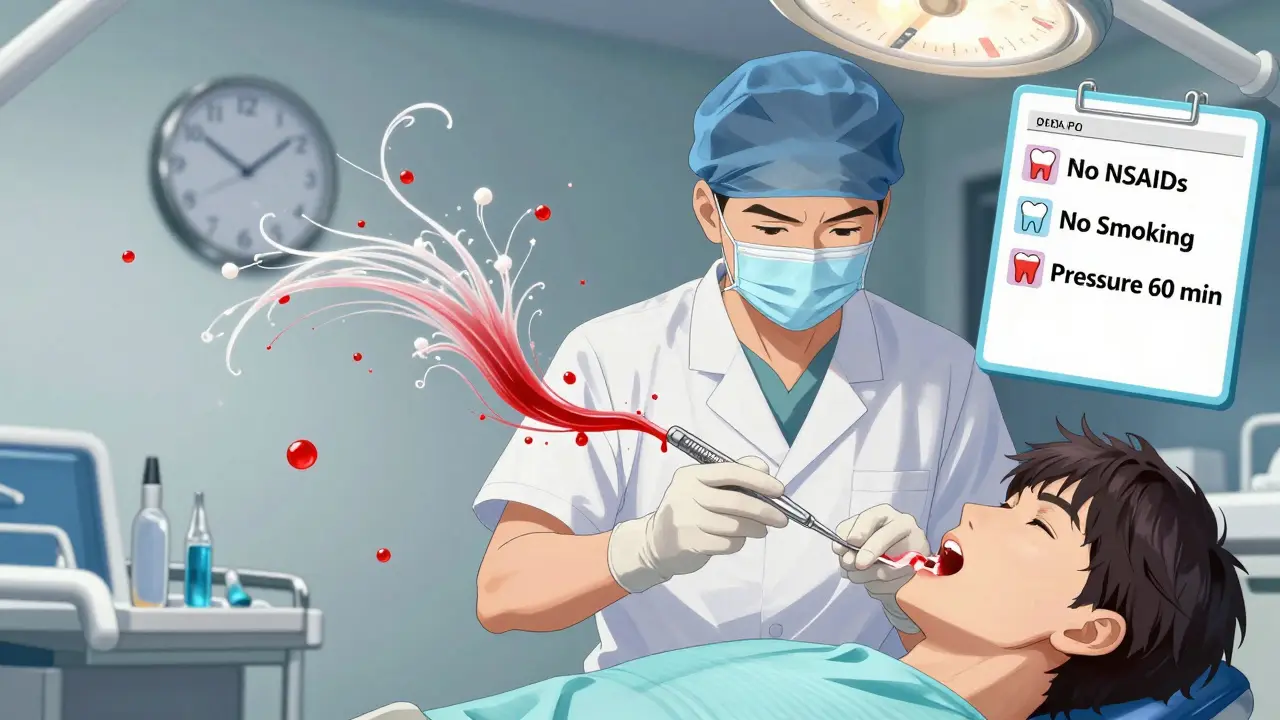
Even if you’re on blood thinners, bleeding during a procedure is usually minor. Dentists have tools to help:- Tranexamic acid mouthwash: A 5% solution you swish for 1-2 minutes, then spit. Repeat every 2 hours for 24 hours. It’s not magic - but it works. Studies show it cuts bleeding by over 60%.
- Sutures and pressure: Stitching the site and using gauze with firm pressure for 30-60 minutes often does the trick.
- Local hemostatic agents: Gelfoam, collagen strips, or oxidized cellulose placed directly in the socket help clot formation.
- Splitting extractions: Instead of pulling three teeth in one visit, your dentist might do one now, one in a week. Less stress on your system.
What to Avoid
Some things make bleeding worse - and they’re easier to prevent than you think.- NSAIDs: Ibuprofen, naproxen, and even aspirin (if not prescribed) can thin blood further. Use acetaminophen (paracetamol) for pain instead.
- Alcohol: Avoid it for 24 hours after any procedure. It interferes with clotting.
- Smoking: Don’t smoke for at least 72 hours. It delays healing and increases dry socket risk.
- Multiple extractions at once: Especially if they’re next to each other. Space them out.
- Strenuous activity: No heavy lifting or intense exercise for 24-48 hours.
When to Call for Help
Most bleeding stops within an hour. But if you notice:- Bleeding that doesn’t stop after 2-3 hours of pressure
- Blood clots in your saliva or a steady drip
- Difficulty breathing or swallowing
- Dizziness or rapid heartbeat
Special Cases: Younger Patients, Pregnancy, and Other Conditions
Blood thinners aren’t just for older people. More young adults are on them now - after a blood clot from travel, pregnancy, or genetic conditions like factor V Leiden. A 28-year-old postpartum patient might need a filling. A 32-year-old athlete with atrial fibrillation might need a crown. These aren’t edge cases anymore. If you’re pregnant, your dentist will coordinate with your OB-GYN. Some DOACs aren’t safe during pregnancy - but warfarin can be used carefully under supervision. Kidney or liver problems? That changes how long your medication lasts. Your dentist needs to know.What to Do Before Your Appointment
Don’t wait until the day of your visit to figure this out. Take these steps:- Bring a list of all your medications - including doses and times
- Let your dentist know if you’ve had a clot, stroke, or heart attack in the past
- Ask if they’ve treated patients on blood thinners before
- If you’re on warfarin, get your INR checked within 1-2 weeks before your procedure
- Don’t stop your medication unless your doctor says so - not your dentist
Bottom Line
You don’t need to fear dental work because you’re on blood thinners. The modern approach is simple: keep taking your meds, plan ahead, and let your dentist use proven techniques to manage bleeding. The biggest mistake? Stopping your blood thinner without medical advice. The real danger isn’t the procedure - it’s the clot you might get if you stop.Most dental procedures are safe. You just need the right team - one that knows the guidelines, not the old myths.
Should I stop my blood thinner before a dental cleaning?
No. Routine dental cleanings are low-risk and do not require stopping blood thinners. The risk of a clot from stopping is higher than the small chance of bleeding. Keep taking your medication as prescribed.
Can I take ibuprofen after a tooth extraction if I’m on blood thinners?
No. Ibuprofen and other NSAIDs increase bleeding risk. Use acetaminophen (paracetamol) for pain relief instead. Always check with your dentist or pharmacist before taking any new medication.
How long should I wait after taking my DOAC before a dental extraction?
For a single tooth extraction, skip your DOAC dose on the morning of the procedure. Wait at least 4 hours after your last dose before surgery. This reduces bleeding risk without increasing clot danger.
What if my INR is above 4.0? Can I still have dental work?
High INR (above 4.0) increases bleeding risk. Your dentist will likely delay non-emergency procedures until your INR is under control. Talk to your doctor about adjusting your warfarin dose. Emergency care can still be provided with extra hemostatic measures.
Is tranexamic acid mouthwash available over the counter?
No. A 5% tranexamic acid solution is compounded by a pharmacy and requires a prescription. Your dentist will provide instructions and often supply it directly. Do not use unapproved substitutes.
Do I need to tell my dentist if I’m taking aspirin for heart health?
Yes. Even low-dose aspirin affects bleeding. Most guidelines recommend continuing aspirin for dental procedures because stopping it raises heart attack risk. Your dentist will plan accordingly, often using extra hemostatic techniques.
Can I get a dental implant while on blood thinners?
Yes. Dental implants are considered moderate-risk procedures, but they can be done safely with your blood thinner active. Your dentist may hold your DOAC for one dose or adjust warfarin slightly. Local hemostatic measures are key. Always coordinate with your prescribing doctor.




Alexander Erb March 10, 2026
Just had a cleaning last week while on apixaban 🙌 Dentist didn’t even blink. Used that tranexamic acid rinse - felt like mouthwash but way more sci-fi. Zero bleeding. My doctor was shocked I didn’t stop it. Turns out, the old school advice is basically a myth. 🤯
Chris Bird March 11, 2026
Stop blood thinner? No. Just don’t do teeth stuff. Too risky. Better safe than sorry. Simple.
David L. Thomas March 12, 2026
It’s fascinating how the paradigm shifted from bleeding risk to thrombotic risk. The data is overwhelmingly clear: the number needed to harm from discontinuing anticoagulants for minor dental procedures vastly exceeds the number needed to benefit from bleeding mitigation. Hemostatic adjuncts like tranexamic acid, collagen, and fibrin sealants have revolutionized this space - we’re no longer managing risk by omission, but by precision intervention.
Bridgette Pulliam March 13, 2026
Thank you for this. As someone who’s been on warfarin for 8 years, I’ve had dentists panic and refuse to treat me. One even said, 'I can't do this without you stopping your meds.' I had to call my cardiologist to send a letter. It’s 2025 - we need more providers who know the guidelines. Please share this with your dentist. They might not know.
Mike Winter March 14, 2026
Interesting. I’ve always assumed that stopping anticoagulants was prudent, but the evidence seems to suggest otherwise. The balance of risks is counterintuitive - we fear the bleeding because it’s visible, but the clot is silent, and far deadlier. Still, I wonder if individual variation - say, in fibrinolytic activity - might affect outcomes. Maybe we need personalized thresholds?
Randall Walker March 16, 2026
So… you’re telling me… I don’t have to stop my blood thinner… for a cleaning?… Wow. That’s… wild. 😅 I thought I was gonna need a blood transfusion just to get a filling. My dentist still thinks I’m lying when I tell him I’m on rivaroxaban. He says 'I’ve been doing this for 30 years.' Me: 'So have I. And I’ve been alive this whole time.'
Miranda Varn-Harper March 16, 2026
Let me get this straight. You’re advocating for continuing life-threatening anticoagulation therapy during invasive oral procedures? Without even a single lab test? This is reckless. You’re gambling with people’s lives. The ADA is not a medical board - it’s a trade association. And you’re following their marketing pamphlet like gospel.
Donnie DeMarco March 18, 2026
Yo I got my wisdom teeth out last month on Eliquis. Dentist said skip the AM dose. That’s it. No hospital. No drama. Used that green mouthwash thing - tasted like seaweed but worked like a champ. No bleeding. No pain. Just chill. My dog was more nervous than me. 🐶
Tom Bolt March 18, 2026
I can’t believe this is even a debate. My uncle died of a stroke after his dentist told him to stop his blood thinner for a filling. He was 52. He had a family. A dog. A Netflix account. And now? He’s gone. This isn’t about 'risk.' It’s about accountability. Stop the madness. Keep the meds on. Period. 💔
Shourya Tanay March 20, 2026
As a nephrologist, I’ve seen DOAC clearance slow significantly in CKD stages 4-5. For patients with eGFR <30, holding two doses may be prudent even for single extractions. The half-life isn’t just a number - it’s a pharmacokinetic reality. Always check renal function before scheduling. And yes - tranexamic acid is safe in renal impairment. Just avoid IV. Stick to rinse.
LiV Beau March 20, 2026
This is why I love modern medicine - we’re finally ditching the fear-based protocols and moving to evidence-based care. 🌟 I’m on Xarelto and got 3 fillings done last month. No issues. My dentist even gave me a sticker. I feel so empowered now. If you’re on blood thinners, you’re not broken - you’re just managed differently. Keep going. You got this! 💪❤️
Adam Kleinberg March 22, 2026
They say 'don’t stop your meds' - but who’s really behind these guidelines? Big Pharma? Dental supply companies? The FDA doesn’t even regulate this stuff. I read a study that was funded by a DOAC manufacturer. Coincidence? I think not. I stopped my pills before my last cleaning. My dentist didn’t even notice. I’m still here. Maybe the real danger is trusting the system.
Denise Jordan March 23, 2026
Ugh. I just want to get my teeth cleaned. Why does this have to be so complicated? I don’t care about INR levels or half-lives. Just tell me if I can go or not. This post is like reading a textbook written by someone who’s never been to the dentist.