

If you're taking levothyroxine for an underactive thyroid, you might not realize that your daily calcium or iron supplement could be silently sabotaging your treatment. This isn't a myth or an old wives' tale-it's a well-documented, scientifically proven interaction that affects millions of people. In fact, research shows that taking calcium or iron at the same time as your thyroid medication can reduce how much of the drug your body absorbs by up to 36%. That means you're not getting the full dose you need, even if you're taking it exactly as prescribed.
Why Calcium and Iron Disrupt Thyroid Medication
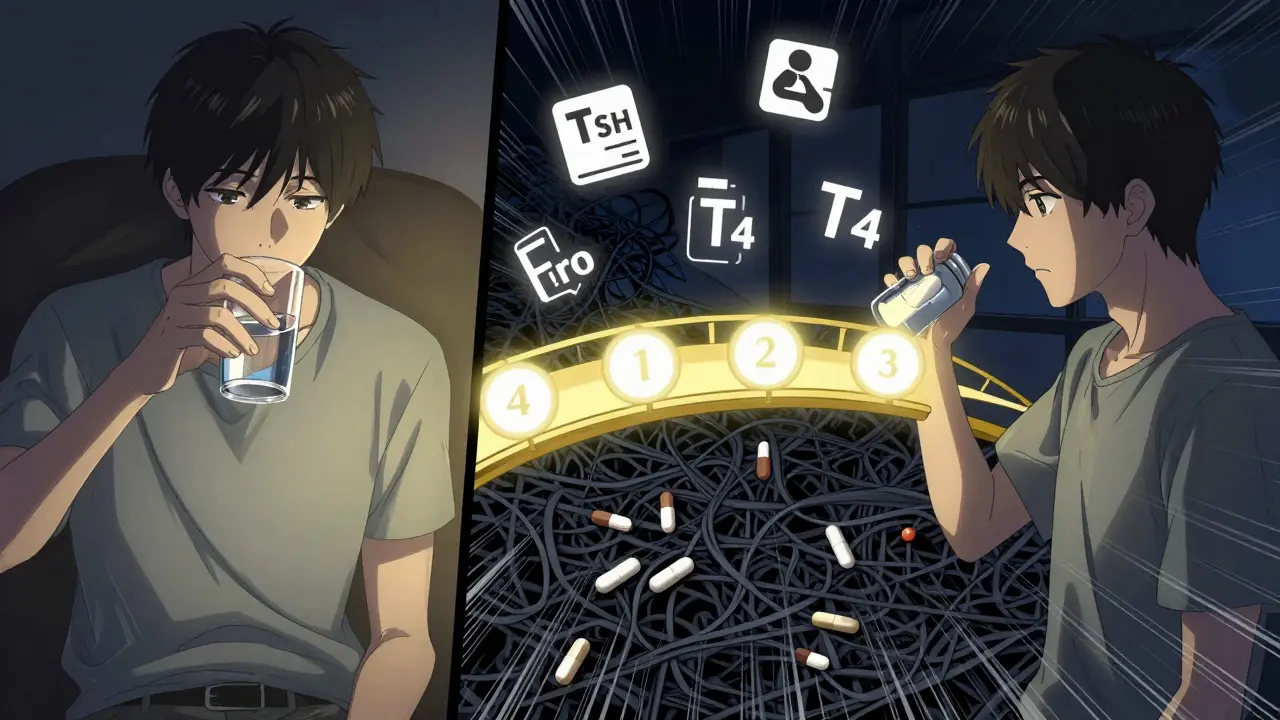
Levothyroxine, the synthetic form of thyroid hormone used to treat hypothyroidism, needs to be absorbed in the upper part of your small intestine. But calcium and iron-especially in supplement form-are like magnets for this drug. Both contain positively charged ions (divalent and trivalent cations) that bind tightly to levothyroxine in your gut, forming a solid, insoluble complex. Think of it like glue: the two stick together and your body can't pull them apart to absorb the hormone.
This isn't just theory. A 2000 study in the Journal of Clinical Endocrinology & Metabolism gave 20 patients on stable levothyroxine doses a daily 1,200 mg calcium carbonate supplement. Within weeks, their free T4 levels dropped and 20% of them developed abnormally high TSH levels-the sign that their thyroid hormone was too low. When they stopped taking calcium with their medication, their levels returned to normal. Similar results were seen with iron: a 2008 study found that 325 mg of ferrous sulfate cut levothyroxine absorption by 21%.
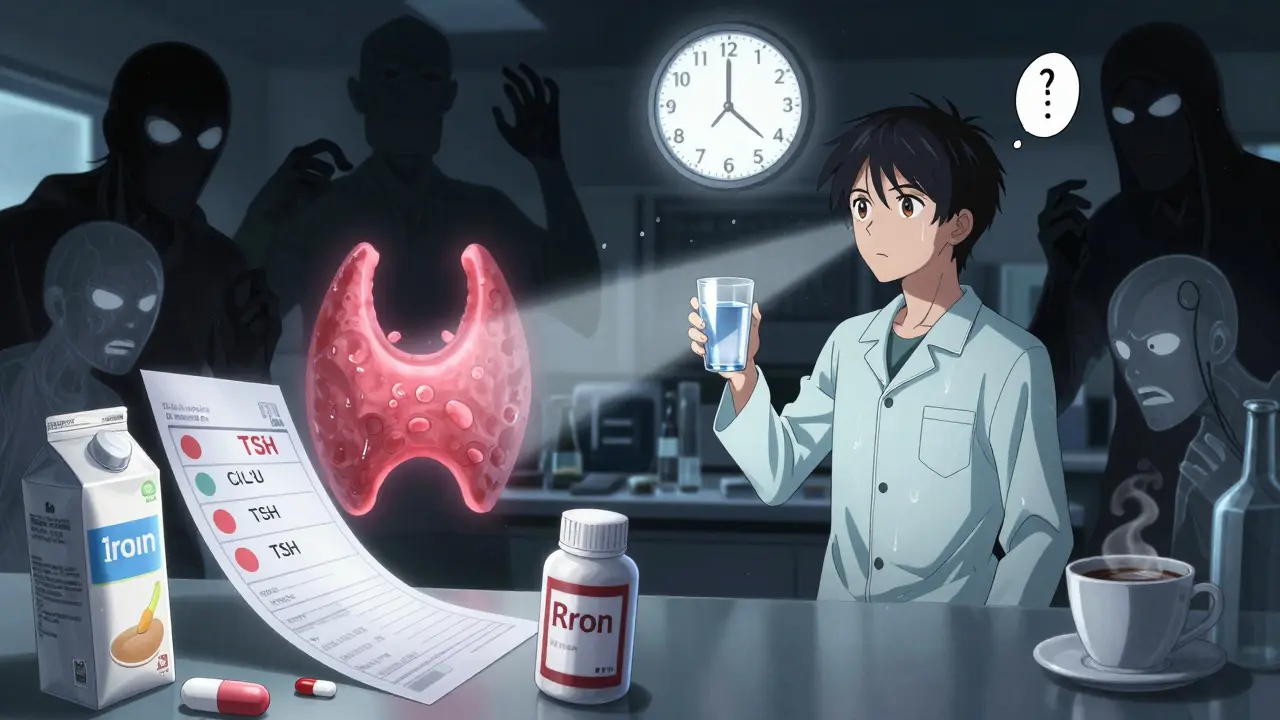
The effect isn't limited to pills. Calcium-fortified orange juice, soy milk, or almond milk can contain 300-400 mg of calcium per cup-enough to interfere if consumed within hours of your thyroid dose. Even iron-fortified breakfast cereals can contribute to the problem if eaten too close to your medication.
How Much Time Should You Wait?
There's no one-size-fits-all answer, but most guidelines agree on a clear window of separation. The Mayo Clinic and the Synthroid prescribing guide recommend waiting at least four hours between taking levothyroxine and calcium or iron supplements. The European Thyroid Association suggests a minimum of two to three hours. Why the difference? It comes down to how much calcium or iron you're taking and how sensitive your body is.
Here’s a practical breakdown based on current clinical evidence:
- Take levothyroxine first thing in the morning on an empty stomach with a full glass of water.
- Wait 30 to 60 minutes before eating, drinking coffee, or taking other medications.
- Wait at least four hours before taking calcium supplements (including antacids like Tums).
- Wait two to four hours before taking iron supplements (ferrous sulfate, ferrous fumarate, etc.).
Some people find it easier to take their thyroid medication at bedtime, as long as they haven't eaten for at least three hours. This can help avoid conflicts with morning meals and supplements. A 2022 Reddit thread from a user named u/HypoMama described how switching her levothyroxine to nighttime improved her TSH levels after struggling with iron supplements for postpartum anemia.
Who’s Most at Risk?
Not everyone will notice a problem-but certain groups are far more likely to see their thyroid levels swing out of range:
- Pregnant women: Iron needs jump during pregnancy, and thyroid hormone requirements rise too. Taking iron and levothyroxine together can lead to under-treated hypothyroidism, which increases risks for preterm birth and developmental delays.
- Postmenopausal women: Often prescribed calcium for bone health, many don’t realize their supplement is interfering with their thyroid meds.
- Women with heavy periods: Iron deficiency is common, and iron supplements are often taken daily without timing adjustments.
- Elderly patients: Those on multiple medications for osteoporosis, anemia, or heart disease are more likely to have timing conflicts.
A 2017 study of 450 patients taking calcium with levothyroxine found that 4.4% developed TSH levels above 5 mU/L within a year-enough to trigger symptoms like fatigue, weight gain, and brain fog. Most didn’t even know their supplement was the culprit.
Other Culprits That Interfere
Calcium and iron aren’t the only troublemakers. Other common substances can also reduce levothyroxine absorption:
- Soy products: Soy milk, tofu, and edamame can increase your required dose by 18-30%.
- Walnuts: One study showed a 24% drop in absorption when eaten with the medication.
- High-fiber foods: More than 30 grams of fiber within an hour of taking your pill can raise TSH by 15-25%.
- Coffee and tea: Tannins in both can interfere. Wait at least one hour after taking your pill before drinking them.
- Biotin: High-dose biotin (5 mg or more daily) can cause thyroid lab tests to read falsely high, leading doctors to mistakenly lower your dose.
- Grapefruit juice: It affects liver enzymes that help process thyroid hormones.
That’s why the American Thyroid Association insists on taking levothyroxine with water only-nothing else.
What Happens If You Don’t Separate Them?
At first, you might not feel anything. Thyroid hormone levels change slowly. But over weeks or months, your body slowly becomes under-treated. You might start feeling tired again, gain weight, or struggle with depression or brain fog-even though you’re taking your pill every day.
Doctors often miss this. A 2023 study found that only 42% of patients received clear advice about supplement interactions during their initial prescription. Many assume their pharmacist or doctor already told them. They didn’t.
The financial cost is real too. In the U.S. alone, improper timing leads to $187 million in unnecessary healthcare spending each year-from repeat blood tests and doctor visits to higher doses of medication and hospitalizations from undiagnosed hypothyroidism.
What Can You Do?
You don’t have to stop taking calcium or iron. You just need to time them right. Here’s a simple plan:
- Take levothyroxine first thing in the morning, 30-60 minutes before breakfast, with water only.
- If you take calcium or iron supplements, take them at dinner time or right before bed-wait at least four hours after your thyroid pill.
- Check labels. Many multivitamins, prenatal vitamins, and bone health formulas contain calcium or iron. If they do, take them separately from your thyroid medication.
- Ask your pharmacist to review all your supplements. Many don’t know about this interaction either.
- Get your TSH tested 6-8 weeks after changing your supplement timing. This confirms your levels are back in range.
Some patients have switched to liquid levothyroxine formulations, which appear less affected by mineral interactions. One 2023 study showed only an 8% drop in absorption with calcium, compared to 32% for tablets. But these cost around $350 a month-far more than the $15 generic tablets most people take. For now, timing remains the most practical and affordable solution.
Final Thoughts
Thyroid medication works-but only if your body can absorb it. Calcium and iron supplements aren’t bad. They’re essential for many people. But when taken carelessly, they can undo years of careful treatment. You don’t need to be perfect. Just consistent. Separate your pills. Stick to the timing. And if you’re unsure, ask for a blood test. Your body will thank you.
Can I take calcium and iron together with my thyroid medication if I space them out?
No. Even if you take calcium and iron at different times on the same day, both can still interfere with levothyroxine absorption. The safest approach is to take your thyroid medication on an empty stomach with water, wait 30-60 minutes before eating, and then take calcium and iron supplements at least four hours later-preferably at night. Don’t assume that spacing them apart from each other is enough.
What if I forget and take my calcium with my thyroid pill?
Don’t panic. One mistake won’t ruin your treatment. But don’t double up on your next dose. Instead, wait until the next day and get back on schedule. If this happens often, consider changing the time you take your supplements. Track your symptoms and ask your doctor to check your TSH level in 6-8 weeks.
Is there a better time of day to take thyroid medication?
Morning is standard, but nighttime can work better for some people-especially those who take iron or calcium supplements during the day. A 2020 study found that taking levothyroxine at bedtime improved absorption and led to more stable TSH levels in patients who struggled with morning timing. The key is consistency: take it at the same time every day, and stick to the 3-4 hour gap before food or supplements.
Do all forms of iron interfere the same way?
Yes. Ferrous sulfate, ferrous fumarate, and ferrous gluconate all contain iron in a form that binds to levothyroxine. Even slow-release or enteric-coated iron supplements still interfere. The only exception is intravenous iron, which bypasses the gut entirely. But for oral supplements, timing is critical regardless of the type.
Can I take a multivitamin with my thyroid medication?
Most multivitamins contain iron, calcium, or both. Unless it’s labeled as iron-free and calcium-free, assume it will interfere. If you need a multivitamin, take it at night, at least four hours after your thyroid pill. Or ask your doctor about a thyroid-friendly supplement without these minerals.
How long does it take for thyroid levels to normalize after fixing supplement timing?
It usually takes 4-8 weeks. Thyroid hormone has a long half-life, so changes in absorption don’t show up in blood tests right away. Your doctor will likely recheck your TSH after six weeks to confirm your levels are back in range. Don’t adjust your dose on your own-wait for test results and medical advice.





Stephen Habegger March 20, 2026
I used to take my iron at breakfast with my thyroid med-felt like a zombie for years. Then I switched to taking it at bedtime. Game changer. Energy’s back, brain fog lifted. Simple fix, huge difference.
Justin Archuletta March 20, 2026
Wait, so my prenatal vitamin is sabotaging me?? I’ve been taking it with my pill since day one…
jerome Reverdy March 21, 2026
This is one of those things that sounds like a myth until you realize your TSH has been hovering at 7.2 for six months and you’re taking the exact dose your doctor prescribed. The science is solid: divalent cations bind to levothyroxine like velcro. Calcium carbonate? Iron sulfate? They’re not just inert fillers-they’re molecular handcuffs. The 36% absorption drop isn’t a rumor; it’s replicated across multiple RCTs. And yeah, soy milk, coffee, fiber, even walnuts-they all mess with it. You’re not crazy for feeling awful. Your gut is just rejecting your meds because it’s glued together. The fix? Water only. 30 minutes. Then food. Then supplements at night. It’s not hard. It’s just not intuitive. And no, your pharmacist didn’t tell you. They’re not thyroid specialists. You have to be your own advocate.
Melissa Starks March 22, 2026
I’m a postmenopausal woman on calcium for osteoporosis and levothyroxine for hypothyroidism… and I had NO IDEA. I’ve been taking them together since 2019. I thought my fatigue was just aging. Turns out my TSH was 9.8. My endo was shocked. I switched calcium to bedtime, waited 4 hours after my pill, and within 6 weeks I was back to normal. I feel like a new person. Also-why isn’t this on the pill bottle? Why isn’t every doctor screaming this? I’m so mad I wasted 4 years. But also… thank you for this. I’m telling everyone.
cara s March 23, 2026
The physiological mechanism underlying the chelation of levothyroxine by polyvalent cations is well-characterized in the pharmacokinetic literature. The formation of insoluble complexes in the duodenum, mediated by electrostatic interactions between the carboxyl groups of levothyroxine and the cationic centers of calcium and iron, results in a significant reduction in bioavailability. This phenomenon has been quantified in controlled trials with serum T4 and TSH as primary endpoints. It is not anecdotal. It is pharmacological. The recommended temporal separation is not arbitrary-it is derived from the gastric emptying half-life of mineral supplements and the absorption window of levothyroxine. One must be rigorous. Consistency is not optional. It is non-negotiable for therapeutic efficacy.
Amadi Kenneth March 24, 2026
Wait… so this is all a Big Pharma scam?? They want you to buy expensive liquid thyroid meds instead of generics… and they don’t want you to know you can just take your supplements at night?? And why is everyone so obsessed with timing?? What if I just… take less thyroid med?? I’ve been reading about how TSH is overdiagnosed… maybe I don’t even need this pill??
Shameer Ahammad March 25, 2026
You people are missing the point entirely. The real issue is not calcium or iron-it’s the systemic failure of medical education. If a patient is prescribed levothyroxine, it is the prescriber’s ethical and professional obligation to provide explicit, written instructions regarding drug-supplement interactions. The fact that 58% of patients receive no such guidance is a scandal. The American Thyroid Association’s guidelines are clear. The Synthroid package insert is explicit. The failure lies not with the patient, but with the healthcare system that treats adherence as a personal failing rather than a structural flaw. You are not lazy. You are neglected. And this is unacceptable.
Alexander Pitt March 26, 2026
I’m a pharmacist. This interaction is one of the most common causes of therapeutic failure in endocrine practice. I’ve seen it 100+ times. Patient takes levothyroxine at 7 a.m., multivitamin at 7:15 a.m., calcium at noon, iron at 6 p.m. They come in with TSH 12. We ask about supplements. They say, ‘I thought the vitamin was fine.’ No. It’s not. I always ask: ‘When do you take your thyroid med?’ 90% of the time, they say ‘with breakfast.’ I tell them: water only. 30 min. Then food. Then supplements at night. 95% of them improve within 6 weeks. No extra cost. No new drugs. Just timing. It’s the simplest fix in medicine.