

Supplement & Medication Timing Checker
Check if the time gap between your supplements/medications is sufficient for proper absorption.
You take your vitamins and medications every morning to stay healthy, but what if they are actually canceling each other out? It sounds like a plot from a medical drama, but for millions of people, it's a daily reality. Many common supplements, specifically Calcium is an essential mineral for bone health and nerve function and Iron, can act like a roadblock in your gut, stopping your prescriptions from ever reaching your bloodstream.
If you're taking antibiotics for an infection or medication for your thyroid, popping a calcium pill at the same time could mean your treatment simply doesn't work. This isn't about a minor dip in effectiveness; in some cases, the minerals physically bind to the medicine, turning it into an unabsorbable clump. To get the most out of your health routine, you need to understand the "traffic jam" happening in your intestines.
The Battle for Absorption: Calcium vs. Iron
Ever wonder why some doctors tell you to take your iron in the morning and your calcium at night? It's because these two minerals are rivals. They both use the same "doors"-known as divalent metal transporters-to get from your gut into your blood. When you take them together, they compete for these spots, and usually, the calcium wins, leaving the iron behind.
Research shows this isn't just a theoretical problem. A study in the American Journal of Clinical Nutrition found that calcium supplements can slash iron absorption by anywhere from 49% to 62% when taken without food. For women, who already have a higher daily iron requirement of 18 mg, this is a significant hurdle that can lead to iron-deficiency anemia if not managed correctly.
It's not just the competition for space, either. Calcium Carbonate is a common form of calcium supplement that also acts as an antacid. By raising the pH level in your stomach, it makes non-heme iron (the kind found in plants and most supplements) less soluble, making it even harder for your body to soak it up.
How Minerals Block Your Medications
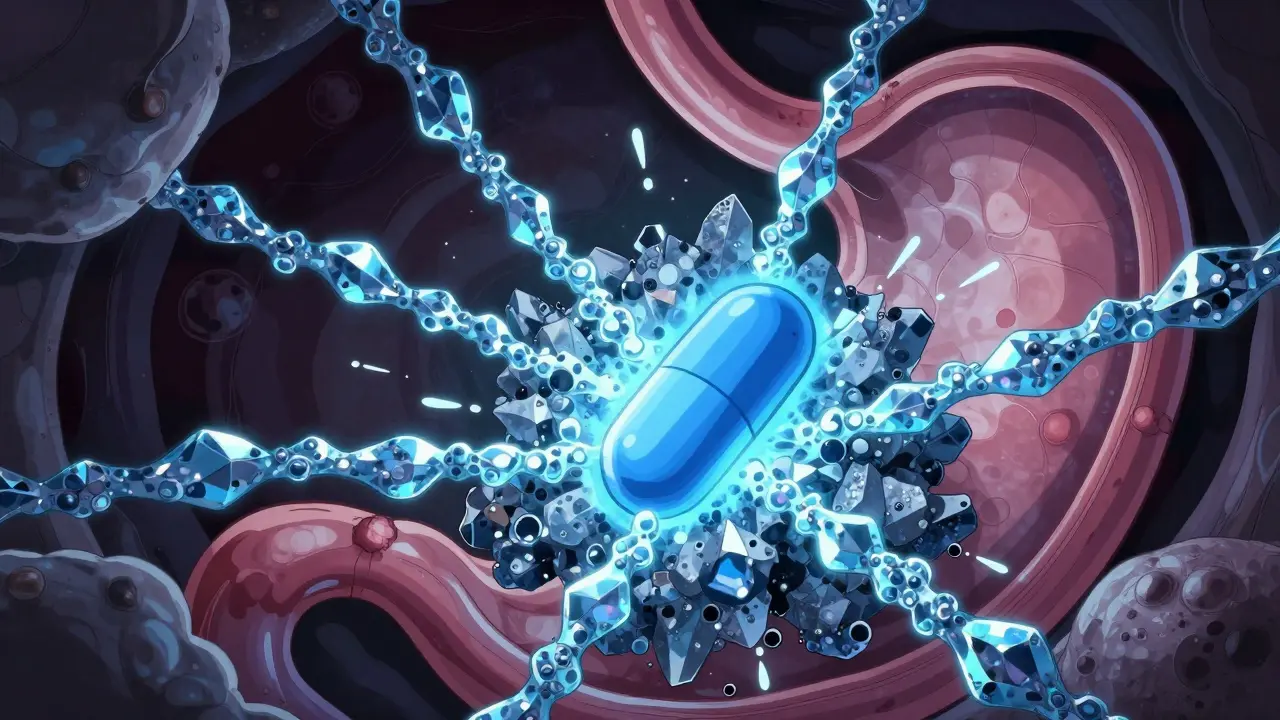
The problem extends beyond just other vitamins. Calcium, iron, and aluminum all carry a positive charge. This makes them "sticky" when they encounter certain medications, especially antibiotics. They form a complex that the body cannot absorb, meaning the drug is simply flushed out of your system.
The most common culprits are Fluoroquinolones is a class of broad-spectrum antibiotics including ciprofloxacin and ofloxacin and Tetracyclines. If you're fighting a bacterial infection and take a calcium supplement at the same time, you might not reach the therapeutic levels needed to actually kill the bacteria. This essentially wastes your medication and could potentially lead to a lingering infection.
Other critical medications that get blocked include:
- Levothyroxine: Used for hypothyroidism. Calcium and iron can prevent this thyroid hormone from being absorbed.
- Bisphosphonates: Used for osteoporosis; these are highly sensitive to mineral interference.
- Parkinson's and Seizure Medications: Iron supplements can reduce the effectiveness of several drugs used to manage these neurological conditions.
| Supplement | Interacting Medication | Effect | Recommended Gap |
|---|---|---|---|
| Iron | Tetracycline Antibiotics | Reduced drug absorption | 2-4 hours |
| Calcium | Levothyroxine (Thyroid) | Blocked hormone absorption | 4 hours |
| Iron/Calcium | Ciprofloxacin | Reduced antibiotic potency | 2 hours |
| Calcium | Iron Supplements | Competitive inhibition | 2-6 hours |
The Role of Stomach Acid and pH
To absorb iron, your stomach needs to be acidic. This is why medications that lower stomach acid-like Proton Pump Inhibitors (PPIs) is medications like omeprazole and pantoprazole that reduce gastric acid production-can lead to iron deficiency over time. Whether it's a prescription drug like Prilosec or an over-the-counter antacid like Tums, reducing acid means reducing the solubility of iron.
If you're taking these for chronic heartburn, you might find that your iron levels drop even if you're taking a supplement. The key is to create an environment where the iron can actually dissolve and enter the bloodstream, which is why timing is everything.
Practical Timing Strategies for Maximum Absorption
You don't have to stop taking your supplements; you just have to stop taking them all at once. The goal is to separate the "rivals" by a few hours so the body can process one before the next arrives.
Here is a pro-level schedule for managing these interactions:
- Morning (Empty Stomach): Take your iron supplement. For an extra boost, drink a glass of orange juice or take a Vitamin C supplement. Vitamin C can increase iron absorption by up to 300% by keeping the iron in a soluble form.
- Mid-Day: Take your prescription medications, especially antibiotics or thyroid hormones. Ensure there is at least a 2-hour window after your morning iron.
- Evening (With Food): Take your calcium supplements. Calcium is generally better absorbed and better tolerated when taken with a meal, and this puts it far away from your morning iron dose.
For those on tetracycline antibiotics, the window needs to be even wider: take the antibiotic at least 2 hours before or 4 hours after your iron supplement. This ensures the drug is absorbed before the iron can bind to it.

Pitfalls and Red Flags to Watch For
When you start adjusting your iron intake, your body might react. It's common for 30-50% of people to experience stomach cramps, nausea, or diarrhea when taking iron on an empty stomach. While uncomfortable, this is often a trade-off for much better absorption. If it's too intense, talk to your doctor about liquid iron options.
Be aware of the visual changes. Iron tablets often cause stools to turn black; this is normal and not a cause for concern. However, if you see red streaks or if the stool looks like tar, this could indicate gastrointestinal bleeding and requires immediate medical attention.
A word of caution for parents: keep iron supplements locked away. Because they can look like candy, accidental ingestion is a major risk. Iron poisoning is a leading cause of fatal childhood poisoning in the US, so treat these bottles with the same caution as prescription medicine.
Can I take my calcium and iron supplements at the same time if I take them with food?
No, it is not recommended. Even when taken with food, calcium inhibits the absorption of iron. Studies show that calcium carbonate and citrate significantly reduce the amount of iron your body can absorb, making it difficult for people (especially women) to meet their daily requirements. It is best to space them by at least 2 to 4 hours.
Why does Vitamin C help with iron absorption?
Vitamin C acts as a reducing agent that helps convert ferric iron to ferrous iron, which is the form most easily absorbed by the body. It also prevents the formation of insoluble iron compounds. This can increase absorption by as much as 300%, which is why orange juice is often recommended alongside iron pills.
Will my calcium supplement make my antibiotics less effective?
Yes, if you are taking certain types of antibiotics like fluoroquinolones (ciprofloxacin) or tetracyclines. The positive charge of the calcium binds to the medication, creating a complex that your gut cannot absorb. This can lead to inadequate drug levels in your blood, potentially allowing the infection to persist.
Do antacids like Tums interfere with iron?
Yes. Tums contain calcium carbonate, which does two things: it provides calcium that competes with iron for absorption, and it reduces stomach acid. Since iron needs an acidic environment to dissolve and be absorbed, the antacid effect further blocks the iron from entering your system.
What is the safest way to take liquid iron to avoid teeth staining?
Liquid iron can stain teeth over time. To prevent this, use a straw to bypass the teeth entirely. If staining does occur, it can often be treated with a mixture of baking soda or peroxide, though prevention with a straw is the most effective method.
Next Steps for Your Health Routine
If you're currently taking a combination of these supplements and meds, don't panic, but do make a plan. Start by listing every supplement and medication you take and the time of day you take them. Look for the "overlaps" where iron, calcium, or acid-reducers are hitting your system at the same time as your prescriptions.
For those managing thyroid issues, the priority is usually the levothyroxine. Ensure that is taken first thing in the morning, and push your mineral supplements to the afternoon or evening. If you experience severe stomach upset with morning iron, try a liquid formulation or ask your pharmacist about a buffered version, but always keep that gap between your minerals and your meds.





Mikaela -anonymous 😏 May 1, 2026
Wow... just wow... because apparently my life was too simple before I knew my vitamins were fighting a war in my gut!!! Truly groundbreaking stuff...!!!
kelvin villa saab May 3, 2026
I tried taking them together and felt like garbage. Totaly ignored the warninngs and now my stomach is just... wow. Listen to the advice people, dont be like me.
Spencer Farrell May 3, 2026
One must contemplate the inherent paradox of supplementation; we introduce synthetic compounds to rectify biological deficits, yet in doing so, we create a new chemical battlefield within the intestinal lumen. The biochemical antagonism between divalent cations is a testament to the delicate equilibrium of human physiology.
Kartik Agarwal May 4, 2026
From a pharmacokinetic perspective, the chelation process mentioned here is critical. We are essentially seeing a competition for ligand binding sites which alters the bioavailability of the solute. It's imperative to optimize the therapeutic window to ensure maximal serum concentration of the active pharmaceutical ingredient.
Kelly Feehely May 5, 2026
Typical medical advice pushing you to take more pills to fix the problems created by the first set of pills. They don't tell you why these "interactions" are suddenly a big deal now when we've been taking vitamins for decades. It's all just a way to keep us dependent on a cycle of synthetic minerals and prescription drugs while they ignore the real root causes!
princess lovearies May 7, 2026
Just remember to be kind to yourself while adjusting your routine. It takes time for the body to adapt to new schedules, so just take it one day at a time.
Jimmy Crocker May 8, 2026
It is quite frankly astounding that such basic pharmacollogy isn't common knowledge, though I suppose the general populace lacks the intellectual rigour to grasp the nuance of molecular bindng, which is why we see so many people simply tossing pills back without a single thought as to the chemical kinetics involved in the absorption process of the small intestine, which is frankly justembarrassing.