
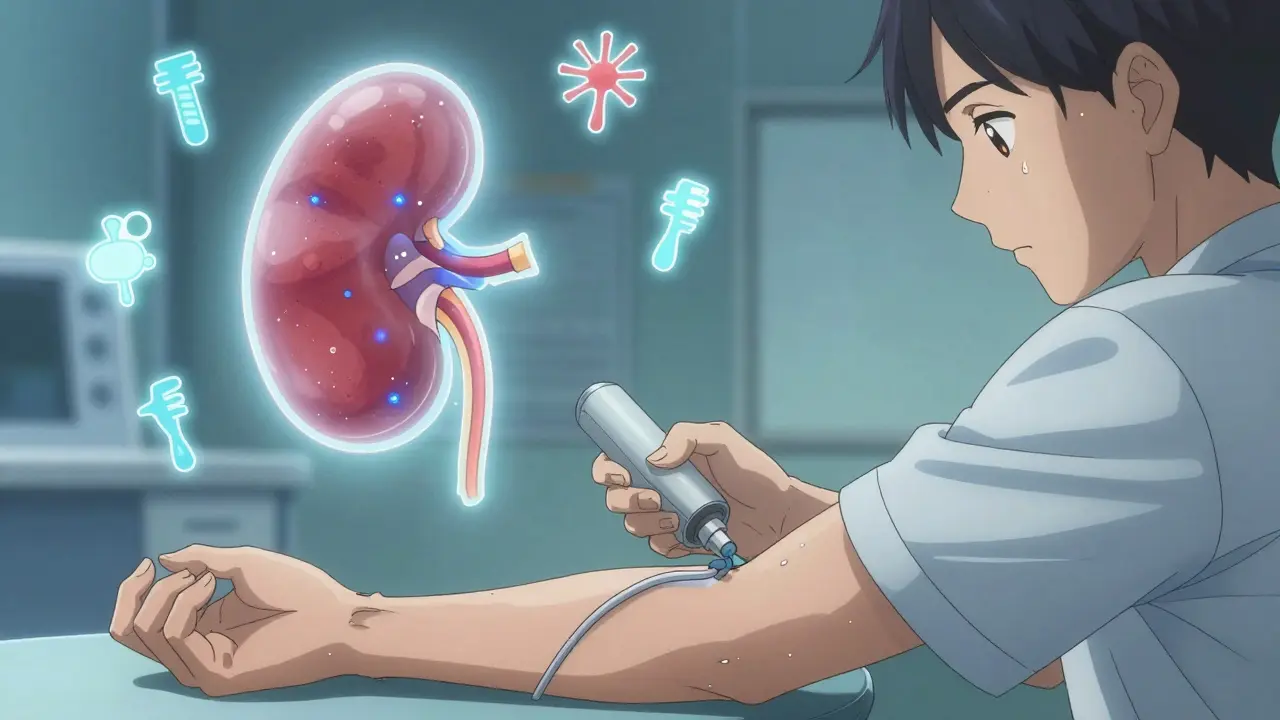
When your doctor orders a kidney function test, it’s not just another blood draw or urine sample-it’s a quiet but powerful check on how well your body is filtering waste. Many people don’t think about their kidneys until something goes wrong. But by then, up to half the kidney function may already be gone. That’s why tests like creatinine, GFR, and urinalysis matter. They catch problems early, when you still have a chance to slow or even stop damage.
What Creatinine Tells You About Your Kidneys
Creatinine is a waste product made when your muscles break down. Healthy kidneys filter it out of your blood and send it out in your urine. When your kidneys aren’t working well, creatinine builds up in your bloodstream. That’s the simple idea behind the creatinine blood test.
But here’s the catch: creatinine doesn’t rise until your kidneys have lost at least 50% of their filtering power. That makes it a late warning sign. Someone with early kidney damage might have perfectly normal creatinine levels. That’s why doctors don’t rely on creatinine alone. Still, it’s the starting point for almost every kidney check.
Normal creatinine levels vary by age, sex, and muscle mass. For adult men, it’s usually between 0.7 and 1.3 mg/dL. For adult women, it’s 0.6 to 1.1 mg/dL. If you’re very muscular, your creatinine might be higher-even if your kidneys are fine. If you’re older or have low muscle mass, your levels might be lower, even with kidney problems. That’s why creatinine needs context.
What GFR Really Measures (And Why It Matters More Than Creatinine)
Doctors don’t just look at your creatinine number. They plug it into a formula to calculate your estimated Glomerular Filtration Rate, or eGFR. This tells you how much blood your kidneys filter each minute. It’s the best single number to show how well your kidneys are working.
The most common formula used today is the CKD-EPI equation. It takes your creatinine, age, sex, and sometimes race to give you an eGFR in milliliters per minute per 1.73 square meters of body surface area. That last part sounds complicated, but it’s just a way to compare people fairly-no matter their size.
Here’s what your eGFR means:
- 90 or higher: Normal kidney function
- 60-89: Mildly reduced function-may mean early damage
- 45-59: Moderately reduced
- 30-44: Severely reduced
- 15-29: Very severe decline
- Below 15: Kidney failure
Many people don’t realize their eGFR has dropped until their doctor points it out. That’s because symptoms like fatigue, swelling, or trouble sleeping often show up only after damage is advanced. That’s why annual blood tests are so important-especially if you have diabetes, high blood pressure, or a family history of kidney disease.
Why Urinalysis Is Just as Important as Blood Tests
Even if your creatinine and eGFR look fine, your kidneys could still be leaking protein. That’s where urinalysis comes in.
The most important urine test for kidney health is the Albumin-to-Creatinine Ratio (ACR). It measures how much albumin-a type of protein-is slipping through your kidneys into your urine. Healthy kidneys don’t let protein out. But when they’re damaged, even small amounts leak through. That’s one of the earliest signs of kidney disease.
According to the UK Kidney Association, ACR is now the gold standard for detecting proteinuria. A result under 3 mg/mmol is normal. Between 3 and 70 mg/mmol suggests early damage. Above 70 means more serious leakage.
Older dipstick tests-where you dip a paper strip into urine-used to be common. But they’re not accurate enough anymore. ACR gives you a real number, not just “trace” or “moderate.” That’s why doctors now require a lab test, not a quick dipstick.
And it’s not just about protein. Urinalysis also checks for blood, sugar, or signs of infection. Blood in the urine can mean kidney stones, infection, or even cancer. Sugar might point to uncontrolled diabetes. Each clue adds to the picture.
When You Need All Three Tests Together
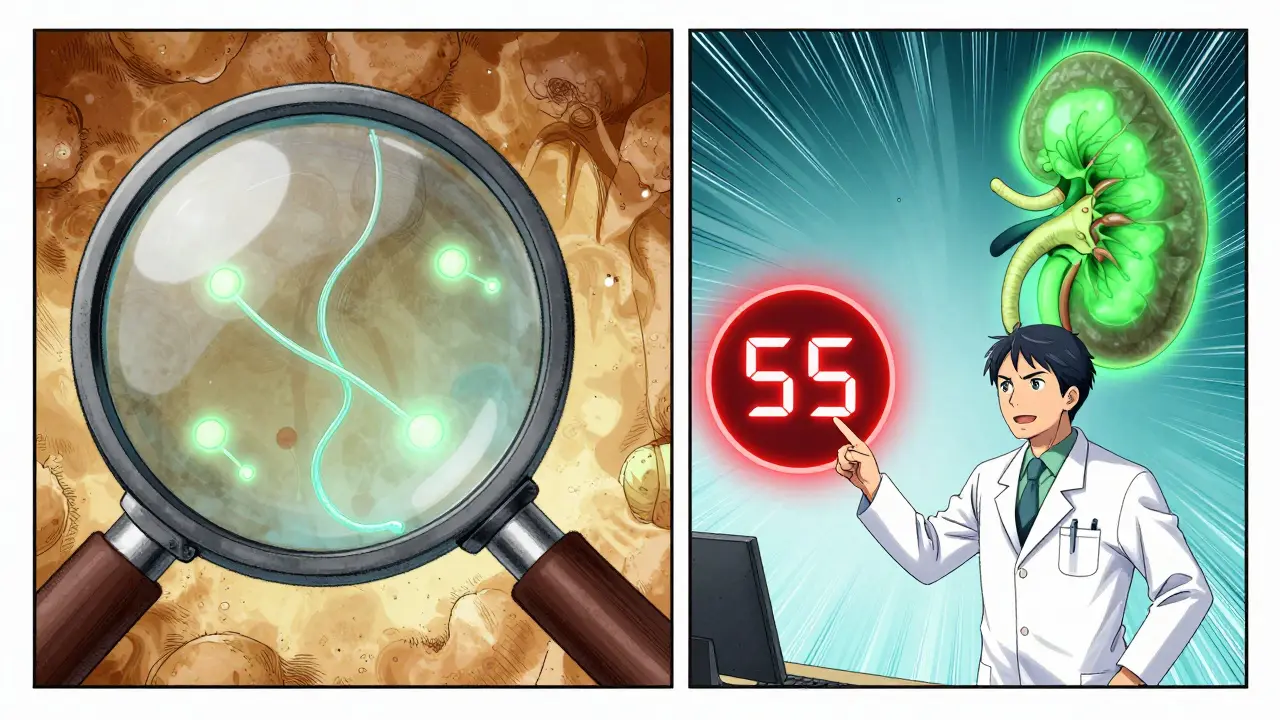
Doctors don’t order creatinine, GFR, and urinalysis just to check boxes. They use them as a team.
Think of it like this: creatinine tells you how much waste is building up. GFR tells you how fast your kidneys are cleaning it out. And urinalysis tells you if the filters themselves are torn.
For example:
- If your eGFR is 55 and your ACR is 80, you have moderate kidney damage with protein leakage-likely from diabetes or high blood pressure.
- If your eGFR is 75 but your ACR is 120, your kidneys are filtering okay, but they’re leaking protein. That’s an early warning you need to act on.
- If your eGFR is 95 and your ACR is 2, you’re in the clear.
People with diabetes, high blood pressure, heart disease, or a history of kidney injury should get both tests every year. Even if you feel fine. Kidney disease doesn’t always cause symptoms until it’s too late.
What Can Throw Off the Results?
These tests aren’t perfect. Some things can make them look worse than they are.
For creatinine and eGFR:
- Being very muscular can raise creatinine-making your eGFR look lower than it is.
- Being very thin or elderly can lower creatinine-making your eGFR look higher than it is.
- Being pregnant can lower creatinine, masking real problems.
- Dehydration can temporarily raise creatinine.
For ACR:
- Intense exercise right before the test can cause a false positive.
- Urinary tract infections can cause protein to appear.
- Menstruation can contaminate the sample.
That’s why doctors often ask for a second test. One high result doesn’t mean you have kidney disease. Two or three high results over weeks or months do.

What Happens If Your Results Are Abnormal?
If your numbers are off, your doctor won’t panic. They’ll look at the full picture: your age, medical history, medications, and other test results.
They might:
- Ask you to repeat the tests in a few weeks.
- Order a cystatin C test-a different blood marker that’s not affected by muscle mass.
- Check your blood sugar and blood pressure.
- Recommend a kidney ultrasound to look for physical changes.
If you’re diagnosed with early kidney disease, the goal isn’t to fix it overnight. It’s to slow it down. That usually means controlling blood pressure, managing blood sugar, eating less salt, quitting smoking, and avoiding certain painkillers like ibuprofen or naproxen.
Medications like ACE inhibitors or ARBs are often used-they don’t just lower blood pressure. They also protect your kidneys by reducing protein leakage.
How Often Should You Get Tested?
There’s no one-size-fits-all answer.
If you’re healthy, under 50, with no risk factors: you don’t need regular kidney tests unless your doctor recommends them. But if you’re getting a yearly metabolic panel (which most people should), your creatinine and eGFR are already being checked.
If you have:
- Diabetes: Get eGFR and ACR every year.
- High blood pressure: Get tested at least once a year.
- Heart disease or past kidney injury: Get tested every 6-12 months.
- Family history of kidney failure: Start testing at age 40.
And if you’re over 60, even without risk factors, it’s smart to ask your doctor if you should be tested. Kidney function naturally slows with age-but that doesn’t mean you should ignore it.
What If You’re Young, Fit, and Healthy?
Yes, even athletes and people who eat well can develop kidney problems. Diabetes doesn’t care how fit you are. High blood pressure can sneak up on anyone.
And here’s something most people don’t know: some kidney diseases are genetic. If a close relative had kidney failure before age 60, you’re at higher risk-even if you feel perfect.
Getting tested isn’t about fear. It’s about knowing. If your kidneys are healthy, you’ll walk away relieved. If there’s a problem, you’ll catch it early enough to make a real difference.
Can I check my kidney function at home?
No reliable at-home test exists for creatinine, GFR, or ACR. Some urine strips claim to detect protein, but they’re not accurate enough for diagnosis. Only a lab can give you the numbers your doctor needs. If you’re worried, talk to your doctor about getting a simple blood and urine test.
Is a high creatinine level always serious?
Not always. If you’re young, muscular, or eat a lot of meat, your creatinine can be higher without any kidney damage. That’s why doctors always look at your eGFR, not just creatinine. If your eGFR is normal, your kidneys are likely fine-even if creatinine is slightly elevated.
Can I improve my GFR naturally?
You can’t directly boost your GFR, but you can protect your kidneys. Controlling blood pressure and blood sugar, cutting back on salt, staying hydrated, avoiding NSAIDs like ibuprofen, and not smoking can help slow or stop further decline. In early stages, this can keep your GFR stable for years.
What’s the difference between GFR and eGFR?
GFR is the actual rate your kidneys filter blood-measured with a complex, invasive test using dyes. eGFR is an estimate based on your creatinine, age, sex, and sometimes race. Doctors use eGFR because it’s simple, cheap, and accurate enough for routine care. You’ll never hear “GFR” in your results-you’ll see “eGFR.”
Why do they ask for a morning urine sample?
Morning urine is more concentrated and consistent. After hours without drinking, protein levels are more stable and easier to measure. A random sample might show low protein just because you drank a lot of water. The morning sample gives the clearest picture.




Laia Freeman January 29, 2026
OMG I just found out my eGFR was 58 and I thought I was fine??!! Like, I jog 5 miles a day and eat kale like it’s my job?? 😭
Kacey Yates January 30, 2026
Same. My doctor never explained ACR. I thought dipstick was enough. Never again. Lab test only from now on. 💪
Ryan Pagan January 31, 2026
Man, I used to think high creatinine meant I was overtraining. Turned out I was just dehydrated. Now I chug water like it’s my job. And yeah, I still lift heavy. But I also get my labs done every 6 months. No regrets. 🏋️♂️💧
Alex Flores Gomez February 2, 2026
Ugh. I can’t believe people still rely on eGFR. It’s a flawed algorithm that discriminates by race and ignores sarcopenia. Real nephrologists use cystatin C + urinary biomarkers. If you’re not measuring NGAL or KIM-1, you’re practicing paleo-medicine. 🤦♂️
kabir das February 4, 2026
My mom died of kidney failure at 52... I’m 38 now. I’ve been terrified to check my numbers. But this post... I’m going to the clinic tomorrow. Thank you for writing this. I’m not alone. 😢
Andy Steenberge February 4, 2026
It’s fascinating how these tests work together. Creatinine is the canary in the coal mine, but it’s too slow. GFR gives you the rate of decline. ACR reveals the structural damage before the system crashes. It’s like having three different smoke alarms in your house - one for heat, one for carbon monoxide, one for actual flames. You need all three. And yes, morning urine matters. I used to pee in a cup after my coffee. Big mistake. Now I do it first thing. No excuses.
Also, if you’re on NSAIDs daily - stop. Seriously. Ibuprofen isn’t a vitamin. It’s a silent killer for kidneys. I used to take two every time I had a headache. Now I take Tylenol or just lie down. My eGFR went from 62 to 74 in six months. No meds. Just awareness.
And if you’re diabetic - control your sugars like your life depends on it. Because it does. Your kidneys are filtering 180 liters of blood a day. They’re not built for sugar floods. They’re built for balance. Treat them like a Ferrari, not a pickup truck.
Don’t wait for swelling or fatigue. By then, it’s too late. Get tested. Repeat. Track. Know your numbers. Your future self will thank you.
And yes, even if you’re young. Even if you’re fit. Even if you think you’re invincible. Kidney disease doesn’t care how many pushups you do. It only cares if you’re ignoring the signs.
Also, avoid those ‘kidney cleanse’ supplements. They’re scams. Water and sleep are the only cleanses you need.
And if you’re over 60 - don’t assume it’s just aging. Aging is natural. Decline isn’t. Get checked. Every year. No exceptions.
Finally, if your doctor doesn’t order ACR - ask for it. Politely but firmly. You’re not being difficult. You’re being smart.
Knowledge isn’t power. Action is. And action starts with a blood draw and a urine cup.
paul walker February 5, 2026
Wait so if I’m muscular and my creatinine is 1.5 but my eGFR is 85 I’m good right? 😅
Andy Steenberge February 7, 2026
Exactly. Muscle mass = higher creatinine. But if your eGFR is solid and your ACR is low? You’re golden. Don’t let the number freak you out. Context is king.
Laura Arnal February 7, 2026
This is so helpful!! I just got my results and my ACR was 4.5 😊 I thought I was doomed but now I know it’s just a heads up! Thanks for the clarity!! 🙌❤️
Robin Keith February 7, 2026
...And yet, we live in a world where the body’s most vital filtration system is reduced to a blood test and a dipstick - as if the kidneys are just a plumbing issue, not a sacred, ancient engine that has carried us since the dawn of time. We measure, we label, we quantify... but do we *understand*? Do we honor the silent workers that filter our poison, regulate our balance, and never ask for thanks? The kidneys don’t scream. They whisper. And we’ve trained ourselves to ignore whispers. We are the generation that tracks steps and calories but forgets to listen to the quiet hum of our own biology. And when the whisper becomes a cry - we are shocked. But the kidneys never lied. We just stopped paying attention.
Kristie Horst February 9, 2026
How charming. You’ve written a textbook chapter and called it a Reddit comment. I’m sure your patients appreciate the theatrical gravitas. Now, if you’ll excuse me, I have a 72-year-old diabetic with an eGFR of 41 who needs to hear the truth - not poetry.