
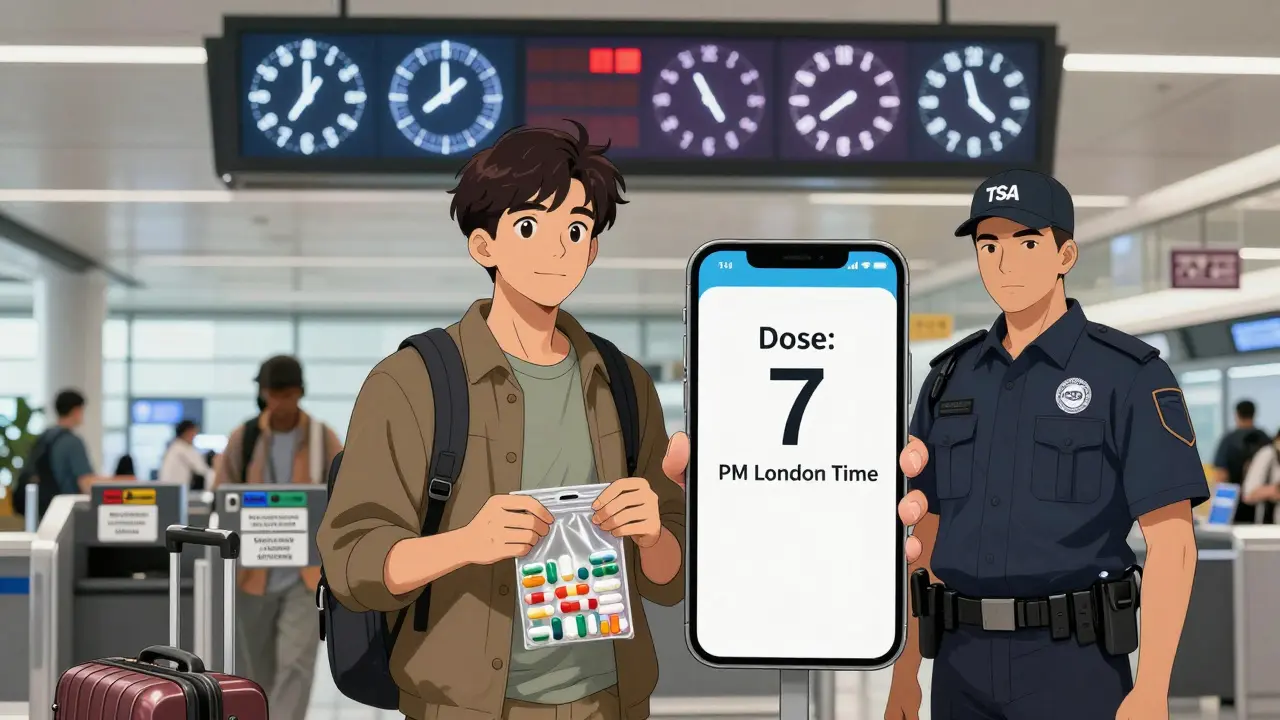
Traveling across time zones isn't just about jet lag-it’s about making sure your medication still works the way it should. For over half of Americans who take prescription drugs regularly, skipping a dose or taking it at the wrong time can mean the difference between staying healthy and ending up in the ER. Whether you're flying to Tokyo, hopping across Europe, or just heading west for a weekend, your body’s clock doesn’t reset the moment you land. And neither should your pill schedule.
Don’t Guess. Plan Ahead.
The biggest mistake travelers make? Waiting until the day before departure to think about meds. If you’re on insulin, seizure meds, birth control, or blood thinners, you need a custom plan-not a guess. Start at least four to six weeks before you leave. Book a quick appointment with your doctor or pharmacist. Bring your itinerary, flight times, and a list of every medication you take, including supplements. They’ll help you map out exactly when to take each dose based on your destination and how many time zones you’re crossing.For most people, if you’re crossing less than three time zones, you can stick to your home schedule. That means if you take your pill at 8 a.m. EST, you still take it at 8 a.m. your local time, even if that’s 5 a.m. in California. Your body will adjust slowly, and you won’t risk a therapeutic gap.
But if you’re crossing four or more time zones? That’s when things get tricky. Most doctors recommend taking your first dose at your home time, then switching to the destination time for future doses. For example, if you fly from New York to London (5-hour difference) and usually take your pill at 7 p.m., take it at 7 p.m. New York time before you leave. Then, once you land, start taking it at 7 p.m. London time the next day. This gives your body a gentle transition.
Know Your Meds-Not All Pills Are Created Equal
Some medications can handle a little flexibility. Others? Not so much. The University of California San Francisco found that for most drugs, taking them up to two hours early or late is safe. But that’s not true for everything.- Insulin: If you’re crossing five or more time zones, basal insulin may need a 20% dose adjustment per additional time zone. Meal-time insulin should match local meal times. Never guess-talk to your endocrinologist.
- Seizure meds: Johns Hopkins research shows that going more than two hours off schedule increases seizure risk by 3.7 times. Set a hard alarm. No exceptions.
- Oral contraceptives: If you’re more than 12 hours late, use backup contraception for the next seven days. Take it at the same local time every day, no matter what.
- Anticoagulants (like warfarin): Your INR levels can shift due to diet changes and sleep disruption. Get tested within 72 hours of returning home.
- HIV meds: Missing a dose can lead to drug resistance. If you miss one, take it as soon as you remember-even if it’s close to the next dose.
For antibiotics, never double up. Skipping a dose is better than overdosing. The CDC says inconsistent dosing increases antibiotic resistance by 18%. Stick to the schedule, even if you feel better.
What to Pack-and Where
Packing meds in your checked bag is one of the top reasons people end up without their meds. A 2024 survey found 63% of medication-related emergencies happened because bags got lost. Don’t be one of them.- Keep all meds in your carry-on. Always.
- Bring enough for the entire trip, plus at least seven extra days. For international travel, aim for 14 extra days. Delays happen.
- If you need refrigeration (like insulin), use an insulated pouch with ice packs. Insulin exposed to heat above 86°F for over 24 hours can lose nearly 30% of its potency.
- Don’t transfer pills into daily pill organizers unless you’ve confirmed they’re safe. Some meds degrade in plastic or lose effectiveness.
The TSA allows medications in containers larger than 3.4 ounces if they’re for personal use. But you must tell the agent at the start of screening. No surprises. Have a printed list ready.
Documentation Is Your Shield
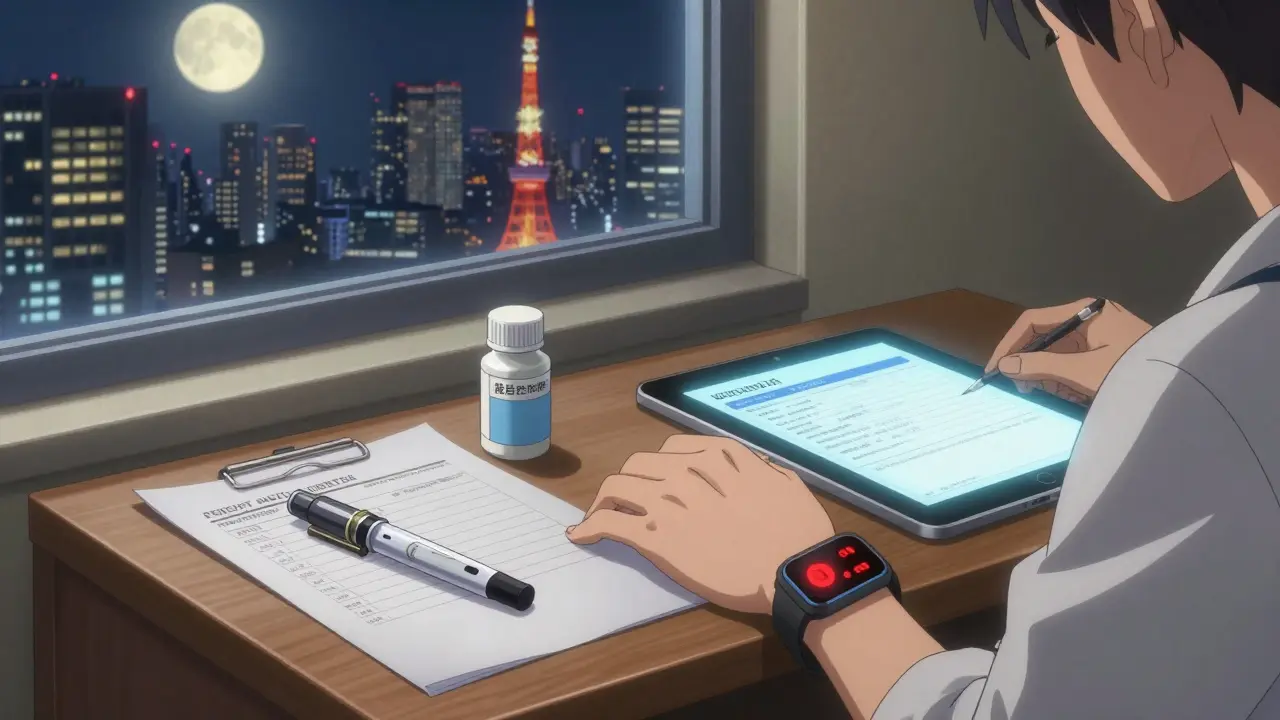
You might be stopped at customs. You might need a doctor’s note. You might be asked why you’re carrying 30 days’ worth of pills. Be ready.- Carry a printed list with: brand name, generic name, dosage, frequency, reason for use, prescribing doctor’s name and phone number.
- Include allergies. 41% of international medical emergencies involve medication confusion due to language barriers.
- For controlled substances (opioids, ADHD meds, benzodiazepines), get a signed letter from your doctor. Japan, South Korea, UAE, and 17 other countries ban these without documentation.
- Keep a digital copy on your phone and in your email. Store the printed copy separately from your meds.
Use Tech-But Not Just Any App
Your phone alarm won’t cut it. Time zones change. You forget to update it. A 2024 study found that travelers who used apps with automatic time zone adjustment had 47% fewer missed doses than those using regular alarms.Look for apps that:
- Auto-adjust based on your location
- Send push notifications, not just sounds
- Let you set backup reminders (like a vibrating watch alert)
- Allow you to log missed doses and share reports with your doctor
Some pharmacies like CVS and Walgreens now offer free pre-travel consultations. They’ll help you set up the app, print your list, and even pack your meds in travel-ready containers. Take advantage.
What If You Miss a Dose?
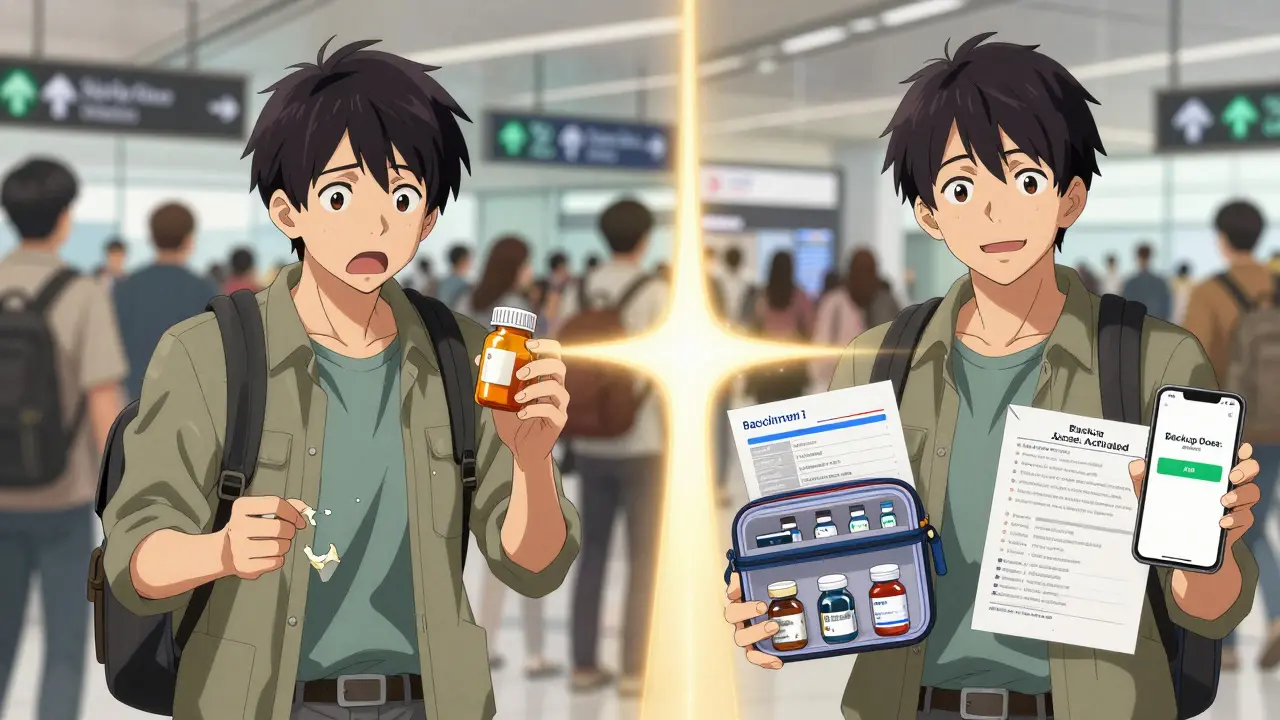
Don’t panic. Don’t double up. That’s more dangerous than missing it.- If you miss a dose within two hours of the scheduled time, take it right away.
- If it’s been more than two hours, skip it-unless it’s an HIV med or seizure med. Then, take it as soon as possible.
- Never take two doses at once to make up for a missed one. Mayo Clinic data shows this increases adverse reactions by 4.2 times.
- For antibiotics, keep the schedule going. Don’t restart the course.
If you’re unsure, call your pharmacy. Most offer 24/7 advice lines for travelers.
The Bottom Line
Managing meds while traveling isn’t about being perfect. It’s about being prepared. You don’t need to memorize every guideline. You just need to know your meds, plan ahead, pack smart, and use tools that adapt with you. The goal isn’t to replicate your home routine-it’s to keep your treatment effective, no matter where you are.Travelers who follow these steps reduce medication-related emergencies by up to 67%. That’s not luck. That’s planning.
Can I take my medication on the plane?
Yes. The TSA allows all prescription and over-the-counter medications in carry-on luggage, even in containers larger than 3.4 ounces, as long as they’re for personal use. You must declare them at the security checkpoint. Never pack meds in checked bags.
Do I need a doctor’s note to travel with my meds?
For most medications, no. But if you’re carrying controlled substances-like opioids, ADHD meds, or strong anxiety drugs-you need a signed letter from your doctor. Countries like Japan, South Korea, and the UAE ban these without documentation. Even if you’re not sure, bring one. It saves time and stress.
What if I lose my meds while traveling?
If you lose your meds, contact your pharmacy or doctor immediately. Many U.S. pharmacies can fax a prescription to a local pharmacy abroad. For emergencies, visit a local clinic or hospital. Always carry a digital copy of your prescription and doctor’s contact info. Never try to buy meds overseas without verifying their authenticity.
Should I adjust my dose for jet lag?
Only if your doctor says so. For most medications, you don’t need to change the dose-just the timing. But for insulin, anticoagulants, or seizure meds, timing and sometimes dose adjustments are critical. Never adjust on your own. A 2022 study from the American Diabetes Association showed that 89% of insulin-related complications during travel were due to unsupervised dose changes.
Can I use a pill organizer for travel?
Only if you’re sure the meds are safe to transfer. Some pills degrade in plastic, lose potency, or react with other drugs in the same compartment. Always check with your pharmacist first. If you do use one, keep the original bottles with labels in your carry-on as backup.



Christina VanOsdol February 25, 2026
I can't believe people still forget to pack meds in their carry-on... I lost my entire week's supply of blood thinners in 2019 because I trusted checked luggage. Never again. I now have a tiny ziplock with my meds, a printed list, and my doctor's number taped inside my passport. 🤯💊
Brooke Exley February 25, 2026
Y'all need to stop treating meds like snacks. This article is GOLD. Seriously. I used to wing it until I had a seizure scare in Bali. Now I use Medisafe + a vibrating watch alarm. I don't care if I'm drunk on margaritas - if the watch buzzes, I take it. Period. You're not invincible. Your meds are not optional. 💪
Alfred Noble February 26, 2026
I'm a nurse and I travel for work. I've seen so many people panic when they miss a dose. The thing no one tells you? Most apps don't auto-adjust if you're on a red-eye. I use Medisafe + set a backup text reminder to my husband. Also - never trust pill organizers for insulin. Heat kills it. I keep mine in a thermos with a cold pack. Simple. Works.
Matthew Brooker February 26, 2026
Honestly if you're traveling with chronic meds and you're not planning ahead you're playing russian roulette with your health. I had a friend who missed 3 days of HIV meds in Thailand and ended up with a resistant strain. It's not a joke. Use the apps. Talk to your pharmacist. Print the list. Carry a backup. It takes 20 minutes. Your future self will thank you.
Emily Wolff February 26, 2026
This article is overly simplistic. If you're on warfarin, diet changes alone can alter INR - not just jet lag. And 'take it at the same local time' is dangerous advice for anticoagulants. You need to adjust based on circadian rhythm shifts, not just time zones. Also, TSA doesn't 'allow' anything - they just don't confiscate. Don't be naive.
Lou Suito February 26, 2026
I read this and thought: 'Who wrote this? A pharmaceutical rep?' The '47% fewer missed doses' stat? Source? Where? Also - 'never double up'? What about seizure meds? Johns Hopkins says take it ASAP even if it's 1 hour before the next dose. You're not a robot. Your body isn't a vending machine. Stop following rigid rules. I've been on 8 meds for 12 years. I adjust. I live. You're overcomplicating it.
Joseph Cantu February 28, 2026
You think this is about meds? Nah. It's about control. The system wants you dependent. They sell you apps, pills, doctors, and now 'travel plans' to keep you scared. What if your meds are actually making you sicker? What if the 'dose adjustment' is just corporate greed? I don't trust any of this. I use herbal supplements now. And I don't fly. Airplanes are full of chemtrails anyway. 🕵️♂️
Khaya Street February 28, 2026
I'm from South Africa. We don't have the luxury of 'four weeks to plan'. My meds are often out of stock. I've had to cross borders just to refill. This article feels like it was written by someone who's never had to choose between rent and insulin. Plan ahead? Try surviving. You're not helping. You're preaching.
Jacob Carthy March 1, 2026
I don't need no app to tell me when to take my pills. I'm American. I got discipline. I just set my phone to EST and ignore the time zone. If I'm in Paris at 3am and my pill time is 8am EST? I wake up and take it. No big deal. Stop making this a thing. We're not babies. Also TSA? They're just trying to make you feel insecure. Don't fall for it.
Lisandra Lautert March 2, 2026
I missed my dose on a flight from NYC to Tokyo. Took it 14 hours late. My doctor called me. I cried. I didn't panic. I didn't double. I called the 24/7 pharmacy line. They said 'wait till tomorrow'. I did. I'm alive. This isn't rocket science. Just be smart. Don't be dramatic.